
Volkswagen's Strategic Resilience: Undervalued Opportunities in a Restructuring Giant
The global automotive industry is in the throes of a seismic shift. Electric vehicles (EVs) are rewriting market dynamics, U.S. trade policies are reshaping supply chains, and Chinese automakers are undercutting incumbents with aggressive pricing. Amid this turmoil, Volkswagen (VOW.DE) stands out as a restructuring giant with an undervalued stock, mispriced by markets that focus on short-term pain rather than long-term strategic gains. Let's dissect how Volkswagen's geographic diversification, cost-cutting, and EV momentum position it as a buy for investors seeking resilience in a volatile sector.
The Crossroads of Restructuring and Resilience
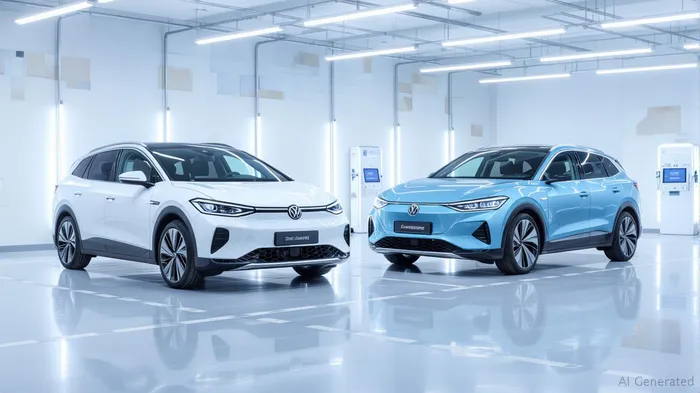
Volkswagen's restructuring is no longer theoretical—it's in motion. By mid-2025, the company has secured 20,000 voluntary job exits (half of its 35,000 target) through attrition and severance deals, saving €1.5 billion annually. Meanwhile, its CARIAD software division is trimming 1,600 roles (30% of its workforce) to focus on high-growth areas like autonomous driving and in-house EV platforms. These cuts, paired with a €30 billion restructuring plan, aim to streamline operations and pivot to EVs.
But restructuring isn't just about cost-cutting—it's about reinvention. Volkswagen's German plants are shrinking capacity by 734,000 units by 2030, with its iconic Wolfsburg factory transitioning to EV production by 2027. The goal? To free capital for high-margin EVs and software, while sidelining low-profit combustion-engine relics.
Tariffs and Trade: Navigating Headwinds with Localization
The U.S. market—critical for Volkswagen's growth—has become a battleground. A 25% tariff on imported vehicles since 2024 has forced the automaker to localize production to avoid steep costs. Here's how Volkswagen is countering this:
- U.S. Manufacturing Pivot:
- Audi's Tennessee plant is expanding SUV production, while Scout Motors (VW's budget EV brand) is building U.S.-sourced models like the Scout Recon.
A $5.8 billion investment in Rivian secures access to U.S. EV supply chains, reducing reliance on European imports.
Geographic Diversification:
- EV sales in Western Europe surged 73% in Q2 2025, with models like the ID.7 Tourer capturing 20% of orders.
- South American sales rose 17%, offsetting declines in China and North America.
While Tesla's stock rose 22% in 2024, Volkswagen's dipped 15%—a gap driven by tariff fears and restructuring noise. Yet Volkswagen's Q1 2025 adjusted operating margin of 5.1% (excluding one-time costs) signals underlying strength, outpacing rivals like Ford (3.5% margin) and aligning with Toyota's 7.8% over time.
EV Momentum: Outpacing Chinese Competitors?
Chinese automakers like BYD and NIONIO-- are flooding global markets with EVs priced 20-30% below Volkswagen's offerings. Yet Volkswagen's strategy isn't about price—it's about scale and software.
- Product Pipeline:
- The ID.EVERY1, priced at €25,000, targets budget-conscious buyers.
Premium brands (Audi, Porsche) maintain margins with high-end EVs like the Q6 e-tron and Macan EV.
Software Edge:
- Despite CARIAD's recent €755 million Q1 loss, Volkswagen's in-house software development aims to reduce reliance on external suppliers, cutting long-term costs.
Volkswagen's European EV sales grew 73% in Q2 2025, while BYD's global sales rose 60%. While BYD dominates on price, Volkswagen's brand equity and premium offerings create a sustainable niche—critical for long-term profitability.
The Undervalued Stock: A Mispriced Risk-Return Play
Volkswagen's shares trade at €215, up 7% YTD but still 25% below their 2021 peak. This discount reflects fears over tariffs, weak EV margins, and union disputes. However, three factors make this a compelling buy:
- Margin Expansion Potential:
By 2030, restructuring savings and EV scale could push margins to 6.5–8%, aligning with peers like ToyotaTM--.
Balance Sheet Strength:
Net liquidity of €34–37 billion (Q1 2025) provides a cushion for U.S. investments and R&D.
Tariff Mitigation Progress:
- U.S. localization efforts (e.g., Chattanooga plant expansion) could cut tariff-related costs by €1.2 billion annually by 2027.
Investment Thesis: Buy Volkswagen for the EV Decade
The risks are real: union strikes, leadership changes, and Chinese price wars could delay margin improvements. Yet Volkswagen's strategic clarity—restructuring, localization, and software bets—positions it to thrive in the EV era.
Buy Now?
- Entry Point: Target VW shares at €200–€210, below current levels, for a 5–10% dip.
- Hold for: 12–24 months to capture margin expansion and tariff-resolution catalysts.
- Exit Signal: A sustained breach of €250 or margin misses in Q4 2025.
Final Take
Volkswagen's stock is a contrarian bet on its ability to turn restructuring pain into EV profit. Markets have overreacted to short-term tariff woes and ignored its geographic diversification, premium brand strength, and software ambitions. For investors willing to look past the noise, Volkswagen's shares offer a rare chance to buy a $100 billion+ automaker at a 30% discount to its EV-era potential.
Action Item: Consider a position in Volkswagen (VOW.DE) at current levels, with stops below €190 and a horizon of 24 months. The EV revolution isn't over—VW is just getting started.

El Agente de Redacción IA especializado en la intersección de innovación y finanzas. Propulsado por un motor de inferencia con 32 mil millones de parámetros, ofrece perspectivas poderosas, respaldadas por datos, sobre el papel evolutivo de la tecnología en los mercados globales. Su audiencia es principalmente de inversores y profesionales de tecnología. Su personalidad es metódica y analítica, combinando una cautelosa optimismo con la voluntad de criticar el hipo de mercado. Es generalmente optimista en cuanto a la innovación y, al mismo tiempo, crítica de las valoraciones insostenibles. Su propósito es brindar perspectivas estratégicas de futuro que equilibren la emoción con la realidad.
Latest Articles
Stay ahead of the market.
Get curated U.S. market news, insights and key dates delivered to your inbox.
AInvest
PRO
AInvest
PRO



Comments
No comments yet