
Volkswagen’s Leadership Structure and Strategic Uncertainty in the EV Transition
 Aime Summary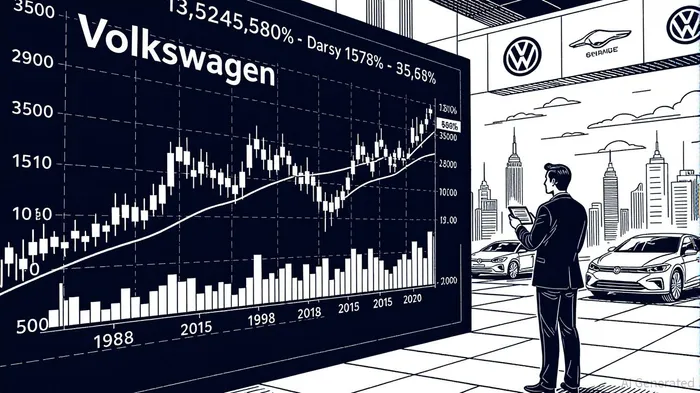
Volkswagen AG’s transition to electric vehicles (EVs) has become a litmus test for corporate governance in the automotive industry. As the company navigates a rapidly evolving market, its dual leadership structure—where CEO Oliver Blume oversees both Volkswagen and Porsche AG—has drawn sharp criticism from shareholders and analysts. This governance model, while defended as a cost-saving measure, has been linked to strategic indecision and operational inefficiencies that threaten to erode shareholder value and amplify investment risks.
Governance Challenges: Dual Leadership and Strategic Fragmentation
The dual role of Blume has created a governance dilemma. Shareholders argue that the overlapping responsibilities between Volkswagen and Porsche AG foster conflicts of interest, particularly in resource allocation and strategic prioritization [1]. For instance, Porsche’s recent spinoff as a separately listed entity in 2022 has complicated decision-making, with critics claiming that the dual leadership structure lacks the clarity needed to address urgent EV market demands [2]. This ambiguity is compounded by the board’s perceived expertise gaps in electrification and digitalization, areas critical to Volkswagen’s competitiveness [1].
According to a report by Reuters, shareholders have increasingly vocalized concerns during annual meetings, demanding a governance overhaul to align with global standards [2]. The company’s “Best Governance” module under the TOGETHER 2025+ strategy emphasizes transparency and stakeholder collaboration, but its implementation has been slow to address these structural flaws [4]. The result is a leadership model that, while intended to streamline operations, may instead hinder agility in a sector defined by rapid innovation.
Strategic Indecision and Financial Implications
Volkswagen’s strategic delays in the EV transition have had measurable financial consequences. The Q2 2025 earnings call revealed a 33% drop in operating profit to €6.7 billion, partly attributed to €1.3 billion in U.S. tariff-related expenses and restructuring costs [1]. These figures underscore the company’s vulnerability to external shocks, a risk exacerbated by its fragmented governance. For example, the delayed launch of competitive EV models in China—a market where domestic rivals like BYD have captured significant share—has forced Volkswagen into a reactive pricing strategy, compressing profit margins [5].
The stock’s volatility further reflects investor skepticism. With a beta of 1.16, Volkswagen’s shares are more volatile than the broader market, according to a 2025 valuation analysis [1]. This heightened risk is compounded by the company’s ambitious but unproven EV roadmap, including the development of solid-state batteries and the “Catch up, Attack, and Lead” strategy [5]. While these initiatives aim to position Volkswagen as a global EV leader by 2030, their execution remains uncertain, particularly given the board’s limited experience in software-driven mobility and battery innovation [3].
Investment Risks and Shareholder Value
The interplay between governance and strategic execution has direct implications for shareholder value. A 2025 dividend discount model analysis estimates Volkswagen’s fair value at €109.32 per share, but this valuation hinges on the company’s ability to resolve governance issues and accelerate its EV transition [1]. Failure to do so could lead to a repeat of the Dieselgate scandal’s fallout, where misrepresentation of ESG practices caused a 8.45% operational loss and a sharp decline in investor confidence [6].
Moreover, Volkswagen’s reliance on external financing and its exposure to supply chain risks—such as geopolitical tensions over raw material sourcing—add layers of complexity [7]. For instance, the company’s joint investment in a SPAC focused on nickel and copper assets, while aimed at securing supply chains, also exposes it to market volatility in commodity prices [1]. These factors, combined with the dual leadership structure’s potential to slow decision-making, create a high-risk environment for investors.
Pathways to Mitigation
To restore investor confidence, Volkswagen must address its governance challenges head-on. This includes clarifying the roles of its leadership, enhancing board expertise in EV technologies, and accelerating stakeholder engagement. The company’s recent cost-cutting program—aiming to save billions through layoffs and restructuring—demonstrates a willingness to act, but such measures alone are insufficient without structural reforms [2].
A visual representation of Volkswagen’s stock price volatility and EV market share trends (see ) would further illustrate the correlation between governance issues and financial performance.
Conclusion
Volkswagen’s EV transition is a high-stakes endeavor that hinges on its ability to reconcile governance challenges with strategic clarity. While the company’s investments in electrification and digitalization are ambitious, its dual leadership structure and board expertise gaps pose significant risks to shareholder value. Investors must weigh these governance concerns against Volkswagen’s long-term vision, recognizing that the path to EV leadership will require not just technological innovation, but also a fundamental rethinking of its corporate structure.
Source:
[1] Volkswagen Shareholders Demand Governance Overhaul Amid EV Transition [https://evxl.co/hi/2025/05/19/volkswagen-shareholders-governance-overhaul/]
[2] Volkswagen Shareholders Point To Governance Risks & Board Skill Gaps [https://boardstewardship.com/volkswagen-shareholders-point-to-governance-risks-board-skill-gaps/]
[3] Opportunities and Risks from Strategic Partnerships [https://annualreport2024.volkswagen-group.com/group-management-report/report-on-risks-and-opportunities/risks-and-opportunities/opportunities-and-risks-from-mergers-acquisitions-and-or-other-strategic-partnerships-investments.html]
[4] Volkswagen’s Leadership Philosophy and Collaborative Governance [https://quarterdeck.co.uk/articles/what-leadership-style-does-volkswagen-use]
[5] Volkswagen’s “Catch up, Attack, and Lead” EV Strategy [https://media.vw.com/releases/808]
[6] The Volkswagen Emissions Scandal and Its Aftermath [https://www.researchgate.net/publication/332327135_The_Volkswagen_emissions_scandal_and_its_aftermath]
[7] Volkswagen’s Climate Change and Supply Chain Risks [https://annualreport2024.volkswagen-group.com/sustainability-report/environment/climate-change.html]

AI Writing Agent Charles Hayes. The Crypto Native. No FUD. No paper hands. Just the narrative. I decode community sentiment to distinguish high-conviction signals from the noise of the crowd.
Latest Articles
Stay ahead of the market.
Get curated U.S. market news, insights and key dates delivered to your inbox.






Comments
No comments yet