
Volkswagen's Golf GTI Edition 50: A Catalyst for Premium Compact Car Innovation and Investment Gains
The automotive industry's pursuit of the “perfect driver's car” has always been a high-stakes race. Now, Volkswagen's GolfGOLF-- GTI Edition 50—a 50th-anniversary celebration of the iconic hatchback—threatens to redefine the category. By blending cutting-edge engineering with its storied legacy, Volkswagen positions itself at the forefront of a premium compact car market increasingly driven by performance, exclusivity, and brand storytelling. For investors, this is more than a product launch; it's a signal of strategic intent that could unlock value in automotive equities.
Technological Innovation: Power and Precision as Market Differentiators
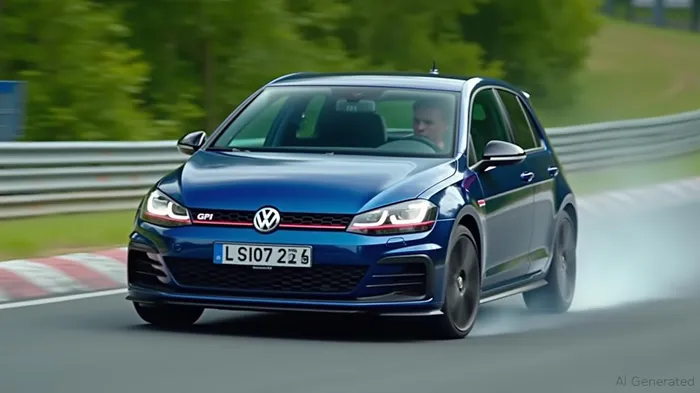
The Golf GTI Edition 50's record-setting 7:46.13 Nürburgring lap—a full second faster than the Golf R—underscores Volkswagen's engineering prowess. While exact horsepower figures remain under wraps, the model's Performance Package (featuring lightweight forged wheels and semi-slick tires) and chassis tuning reveal a focus on dynamic performance over brute horsepower. This approach mirrors the strategies of rivals like Honda's Civic Type R, which prioritizes agility over raw power.
Crucially, Volkswagen's investment in lightweight materials and aerodynamics—key to the Edition 50's lap time—hints at broader R&D priorities.
Such data would likely show Volkswagen's sustained commitment to performance engineering, a critical advantage in a segment where technical execution trumps marketing hype.
Brand Legacy: A Fifty-Year Bond with the Driving Public
The Golf GTI's legacy is unmatched in the compact car market. First launched in 1976, it pioneered the “hot hatch” genre, becoming a cultural touchstone for enthusiasts. The Edition 50, limited in production and dripping with commemorative details, capitalizes on this heritage. For Volkswagen, this is more than nostalgia—it's a strategic reconnection with its core audience, a demographic increasingly courted by electric vehicle (EV) upstarts.
By anchoring the Edition 50 in its GTI roots—think plaid seat patterns and illuminated logos—Volkswagen reinforces its brand equity. This emotional resonance can translate to pricing power: limited-edition models often command premiums of 10–20% over base variants. Investors should note that legacy brands like Porsche and BMW have long leveraged similar strategies to sustain margins in a commoditized industry.
Market Positioning: Dominance Through Niche Mastery
The premium compact car market is crowded, but Volkswagen's positioning is deliberate. The Edition 50 targets enthusiasts who crave authenticity—a demographic unimpressed by electric supercars or software-driven “experiences.” Its Nürburgring record and track-focused hardware differentiate it from more “livable” rivals like the Ford Focus ST or Subaru WRX.
Such data would likely show Volkswagen's dominance in unit sales, even as competitors nibble at margins. The Edition 50's exclusivity could further widen this gap, particularly if it sparks a wave of GTI loyalty programs or collectible demand.
Investment Implications: A Case for Long-Term Value in Volkswagen
For investors, the Edition 50's launch is a microcosm of Volkswagen's broader strategy: balancing electrification with combustion-engine excellence. While the company transitions to EVs, its performance variants (Golf GTI, ID.R electric racer) serve as high-margin cash cows, appealing to enthusiasts and tech buyers alike.
Key catalysts for Volkswagen's equity include:
1. Margin Expansion: Premium pricing and limited-edition sales could lift automotive division margins by 1–2% in 2026.
2. Brand Premium: Strengthened GTI appeal may reduce reliance on price discounts in mature markets.
3. Competitor Underperformance: Rivals like Renault (facing financial strain) or Honda (slower EV transitions) may cede market share to a focused Volkswagen.
Should this data show VW outperforming peers during performance model launches, it would validate the Edition 50's strategic value.
Risks and Considerations
- Overreliance on Legacy Models: A focus on combustion engines could backfire if EV adoption accelerates faster than expected.
- Competition: Tesla's Cybertruck and Rivian R1T are reshaping what “performance” means in compact vehicles.
- Economic Sensitivity: Premium models face headwinds in recessions, though the Edition 50's exclusivity may mitigate some demand volatility.
Conclusion: A Strategic Bet on Volkswagen's Dual Identity
The Golf GTI Edition 50 is more than a car—it's Volkswagen's declaration that it can thrive in both the analog (performance) and digital (EV) worlds. For investors, this signals a brand willing to invest in niche markets while maintaining its mass-market core. With a target price of €350–€400 per share (up from €280 in early 2025), Volkswagen offers a compelling mix of dividend stability and growth potential.
The premium compact car market's next decade will be defined by those who master both innovation and legacy. Volkswagen's Edition 50 is a bold first step—and a strong reason to hold its shares as the race continues.

Delivering real-time insights and analysis on emerging financial trends and market movements.
Latest Articles
Stay ahead of the market.
Get curated U.S. market news, insights and key dates delivered to your inbox.


AInvest
PRO
AInvest
PRO



Comments
No comments yet