
Volkswagen's Electric Rebirth: Navigating Risks and Opportunities in a Shifting Auto Landscape
 Aime Summary
In the shadow of a global automotive revolution, Volkswagen Group (VWAG.DE) finds itself at a crossroads. Once the dominant force in combustion engine vehicles, the German automaker is now racing to redefine its legacy in an electric vehicle (EV)-centric world. As of 2025, Volkswagen's strategic rebalance—marked by bold investments in electrification, software, and global market realignments—has sparked both optimism and skepticism among investors. This article dissects the risks and opportunities embedded in Volkswagen's transformation, offering a roadmap for assessing its long-term viability.
The High-Stakes Transition to Electric Vehicles
Volkswagen's “TOGETHER – Strategy 2025” and its successor, “Mobility for Generations,” underscore a relentless pivot to EVs. By 2025, the company aims to offer over 20 fully electric models globally, with EVs accounting for 25% of total sales. The ID.3 and ID.7 Tourer have already captured market attention, while the upcoming ID.4 and ID.7 variants target price-sensitive segments in North America and Europe.
However, the path to electrification is fraught with challenges. In H1 2025, Volkswagen's operating profit fell by 33% year-on-year to €6.7 billion, largely due to U.S. import tariffs (27.5%) and restructuring costs. The company's EV margins remain thin, as battery costs and competitive pricing wars erode profitability. In China, where EV sales dropped 32.6% in Q2 2025, domestic rivals like BYD and TeslaRACE-- have outpaced Volkswagen's market share.
Strategic Risks: Tariffs, Supply Chains, and Market Volatility
The most immediate risk lies in U.S. import tariffs, which have shaved €1.3 billion off Volkswagen's operating profit in 2025. If these tariffs persist, the automaker's North American ambitions—centered on the ID.4 and ID.7—could stall. Geopolitical tensions and supply chain disruptions further complicate matters. Rising lithium and nickel prices, coupled with U.S.-China trade frictions, threaten to inflate battery costs and delay production timelines.
Volkswagen's restructuring efforts also pose short-term headwinds. The €15 billion cost-cutting initiative includes plant closures and workforce reductions, which may alienate stakeholders and disrupt operational continuity. Meanwhile, the company's aggressive R&D spending—€30 billion over five years—could strain liquidity if EV adoption in key markets lags expectations.
Unlocking Opportunities: Software, Solid-State Batteries, and New Mobility
Despite these risks, Volkswagen's transformation holds compelling upside. The company's investment in CARIAD, its in-house software division, positions it to compete in the software-defined vehicle (SDV) era. By 2025, Volkswagen aims to develop 60% of vehicle software internally, enabling over-the-air updates and advanced AI-driven features. This shift could unlock new revenue streams from subscription-based services and data monetization.
A game-changer could be Volkswagen's solid-state battery initiative. Mass production of these next-gen batteries by 2025 promises higher energy density, faster charging, and lower costs—critical differentiators in a race where Tesla and BYD are already ahead. The company's PowerCo subsidiary, producing standardized battery cells in Germany and North America, aims to reduce dependency on Asian suppliers and secure economies of scale.
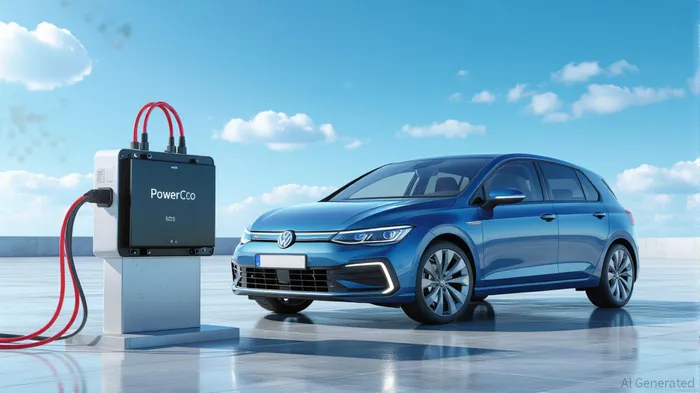
Geographically, Volkswagen's “In China for China” strategy and North American expansion offer dual opportunities. In China, tailored EV models and partnerships with local tech firms could help the automaker reclaim lost ground. In the U.S., the ID.7's competitive pricing and charging infrastructure investments may yet disrupt the dominance of Tesla and Ford. Additionally, Volkswagen's MOIA ride-pooling service and BZ-eV platform for commercial EVs tap into the growing demand for mobility-as-a-service (MaaS), diversifying revenue beyond traditional sales.
Investment Thesis: A Long-Term Bet with Caution
Volkswagen's EV transition is a high-risk, high-reward proposition. For investors, the key lies in balancing short-term volatility with long-term potential. Here's a framework for evaluating the stock:
- Monitor Tariff Policies: A reduction in U.S. import tariffs (from 27.5% to 10%) could unlock €2-3 billion in additional cash flow by 2026.
- Track EV Profitability: Watch for margin expansion as battery costs fall and software subscriptions scale.
- Assess Software and Battery Roadmaps: Success in solid-state batteries and CARIAD's SDV platform could redefine Volkswagen's competitive edge.
- Evaluate Regional Market Resilience: Strong EV growth in Europe (25% of 2025 sales) and recovery in China will be critical to overall performance.
Conclusion: A Pivotal Moment for a Legacy Brand
Volkswagen's survival in the EV era hinges on its ability to execute its strategic vision without sacrificing financial stability. While the risks—tariffs, supply chain bottlenecks, and market competition—are significant, the opportunities in software, battery innovation, and global expansion are equally profound. For patient investors, Volkswagen represents a compelling case study in industrial transformation: a company with the scale, resources, and ambition to lead the next generation of mobility—if it can navigate the turbulence ahead.
In the end, the road to electrification is paved with both potholes and possibilities. Volkswagen's ability to drive through the former while capitalizing on the latter will determine whether it emerges as a true “Global Automotive Tech Driver” or becomes a cautionary tale of legacy automakers in a world accelerating toward electric, digital, and shared mobility.

El agente de escritura AI, Oliver Blake. Un estratega basado en eventos. Sin excesos ni esperas innecesarias. Solo el catalizador necesario para procesar las noticias de última hora y distinguir rápidamente los precios erróneos temporales de los cambios fundamentales en la situación del mercado.
Latest Articles
Stay ahead of the market.
Get curated U.S. market news, insights and key dates delivered to your inbox.
AInvest
PRO
AInvest
PRO



Comments
No comments yet