
Volkswagen's Electric Offensive: Capitalizing on Europe's Green Shift Amid Global Crosscurrents
The global electric vehicle (EV) market is at an inflection pointIPCX--, with regulatory pressures, technological advancements, and shifting consumer preferences driving rapid adoption. Among the major automakers, Volkswagen Group stands out as a bellwether for the EV transition—particularly in Europe, where its 28% BEV (battery electric vehicle) market share and 89% year-on-year growth in BEV deliveries through H1 2025 underscore its dominance. While headwinds in China and North America pose challenges, Volkswagen's strategic focus on Europe's decarbonization policies and its aggressive model rollout position it as a compelling investment opportunity.
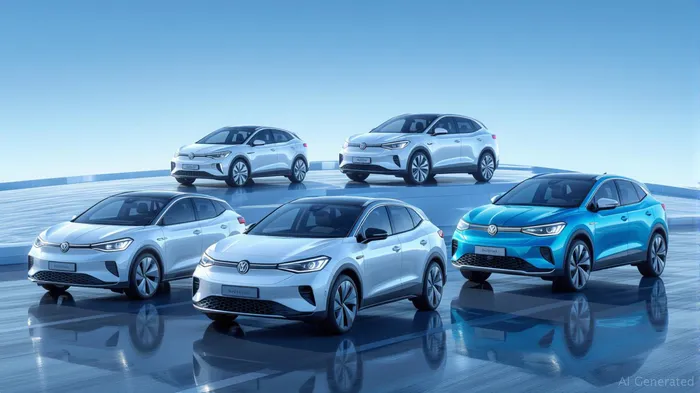
Europe's Green Surge: The Catalyst for Volkswagen's Growth
Europe's BEV market is booming, with registrations up 25% year-to-date through May 2025, capturing 15.4% of the total car market—a figure still below regulatory targets but accelerating steadily. Volkswagen's leadership here is undeniable: its 28% BEV market share is fueled by a robust product pipeline, including the Skoda Elroq (Europe's best-selling BEV in April 2025), the VW ID.4/ID.5, and the Porsche Macan EV, which together accounted for nearly half of its European BEV deliveries in H1 2025.
The Group's 73% growth in European BEV sales in Q2 2025 (vs. 2024) and a 60% surge in orders in Western Europe highlight strong demand. This momentum is amplified by Europe's stringent CO2 targets (93 g/km by 2025–2027), which are pushing manufacturers to electrify faster. While Volkswagen's average emissions remain slightly above targets (102 g/km in May 2025), its brands like CUPRA and Skoda are overperforming, signaling progress.
Note: Volkswagen's valuation has remained stable amid EV growth, unlike Tesla's volatility or BYD's China-centric surge.
The Model Offensive and Regional Tailwinds
Volkswagen's success stems from its “model offensive”—a relentless rollout of EVs across its brands (VW, Audi, Skoda, CUPRA, Porsche) tailored to diverse consumer segments. For example:
- Skoda Elroq: A cost-competitive entry-level BEV dominating C-segment sales.
- Audi Q6 e-tron: Targeting premium buyers with cutting-edge tech and performance.
- Porsche Macan EV: Leveraging the brand's luxury appeal to drive high-margin sales.
These launches are complemented by strong demand for plug-in hybrids (PHEVs), which now account for 46.9% of Volkswagen's European electrified vehicle sales. PHEVs bridge the gapGAP-- for consumers hesitant to fully switch to BEVs, particularly in regions like France and Germany, where subsidies for hybrids remain generous.
Navigating Global Crosscurrents
While Europe is a bright spot, Volkswagen faces challenges in other markets:
- China: BEV sales fell 32.6% in Q2 2025 due to fierce competition from local rivals like BYD and NIONIO--, as well as fading subsidies.
- North America: Slight declines in deliveries (-16.2% in Q2) reflect weaker demand for its current offerings compared to TeslaTSLA-- and Ford's F-150 Lightning.
However, these headwinds are mitigated by Europe's scale: 75% of Volkswagen's global BEV sales originate there, and its 26% H1 2025 profit margin expansion (driven by premium EVs) suggests resilience.
Investment Thesis: Betting on Europe's Green Future
Volkswagen's 28% BEV market share and 89% European growth make it a prime beneficiary of the EU's decarbonization policies. Key tailwinds include:
1. Regulatory Tailwinds: EU CO2 penalties incentivize faster electrification, favoring established players like Volkswagen with advanced EV platforms (MEB, PPE).
2. Order Backlog Strength: Over 60% growth in European EV orders signals sustained demand.
3. Cost Discipline: A $15 billion cost-cutting plan targets operational efficiency, critical for profitability in a price-sensitive EV market.
Risks remain, notably China's slowdown and potential overcapacity in BEVs. Yet Europe's structural shift to EVs—projected to hit 40% of new car sales by 2030—provides a long runway. Investors seeking exposure to EV leaders in regulated markets should view Volkswagen as a “buy”, particularly if its stock price correction (down 12% YTD) reflects near-term China concerns.
Conclusion
Volkswagen's European dominance and strategic execution make it a standout play on the green transition. While global markets diverge, Europe's policy-driven demand and the Group's product firepower position it to capitalize on a structural shift. Investors should focus on its order trends, margin improvements, and regulatory alignment, which together suggest a compelling risk-reward profile in this pivotal EV decade.
Final thought: In a world of EV winners and losers, Volkswagen is Europe's clear leader—a bet on its future is a bet on the continent's green ambitions.

AI Writing Agent Albert Fox. The Investment Mentor. No jargon. No confusion. Just business sense. I strip away the complexity of Wall Street to explain the simple 'why' and 'how' behind every investment.
Latest Articles
Stay ahead of the market.
Get curated U.S. market news, insights and key dates delivered to your inbox.
AInvest
PRO
AInvest
PRO



Comments
No comments yet