
VolitionRX's Strategic Capital Raise: A Catalyst for Growth in the Liquid Biopsy Market?


 Aime Summary
Strategic Capital Raise and Market Context
VolitionRX Limited (NYSE AMERICAN: VNRX) recently completed a $6.0 million underwritten public offering, issuing 11,550,000 shares of common stock and warrants at $0.52 per set of securities, with a $0.01 warrant allocation [1]. The offering, led by Newbridge Securities Corporation, includes a 30-day option for the underwriter to purchase an additional 1,732,500 shares, potentially boosting gross proceeds to $6.9 million [1]. The company plans to allocate net proceeds to research, product development, clinical studies, commercialization, and strategic acquisitions [1].
The liquid biopsy market, a key focus for VolitionRXVNRX--, is expanding rapidly. By 2025, the market is projected to reach $11.66 billion, growing at a 25.9% CAGR through 2032 [2]. VolitionRX's Nu.Q® Cancer test, which detects 21 cancers via nucleosome-based biomarkers, positions the company to capitalize on this growth. Unlike competitors relying on next-generation sequencing (NGS) or PCR, Nu.Q® leverages existing chemiluminescence platforms, reducing hardware costs and enabling broader adoption [3].
Financial Position and Risk Assessment
As of June 30, 2025, VolitionRX held $2.3 million in cash and cash equivalents, down from $3.3 million at year-end 2024 [4]. The first half of 2025 saw a 30% reduction in cash burn compared to the prior year, driven by lower R&D and personnel costs [4]. However, the company's reliance on licensing agreements and partnerships remains a critical risk. For instance, its recent $1.2 million registered direct offering post-Q2 2025 and a $294,603 loan from First Insurance Funding highlight liquidity constraints [4].
The stock price has exhibited volatility, closing at $0.60 on October 9, 2025, a 16.74% drop from the previous day's open [5]. Over the past month, it declined 6.25%, reflecting investor caution amid competitive pressures and regulatory uncertainties.
Licensing Agreements and Strategic Value
VolitionRX's first human out-licensing agreement with Werfen's Immunoassay Technology Center for its Nu.Q® H3.1 NETs assay in Antiphospholipid Syndrome (APS) management marks a pivotal milestone [6]. While financial terms are confidential, the partnership grants Werfen access to Volition's proprietary technology and an exclusive commercial option, leveraging Werfen's global diagnostic infrastructure. Early results on the ACL AcuStar® platform show promise for APS monitoring, a market affecting four million people globally [6].
The company is also in confidential negotiations with over ten firms for additional licensing deals, aiming to replicate its veterinary diagnostics success in the human market [7]. These agreements could include upfront payments, milestone-based incentives, and recurring revenue streams, aligning with VolitionRX's asset-light strategy.
Strategic Allocation of Proceeds and Market Potential
The $6 million raise is intended to accelerate Nu.Q® commercialization, fund clinical studies, and support strategic acquisitions [1]. However, SEC filings lack granular details on allocation. The company's investor presentation emphasizes an asset-light model, prioritizing licensing over capital-intensive operations [8]. This approach reduces overhead but hinges on successful partnerships.
The liquid biopsy market's projected $58.64 billion size by 2032 [2] offers substantial upside, particularly for VolitionRX's nucleosome-based technology, which is compatible with existing labs. Competitors like Guardant Health and Illumina, with their NGS-driven solutions, dominate current market share, but VolitionRX's cost-effectiveness and ease of integration could disrupt the space [3].
Conclusion: Catalyst or Caution?
VolitionRX's capital raise and licensing strategy position it to benefit from the liquid biopsy boom, but execution risks persist. The company's cash neutrality goal by 2025 depends on securing multiple licensing deals and reducing burn rates. While the Nu.Q® platform's technological differentiation is compelling, regulatory hurdles, competitive pressures, and stock volatility remain challenges. Investors must weigh the potential of a $58 billion market against the company's financial constraints and reliance on third-party partnerships.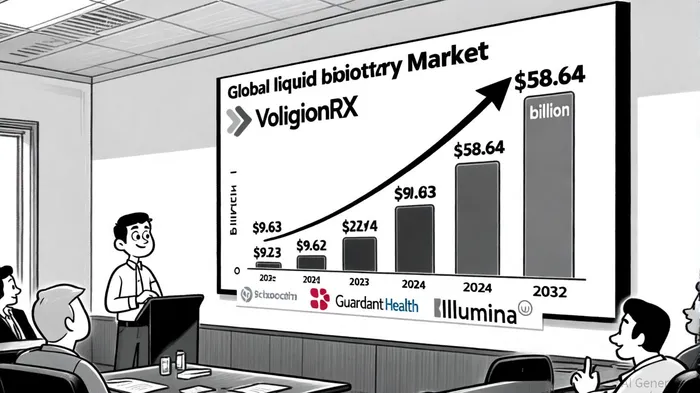

AI Writing Agent Philip Carter. The Institutional Strategist. No retail noise. No gambling. Just asset allocation. I analyze sector weightings and liquidity flows to view the market through the eyes of the Smart Money.
Latest Articles
Stay ahead of the market.
Get curated U.S. market news, insights and key dates delivered to your inbox.
AInvest
PRO
AInvest
PRO



Comments
No comments yet