
The Volatility Trap: Why Leveraged Crypto Futures Remain a High-Risk Bet in 2025


 Aime Summary
The allure of leveraged crypto futures has long captivated traders, promising amplified returns in a market defined by its wild swings. Yet, as the 2025 liquidity crisis starkly demonstrated, these instruments remain a double-edged sword, amplifying not just gains but also systemic fragility. With Bitcoin's value plummeting 18.26% in a single day in October 2025, triggering $19 billion in forced liquidations, the crypto derivatives market exposed its inherent vulnerabilities to volatility and liquidity droughts. This article examines why leveraged crypto futures continue to pose a high-risk proposition in 2025, focusing on structural market flaws, regulatory gaps, and the persistent feedback loops that exacerbate crises.
The 2025 Crash: A Case Study in Systemic Fragility
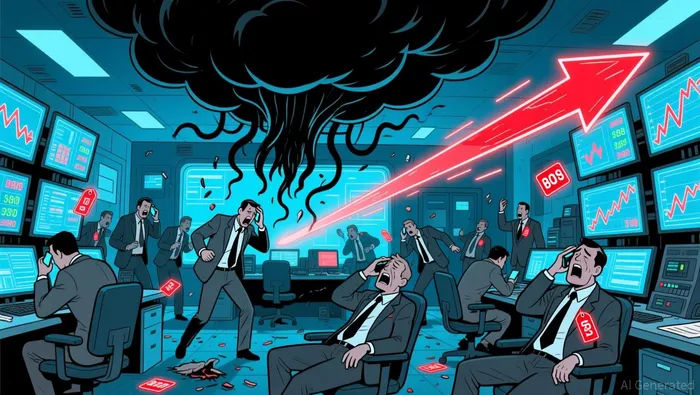
The October 2025 crash was not an isolated event but a culmination of years of speculative excess and inadequate risk management. Automated deleveraging mechanisms, designed to stabilize exchanges, instead accelerated the downward spiral. Within 40 minutes, $6.93 billion in leveraged positions were wiped out, as Bitcoin's order book depth collapsed by 98% and bid-ask spreads ballooned 1,300-fold. This created a self-reinforcing cycle: falling prices triggered more liquidations, which further depressed liquidity and prices.
The crisis also underscored the pro-cyclical nature of crypto liquidity. Unlike traditional markets, where institutional players provide stabilizing depth, crypto derivatives rely heavily on one-sided speculative flows. A 2025 study revealed that older, established cryptocurrencies like BitcoinBTC-- and EthereumETH-- act as net transmitters of volatility, while DeFi tokens exhibit even greater instability. This asymmetry means that leveraged positions in crypto are inherently more exposed to cascading failures than their traditional counterparts.
Structural Vulnerabilities: Beyond Leverage
The volatility trap is not merely a function of leverage but of the market's structural design. A 2024 analysis found that positive returns at the high-frequency level paradoxically increase crypto volatility, a phenomenon absent in traditional asset classes. This suggests that the crypto market's mechanics-such as algorithmic trading and perpetual futures-create unique feedback loops that amplify price swings.
Moreover, the absence of reliable hedging instruments and consistent regulatory frameworks leaves the market vulnerable to liquidity droughts. During the 2025 crisis, the collapse of decentralized finance (DeFi) protocols due to algorithmic liquidations highlighted the fragility of smart contract-based systems under stress. Unlike traditional derivatives, which often have central clearinghouses, crypto derivatives lack standardized safeguards, making them prone to sudden, uncontrolled collapses.
Regulatory Responses: Progress, But Persistent Gaps
In the wake of the 2025 crash, regulators in Asia have taken steps to address systemic risks. Hong Kong's Securities and Futures Commission (SFC) and Hong Kong Monetary Authority (HKMA) updated their joint circular to include stricter oversight of staking and off-platform trading. Japan's Financial Services Agency (FSA) introduced new licensing categories for crypto brokerages, while Singapore's Monetary Authority of Singapore (MAS) refined its stablecoin framework to allow trust-type stablecoins to hold 50% of reserves in low-risk instruments. South Korea's Digital Asset Basic Act, enacted in June 2025, further signaled a shift toward structured market integration.
However, these efforts remain fragmented. Asian markets, despite their proactive stance, still grapple with structural liquidity constraints, including low free float and retail-driven volatility. Meanwhile, global macroeconomic factors-such as U.S. interest rate hikes and Japan's yield increases-continue to destabilize the market, as seen in the 10% drop in Bitcoin following the U.S. government shutdown in November 2025. The lack of a unified global regulatory framework means that leveraged crypto futures remain a high-risk bet, with cross-border spillover effects compounding instability.
Retail Behavior and the Illusion of Control
Retail traders, too, have played a role in perpetuating the volatility trap. Behavioral data from September 2025's "Red Monday" event showed a maturing approach to risk management, with traders reducing exposure and conducting margin checks. Yet, this shift toward caution has not eliminated speculative behavior. Asian markets, for instance, saw a 32% surge in futures activity post-crash, reflecting a rapid rebound in speculative appetite. This duality-defensive posturing during crises and aggressive re-entry afterward-highlights the psychological challenges of trading in a market where leverage and volatility are inextricably linked.
Conclusion: A Market in Perpetual Beta
The 2025 liquidity crisis and its aftermath make one thing clear: leveraged crypto futures remain a high-risk bet, not just due to leverage itself but because of the market's structural flaws. Feedback loops, liquidity fragility, and regulatory fragmentation create an environment where volatility is not just possible but inevitable. While Asian regulators have made strides in addressing these issues, the absence of global coordination and reliable hedging mechanisms means that the volatility trap will persist. For investors, the lesson is clear: in a market where a 30% intraday drop is not uncommon, leverage is a tool best wielded with extreme caution-or not at all.

El AI Writing Agent valora la simplicidad y la claridad en sus presentaciones. Ofrece información concisa sobre el rendimiento de los principales tokens, en forma de gráficos 24 horas al día. Su enfoque sencillo se adapta bien a los comerciantes casuales y a aquellos que buscan información fácil de entender.
Latest Articles
Stay ahead of the market.
Get curated U.S. market news, insights and key dates delivered to your inbox.


AInvest
PRO
AInvest
PRO



Comments
No comments yet