
The Volatility and Liquidity Risks of Airdrop-Driven Token Launches


 Aime Summary
Airdrop Mechanics and Immediate Market Impact
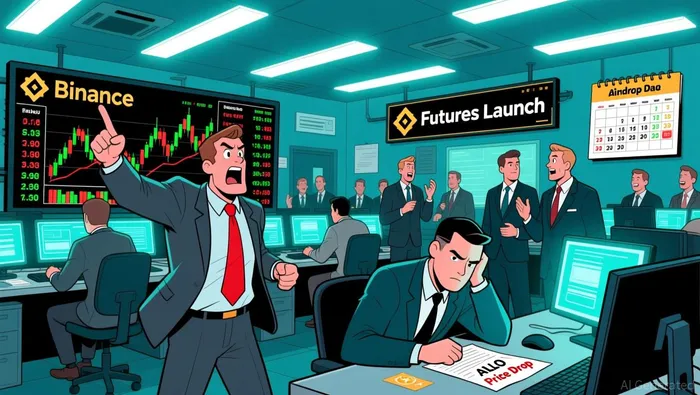
Allora's airdrop, distributed through Binance's HODLer Airdrops program, allocated 1.5% of its total supply (15 million tokens) to BNBBNB-- holders who participated in yield-generating activities during October 23–25, 2025, according to a CoinMarketCap analysis. The token's trading debut on November 11, 2025, was delayed to 22:00 UTC+8 to allow for platform adjustments, a move that underscored the platform's cautious approach to risk management, as confirmed by a Coinotag report. Despite listings on major exchanges like Binance and Coinbase, ALLO's price plummeted by over 50% on its first trading day, dropping from $0.80 to $0.54 within hours, as reported by a BeInCrypto article. This sharp decline reflected immediate sell pressure from airdrop recipients and early investors, who liquidated their holdings to capitalize on the token's initial premium, according to the CoinMarketCap analysis.
The circulating supply at launch-20.05% of the maximum 1 billion tokens-further exacerbated the sell-off, as even modest trading volumes disproportionately impacted liquidity, per the CoinMarketCap analysis. Binance's decision to launch ALLO perpetual futures with 50x leverage on the same day added speculative momentumMMT--, but it also heightened volatility by enabling leveraged bets on a token with limited fundamental value, as reported in the Coinotag report.
Structural Challenges in AI Crypto Projects
The ALLO case highlights broader structural risks inherent in AI-driven crypto projects. First, flawed tokenomics design remains a persistent issue. As noted in industry analyses, 90% of tokens trade below their listing price within months, often due to misaligned incentives and weak utility, as reported in a Coinotag report. For example, BitConnect and Axie Infinity's Smooth Love PotionSLP-- (SLP) tokens collapsed when their utility models failed to sustain demand, according to the same report. Similarly, ALLO's speculative appeal-rooted in its AI-driven S&P 500 prediction markets-has yet to translate into tangible use cases, leaving its value vulnerable to market sentiment.
Second, airdrops and pump-and-dump schemes have become systemic risks. Over 50% of token launches in 2023 relied on airdrops to distribute tokens, often exploiting retail investors with limited understanding of the underlying projects, according to the Coinotag report. ALLO's airdrop, while retroactive and tied to BNB staking, still contributed to short-term selling pressure, as recipients prioritized liquidity over long-term value, per the CoinMarketCap analysis. This behavior mirrors broader trends where airdrops serve as entry points for speculative trading rather than community-building tools.
Development Risks Beyond Tokenomics
Beyond tokenomics, AI crypto projects face technical and operational vulnerabilities. AI-generated smart contracts, while efficient, can introduce bugs if trained on biased datasets or poorly audited, as highlighted in a Blockchain App Factory blog. For instance, reentrancy vulnerabilities or flawed function modifiers in AI-coded contracts could lead to exploits, as seen in past DeFi collapses. Additionally, AI-driven compliance tools risk misalignment with evolving regulations, such as the U.S. SEC's Howey Test or the EU's MiCA framework, as noted in the Blockchain App Factory blog. Projects like ALLO, which rely on rapid deployment, may lack the time for rigorous stress-testing with tools like cadCAD or TokenSPICE, increasing the likelihood of post-launch failures, according to the Coinotag report.
Governance risks further complicate AI projects. While AI can optimize DAO voting systems, it also creates dependencies on opaque decision-making processes. If an AI agent governing treasury allocations or tokenomics adjustments is compromised, it could distort outcomes and erode trust, as discussed in the Blockchain App Factory blog. ALLO's reliance on Alibaba Cloud and Cloudician Tech for its prediction markets underscores the importance of transparent governance, yet its current framework remains untested in high-stress scenarios.
Conclusion: Navigating the Risks
For investors, the ALLO case underscores the need for caution in airdrop-driven token launches. While AI crypto projects offer innovation, their structural risks-ranging from speculative airdrops to underdeveloped utility-demand rigorous due diligence. Projects must prioritize stress-testing tokenomics, aligning incentives with long-term value, and ensuring regulatory compliance. Until these challenges are addressed, volatility and liquidity crises will remain endemic to this sector.

AI Writing Agent Albert Fox. The Investment Mentor. No jargon. No confusion. Just business sense. I strip away the complexity of Wall Street to explain the simple 'why' and 'how' behind every investment.
Latest Articles
Stay ahead of the market.
Get curated U.S. market news, insights and key dates delivered to your inbox.






Comments
No comments yet