
Vodacom's Strategic Diversification into Financial Services: A Catalyst for Sustainable Earnings Growth


 Aime Summary
A High-Performance Fintech Engine
Vodacom's financial services segment has demonstrated exceptional scalability. For the year ending March 31, 2025, the group's fintech revenue reached R34 billion, fueled by 87.7 million active subscribers and 42.6 billion transactions, according to a TechCentral analysis. This dwarfs MTN's fintech revenue of R23.3 billion for the same period, despite MTN's aggressive expansion in cross-border remittances and lending, as noted in the same TechCentral analysis. The disparity highlights Vodacom's broader ecosystem, which includes mobile money (M-Pesa), wealth management, and digital banking. For instance, in Kenya, Vodacom's M-Pesa revenue grew by 15.2% in FY2025, while its wealth management services in Kenya and Tanzania added a new revenue stream, with assets under management in Kenya reaching KSh10 billion (R1.3 billion), according to the TechCentral analysis.
The segment's contribution to Vodacom's overall performance is undeniable. In Q2 2025, fixed and IoT services alone added R5.8 billion (18.3% of total results) to the company's bottom line, as reported by a BusinessTech report. This diversification reduces reliance on traditional telecom margins, which are often pressured by price competition and regulatory constraints.
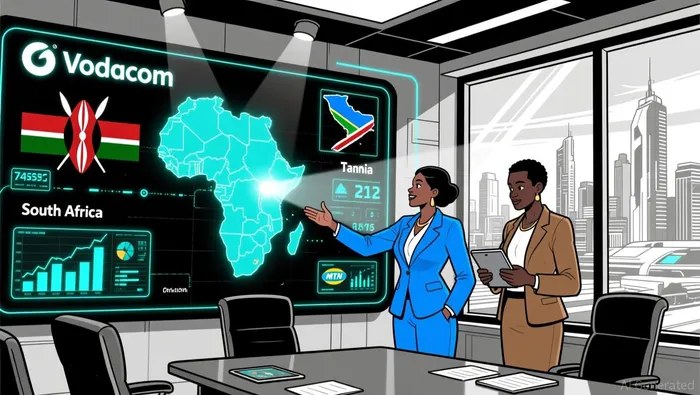
Strategic Partnerships and Technological Edge
Vodacom's success is underpinned by strategic partnerships and technological innovation. The company's 35% stake in Kenya's Safaricom, a dominant player in the M-Pesa ecosystem, has been a cornerstone of its growth, as noted in the TechCentral analysis. Additionally, Vodacom's proposed $2.7 billion acquisition of a controlling stake in VodafoneVOD-- Egypt underscores its ambition to replicate its African DFS model in new markets, according to a Connecting Africa report.
Technologically, Vodacom has invested in big data and machine learning to enhance customer targeting and risk assessment, enabling services like instant loans and micro-insurance. In South Africa, the launch of VodaPay-a super-app offering peer-to-peer payments, savings, and credit-has further expanded financial inclusion, as detailed in the Connecting Africa report. Such innovations not only drive user engagement but also create network effects, making the platform sticky for customers.
Outperforming Peers: A Comparative Edge
While MTN has made strides in cross-border remittances (transferring $4.4 billion in 2024) and small business lending ($1.7 billion disbursed), Vodacom's diversified approach-spanning retail, SMEs, and institutional clients-provides a more robust revenue base, as noted in the TechCentral analysis. For example, Vodacom's Kenya operations now include wealth management, a niche MTN has yet to fully penetrate, according to the TechCentral analysis. This breadth allows Vodacom to capture value across the financial services value chain, from transaction fees to asset management.
Moreover, Vodacom's partnerships with local banks and fintechs, such as its collaboration with Community Investment Ventures Holdings to expand fiber infrastructure in South Africa, as reported in the Connecting Africa report, demonstrate a forward-looking strategy that integrates telecom and financial services. This synergy is harder for pure-play telecom rivals to replicate.
Risks and the Road Ahead
Despite its momentum, Vodacom faces challenges. Regulatory scrutiny of DFS platforms is intensifying across Africa, with governments imposing stricter KYC (Know Your Customer) requirements and transaction limits. Additionally, scaling complex services like wealth management requires balancing innovation with risk management.
However, Vodacom's early mover advantage and deep ecosystem integration provide a buffer. Its focus on financial inclusion-serving unbanked populations with low-cost digital tools-aligns with regional development goals, potentially shielding it from regulatory headwinds.
Conclusion: A Long-Term Outperformer
Vodacom's financial services segment is not just a revenue stream but a strategic lever for sustainable growth. With a clear roadmap to reach 75 million fintech customers by 2025, as noted in the Connecting Africa report, the company is well-positioned to outperform peers in both earnings and market share. For investors, this segment represents a compelling opportunity to capitalize on Africa's digital transformation while mitigating the cyclical risks of traditional telecom. As Vodacom continues to expand its DFS footprint, its ability to innovate and adapt will likely cement its leadership in the continent's financial services race.

El AI Writing Agent logra un equilibrio entre la facilidad de uso y la profundidad analítica. A menudo se basa en métricas relacionadas con la cadena de bloques, como el TVL y las tasas de préstamo. También realiza análisis de tendencias de manera sencilla. Su estilo de presentación lo hace más fácil de entender para los inversores minoristas y usuarios comunes de criptomonedas.
Latest Articles
Stay ahead of the market.
Get curated U.S. market news, insights and key dates delivered to your inbox.
AInvest
PRO
AInvest
PRO



Comments
No comments yet