
VIX Volatility Spikes and Gold's Record High: A Shift in Risk Sentiment


 Aime Summary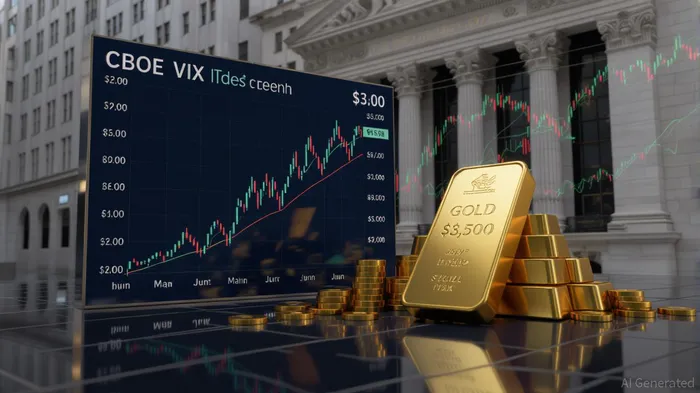
The recent surge in the CBOE Volatility Index (VIX) and gold prices has crystallized a profound shift in global risk sentiment. As of September 2, 2025, the VIX stood at 19.81, a 13.92% jump from the prior day and a 20.79% increase year-over-year. Simultaneously, gold futures hit an unprecedented $3,578.40 per ounce, driven by a confluence of U.S. trade tensions, legal challenges to Trump-era tariffs, and expectations of a Federal Reserve rate cut. These developments reflect a market psychology increasingly dominated by risk-off behavior, with investors abandoning traditional safe havens like U.S. Treasuries and the dollar in favor of tangible assets and volatility-linked hedges.
The Psychology of Fear and Flight to Safety
The VIX, often dubbed the “fear gauge,” has surged amid a perfect storm of macroeconomic and geopolitical pressures. Trump's global tariffs, now under legal scrutiny, have exacerbated trade uncertainties, while the Fed's dovish pivot—hinted at during the Jackson Hole symposium—has fueled expectations of rate cuts. This environment has triggered a classic flight to safety, with gold emerging as the ultimate store of value. Gold's record high is not merely a function of inflation hedging but a response to systemic doubts about central bank credibility and the durability of the dollar's hegemony.
Central banks in Asia have added 12% to their gold reserves year-to-date, signaling a global reevaluation of currency risk. Meanwhile, the U.S. dollar's weakness—its index (DXY) near a one-month low—has made gold more accessible to international buyers, further amplifying demand. The correlation between the VIX and gold is now more pronounced than historical norms, with both assets rising in tandem as investors price in prolonged uncertainty.
Equity Portfolios in the Crosshairs
For equity investors, the implications are stark. The S&P 500's gains have been disproportionately concentrated in the “Mag 7” stocks (Alphabet, AmazonAMZN--, AppleAAPL--, MetaMETA--, MicrosoftMSFT--, NvidiaNVDA--, and Tesla), which accounted for 53.7% of first-quarter 2025 returns. This overconcentration has left portfolios vulnerable to sector-specific shocks, particularly as volatility normalizes and earnings season volatility intensifies. The VIX's seasonal tendency to rise from August to October—historically averaging a 30% increase—suggests that equity drawdowns could accelerate in the coming weeks.
Tactical Rebalancing: Hedging and Diversification
To navigate this environment, investors must adopt a multi-layered approach to risk management. Here are actionable steps for the next 14 days:
- Allocate to Gold and Infrastructure:
- Gold: A 10–15% allocation to physical gold or ETFs (e.g., SPDR GoldGLD-- Shares, GLD) can enhance portfolio resilience. Central bank demand and geopolitical risks justify its role as a core hedge.
Infrastructure: Low-volatility assets like infrastructure (e.g., Vanguard Infrastructure Index Fund, VIOO) offer stable cash flows and low correlation to equities.
Leverage VIX-Linked Instruments:
- VIX Futures and ETFs: ProShares VIX Short-Term FuturesVIXY-- ETF (VIXY) and ProShares Ultra VIX Short-Term Futures ETF (UVXY) can hedge equity exposure. However, caution is advised due to contango decay, particularly for leveraged products like UVXY.
Tail-Risk Protection: Out-of-the-money put options on the S&P 500 or Nasdaq 100 can cap downside risk. A 5% allocation to these instruments could mitigate a 20% drawdown in a worst-case scenario.
Short-Term Bonds and Defensive Sectors:
- Short-Term Bonds: With an average correlation of 0.3 to equities, short-duration bonds (e.g., iShares 1–3 Year Treasury Bond ETF, IUSV) preserve capital during equity downturns.
Defensive Equities: Utilities, healthcare, and consumer staples (e.g., Vanguard Health Care ETF, VHT) offer stability amid volatility.
Tax-Loss Harvesting:
- Selling underperforming equities like Tesla—whose price has swung 30% over three years—can generate tax savings while maintaining growth exposure.
The New Safe-Haven Paradigm
Traditional safe havens are losing their luster. U.S. Treasuries, once the bedrock of risk-off demand, now face structural challenges, including a $35 trillion debt load and a Fed that has ceded some independence. The dollar's role as a reserve currency is also under pressure, with central banks diversifying into gold, euros, and yen. Investors must now consider alternatives like German Bunds, inflation-protected securities (TIPS), and non-U.S. equities (e.g., Asian markets) to diversify risk.
Conclusion: Preparing for the “Sell in September” Volatility
The next 14 days are critical. With the VIX poised to rise and gold's rally showing no signs of abating, investors must act decisively. Rebalancing portfolios toward uncorrelated assets, hedging with volatility products, and leveraging tax-loss harvesting will be essential to weather the “sell in September” volatility. The market's psychology is shifting from complacency to caution, and those who adapt now will be better positioned to navigate the turbulence ahead.
In this fractured market environment, resilience trumps returns. The time to act is now.

Delivering real-time insights and analysis on emerging financial trends and market movements.
Latest Articles
Stay ahead of the market.
Get curated U.S. market news, insights and key dates delivered to your inbox.




Comments
No comments yet