
Vivid Seats' Private Label Growth and Cash Conversion Outlook Clash With Prior 2026 Guidance
 Aime Summary
Date of Call: Aug 4, 2026
Financials Results
- Revenue: $130M, up 3% quarter-to-quarter
Guidance:
- Marketplace GOV for fiscal year 2026 expected in the range of $2.3B-$2.6B.
- Adjusted EBITDA for fiscal year 2026 expected in the range of $34M-$40M.
Business Commentary:
World Cup Impact and Revenue Growth:
- Vivid Seats reported
Q2 2026 Marketplace GOVof$659 million, reflecting an8%sequential increase fromQ1 2026. - The company's
Q2 2026 consolidated revenuewas$130 million, up3%sequentially. - The significant increase in GOV and revenue was primarily driven by the unprecedented demand from the FIFA World Cup, which accounted for a mid-teens percentage of Q2 GOV.
Adjusted EBITDA Growth and Operational Leverage:
- The company's
adjusted EBITDAfor Q2 2026 was$12.6 million, a33%sequential increase fromQ1 2026. - This growth was attributed to improved GOV and revenue, showcasing the benefit of operational leverage, particularly from the World Cup's outperformance.
Private Label Revenue and Market Strategy:
- Vivid Seats'
private label revenuegrew16%sequentially in Q2 2026. - The growth is attributed to the company's focus on optimizing its core transaction funnel, enhancing the customer journey, and expanding its private label offerings, which have shown material uplifts against competitive baselines.
International Expansion and Core Funnel Optimization:
- The company is seeing increasing opportunities in international markets, with plans to re-accelerate growth by implementing targeted upgrades specific to those markets.
- The pause in investment and focus on core transaction funnel enhancements for the North American business will benefit international expansion efforts.
Competitive Landscape and Pricing Strategy:
- There has been a continuation of competitive intensity, with several competitors seeking to fill the gap left by the largest competitor.
- Vivid Seats continues to face pressure on take rates during large events with higher price points but aims to deliver a unique value proposition, adjusting its pricing strategy as market conditions change.
Sentiment Analysis:
Overall Tone: Positive
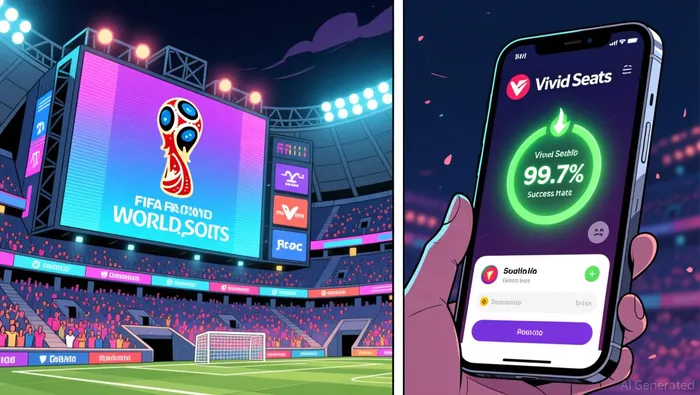
- CEO stated 'Two quarters into the year, we are encouraged by the progress we have made and believe our strategic actions are delivering measurable results' and 'We successfully capitalized on the World Cup opportunity... with a greater than 99.7% successful fulfillment rate'.
Q&A:
- Question from Cameron Mansson-Perrone (Morgan Stanley): Could you provide color on the competitive backdrop and how you view take rate as a competitive tool, particularly during active periods like the World Cup?
Response: Competitive intensity remains elevated but moderated from peak levels. Take rate faces pressure during large, high-price-point events like the World Cup, and the company adjusted its take rate lower to compete and offer differentiated value.
- Question from Dan Kurnos (Benchmark): Did the World Cup resonate with your messaging and shift traffic to in-app, helping gain momentum?
Response: The company outpaced its share of the World Cup volume, indicating successful messaging and app traffic shifts, and delivered superior customer experience metrics.
- Question from Dan Kurnos (Benchmark): What are your thoughts on potential expanded state-by-state regulation?
Response: Near-term impact is not expected due to small jurisdictions, delayed implementations, and frameworks that leave room for questions. Long-term, price-based mechanisms are seen as the most effective and customer-friendly way to manage demand exceeding supply.
- Question from Ryan Sigdahl (Craig-Hallum Capital Group): Can a highly publicized event with positive experiences change the narrative for your marketplace faster than negative publicity fades?
Response: The company bets that positive experiences, especially when combined with better prices and service, will spread through word-of-mouth and social media over time, proving economically right.
- Question from Ryan Sigdahl (Craig-Hallum Capital Group): What product enhancements were accomplished in Q2 and what's coming in the back half of the year?
Response: Focus in Q2 was on reducing friction in the core transaction funnel. In the second half, the focus shifts to improving the seat selection journey and app engagement to increase conversion and customer retention.
- Question from Ralph Schackart (William Blair): Can you talk about app traffic growth in Q2 and strategies to drive more app traffic?
Response: App volume growth continues to outpace the broader market. The strategy centers on communicating the app's best-in-class value proposition, improving onboarding, and leveraging the fulfillment process to build customer awareness and loyalty.
- Question from Audrey Stewart (RBC): Can you provide an update on the new private label partner's Q2 performance and confidence in adding more partners?
Response: The partner continues to outperform expectations, representing a competitive win. Upgrades to the onboarding stack and positive leading indicators give confidence in the pipeline and ability to add more partners.
- Question from Thomas Forte (Maxim Group): What are your current thoughts on international expansion efforts?
Response: International opportunity is seen as large and untapped. The company paused investment to focus on core funnel upgrades, which will benefit international, with targeted upgrades expected to re-accelerate growth in 2027.
- Question from Thomas Forte (Maxim Group): What are your current thoughts on cash conversion for 2026?
Response: Cash conversion remains consistent with the prior framework, expecting high $30M-$40M in CapEx, interest, and taxes. If GOV growth is returned, working capital would be a source of cash, making it a cash generative year.
- Question from Steven McDermott (Bank of America): Can you provide color on dynamics in verticals outside of sports, like concerts and theater?
Response: Overall industry volumes outside of World Cup were softer, potentially due to World Cup cannibalization. Competitive intensity increased in theater, and Vegas theater performance reflects softness in leisure travel.
- Question from Steven McDermott (Bank of America): How are you thinking about AOVs in Q3 and the back half of the year?
Response: AOV is expected to be up year-over-year in Q3 due to World Cup bleed-over. Q4 is speculative, depending on the concert roster and World Series matchups, but long-term AOV growth is expected at inflation plus a couple hundred basis points.
Contradiction Point 1
App Traffic Growth and Strategy
It presents differing strategies and performance metrics for app traffic growth, affecting expectations for future market share and business volume.
Ralph Schackart (William Blair) - Ralph Schackart (William Blair)
2026Q2: The app offers best in class value... Since initiating the app promotion in Q3 2025, the company has seen compelling metrics with app volume growth outpacing the broader market. - Larry Se(CEO)
What were the Q2 app traffic growth results and the strategies to drive more traffic? - Ralph Schackart (William Blair)
2026Q1: App GOV share is up 20% year-over-year and exceeded 40% in Q1. The ambition is for a majority of business to come through the app, realistically aiming for a run-rate basis by some point in 2027. - Lawrence Fey(CEO)
Contradiction Point 2
Private Label Partner Performance and Outlook
It frames the target and outlook for the private label segment's growth differently, impacting expectations for the channel's profitability and contribution.
Audrey Stewart (RBC, on for Brad Erickson) - Audrey Stewart (RBC, on for Brad Erickson)
2026Q2: The partner outperformed expectations and represents a competitive win... The private label channel is now contribution margin positive and ahead of schedule... The channel is now a growth driver. - Larry Se(CEO)
Can you provide an update on the new private label partner's Q2 performance and what factors give confidence in the relationship and the ability to add more partners? - Maria Ripps (Canaccord)
2026Q1: Returning to the absolute size pre-large-customer-loss levels seen in 2024/2025 is not a near-term target. The goal is for the segment to grow at or above broader marketplace and industry rates... - Lawrence Fey(CEO)
Contradiction Point 3
Cash Conversion for 2026
It provides inconsistent guidance on 2026 cash conversion and free cash flow, affecting investor expectations regarding the company's financial health and cash management.
Thomas Forte (Maxim Group) - Thomas Forte (Maxim Group)
2026Q2: The cash conversion framework remains consistent. The company expects 'high $30 million-$40 million' in cash outflows... Cash generation for the year will depend on working capital movement... - Larry Se(CEO)
What are your current thoughts on the international expansion strategy and cash conversion expectations for 2026? - Thomas Forte (Maxim Group)
2025Q4: ...the company expects to be modestly cash generative in 2026. - Lawrence Fey(CEO)
Contradiction Point 4
Competitive Landscape Assessment
It contradicts the current state of competitor aggressiveness and market share dynamics, influencing the strategic approach to competition and pricing.
Cameron Mansson-Perrone (Morgan Stanley) - Cameron Mansson-Perrone (Morgan Stanley)
2026Q2: The competitive landscape shows **'moderation'** from the largest competitor but remains **'elevated'** with others prioritizing volume and share. - Larry Se(CEO)
How has the competitive landscape evolved this year, and what was your approach to using take rate as a competitive tool during the World Cup, including future strategy? - Maria Ripps (Canaccord Genuity)
2025Q3: There has been a **shift in competitive posture**, with StubHub's market share reversing year-over-year in September and October, tied to a **change in marketing aggressiveness**. - Lawrence Fey(CEO)
Contradiction Point 5
World Cup Impact on Guidance and Business Outlook
It contradicts whether the World Cup is assumed to have a material impact on 2026 performance, affecting the company's event-driven growth strategy and forecasting.
Dan Kurnos (Benchmark) - Dan Kurnos (Benchmark)
2026Q2: The World Cup's take rate was influenced by... and the event demonstrates the **'flywheel'** effect: strong initial acquisition combined with a differentiated experience should drive future returns. - Larry Se(CEO)
2025Q3: No meaningful World Cup impact is assumed due to lack of precedent data and FIFA's aggressive monetization; any impact would be upside. - Lawrence Fey(CEO)

Discover what executives don't want to reveal in conference calls
Latest Articles
Stay ahead of the market.
Get curated U.S. market news, insights and key dates delivered to your inbox.


AInvest
PRO
AInvest
PRO




Comments
No comments yet