
Vitalik Buterin's New ZK Vision and Its Implications for Crypto Markets


 Aime Summary
The crypto landscape in 2025 is being reshaped by a seismic shift in zero-knowledge (ZK) technology, driven by Vitalik Buterin's latest breakthroughs. As Ethereum's co-founder continues to refine ZKZK-- proof mechanisms, the implications for scalability, institutional adoption, and market dynamics are profound. This analysis evaluates the investment potential of ZK technologies post-Vitalik's announcement, dissecting technical advancements, market performance, and institutional trends.
The GKR Protocol: A Game-Changer for ZK Scalability
Vitalik Buterin's GKR protocol has emerged as a cornerstone of Ethereum's 2025 scalability roadmap. By reducing verification costs and hardware requirements by up to 15-fold in theory and 10-fold in practice, the protocol addresses a critical bottleneck in ZK-EVM proving, according to
Bitget. This innovation has enabled projects like ZKsyncZK-- to achieve 15,000 TPS and near-zero gas fees, propelling its native token to a 150% surge in November 2025, Bitget reports. However, Buterin has candidly acknowledged a lingering challenge: the modular exponentiation (modexp) precompile, which he admits is a 50x scalability bottleneck, according to
AmbCrypto. This admission underscores the need for further technical refinements, such as replacing modexp with standard EVM bytecode, to unlock ZK's full potential, Bitget reports.
Market Performance: ZKsync's Surge and Competitive Landscape
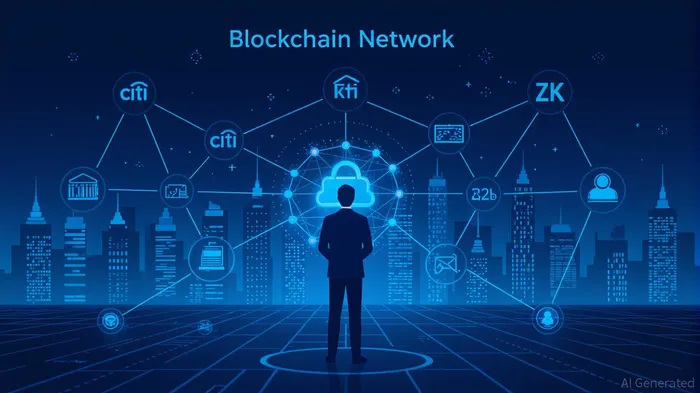
ZKsync has become the poster child of ZK's market potential. Its Atlas upgrade, endorsed by Buterin, not only slashed gas fees but also attracted institutional giants like Citibank and Deutsche Bank, which now leverage its Prividium solution for privacy-centric infrastructure, according to Bitget. Meanwhile, competitors like StarknetSTRK-- and zkSync Era are vying for dominance. Starknet's STARK-based architecture excels in transaction compression, while zkSync Era's Boojum upgrade has cut verification expenses by 39%, Bitget reports.
Other ZK projects are also gaining traction. Immutable's zkEVM has enabled live gaming ecosystems, with titles like TOKYO BEAST and Might & Magic: Fates driving on-chain activity, according to
BingX. Linea's EVM equivalence and institutional partnerships, such as SharpLink's $200 million ETH deployment, further highlight the sector's diversification, BingX reports. ZcashZEC-- (ZEC) and WorldcoinWLD-- (WLD) are carving niches in privacy and identity verification, with Zcash's shielded pool now accounting for 27.5% of its total supply, according to Bitget.
Institutional Adoption and Technical Viability
Institutional adoption is accelerating, with banks and corporations prioritizing ZK solutions for compliance and efficiency. ZKsync's Prividium has become a go-to tool for enterprises seeking regulation-friendly blockchain infrastructure, Bitget reports. Similarly, projects like Brevis' Pico Prism are gaining traction in DeFi and cross-chain applications, Bitget reports.
Technically, the sector is maturing. Starknet's Kakarot EVM compatibility and Linea's MetaMask integration signal robust developer ecosystems, BingX reports. However, challenges remain. Zcash's optional transparency model, while compliant, faces regulatory scrutiny, Bitget reports. Meanwhile, Ethereum's modexp bottleneck and the need for GKR integration across projects highlight the sector's technical fragility, AmbCrypto reports.
Risks and the Road Ahead
Despite the optimism, risks loom. Ethereum's scalability hurdles and the volatility of ZK token prices (e.g., ZKsync's 150% surge) reflect the sector's nascent stage. Institutional capital outflows from ETH ETFs also raise questions about Ethereum's ability to sustain its ZK-driven growth, AmbCrypto reports. For investors, the key will be to differentiate between projects with strong technical foundations (e.g., Starknet's TVL of $700 million, BingX reports) and those reliant on speculative hype.
Conclusion: A ZK-Driven Future
Vitalik Buterin's ZK vision is undeniably transformative, but its success hinges on overcoming technical bottlenecks and securing institutional buy-in. ZKsync, Starknet, and ImmutableIMX-- are leading the charge, but the sector's long-term viability will depend on continued innovation and regulatory alignment. For investors, the next 12–18 months will be critical-those who prioritize projects with proven scalability, institutional partnerships, and active developer ecosystems are likely to reap the greatest rewards.

Blending traditional trading wisdom with cutting-edge cryptocurrency insights.
Latest Articles
Stay ahead of the market.
Get curated U.S. market news, insights and key dates delivered to your inbox.






Comments
No comments yet