
Vitalik Buterin's Recent ZK-Related Announcement and Its Implications for Blockchain Scalability


 Aime Summary
Technical Innovations and Scalability Breakthroughs
Buterin's proposal to layer ZK proofs with MPC and FHE represents a sophisticated approach to securing blockchain applications. These technologies collectively mitigate risks, particularly in sensitive use cases like secure voting systems and private state queries. However, the most transformative aspect of his recent work lies in the optimization of ZK verification costs. The introduction of the GKR protocol-a novel method for arithmetization-has reduced verification costs by up to 15 times, enabling platforms like ZKsyncZK-- to process 43,000 transactions per second (TPS) with near-zero fees. This leap in efficiency directly addresses Ethereum's scalability bottlenecks, aligning with the "Lean Ethereum" strategy to prioritize lightweight, high-throughput solutions.
The technical implications are profound. By lowering computational overhead, ZK rollups can now handle complex smart contracts at scale, a critical requirement for enterprise adoption. For instance, Deutsche Bank and Sony have already integrated Ethereum-based ZK-rollups to meet regulatory compliance while maintaining transaction efficiency, with ZK-rollups now accounting for 83% of enterprise smart contracts by late 2025. Such developments underscore the transition of ZK technology from a niche cryptographic tool to a foundational infrastructure layer.
Market Impact and Investment Trends
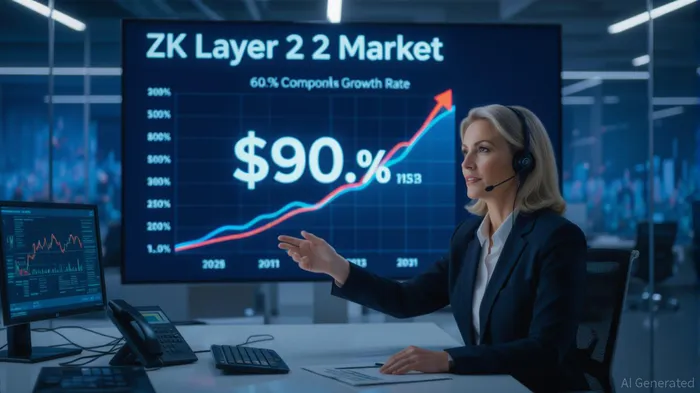
The market has responded enthusiastically to these advancements. The ZK Layer 2 sector is forecasted to grow at a 60.7% CAGR, reaching $90 billion by 2031, driven by performance gains and institutional demand. Projects like StarkNetSTRK-- and ZKsync have demonstrated robust traction: StarkNet's Total Value Locked (TVL) tripled to $72 million in Q3 2025, while ZKsync's transaction throughput of 43,000 TPS has attracted partnerships with firms like Mantle-Anchorage Digital.
Investor sentiment is further bolstered by the emergence of ZK-based infrastructure tokens, such as ZKS (ZKsync) and ETHA, which have seen significant inflows due to their alignment with Ethereum's roadmap. Institutional players, including Citibank and Sony, are leveraging ZK-rollups to bridge traditional finance (TradFi) and decentralized finance (DeFi), creating hybrid ecosystems that balance regulatory compliance with decentralized innovation.
Challenges and Risks
Despite the optimism, challenges persist. Regulatory scrutiny of privacy-focused projects remains a wildcard. For example, Zcash-a privacy coin utilizing ZK proofs-faces heightened regulatory attention due to its association with illicit activity, raising questions about the broader acceptance of privacy-centric ZK applications. Additionally, the technical complexity of GKR adoption could slow widespread implementation, particularly for projects lacking the resources of Ethereum's core developers.
Another concern is the temporary increase in gas fees caused by Ethereum's modexp precompile removal under the "Lean Ethereum" initiative. While this change aims to reduce centralization risks, it has created short-term friction for developers and users, highlighting the trade-offs inherent in scaling solutions.
Conclusion
Vitalik Buterin's ZK innovations have catalyzed a paradigm shift in blockchain scalability, offering a viable path to reconcile privacy, performance, and decentralization. For investors, the ZK Layer 2 sector presents a compelling opportunity, supported by institutional adoption, performance benchmarks, and a clear technical roadmap. However, the path to mainstream adoption is not without hurdles. Regulatory uncertainties and technical execution risks necessitate a cautious, long-term perspective. Those willing to navigate these challenges may find themselves at the forefront of a technological revolution that could redefine the future of digital infrastructure.

Mezclando la sabiduría tradicional en el comercio con las perspectivas más avanzadas sobre criptomonedas.
Latest Articles
Stay ahead of the market.
Get curated U.S. market news, insights and key dates delivered to your inbox.


AInvest
PRO
AInvest
PRO



Comments
No comments yet