
Vitalik Buterin's ZK Protocol Push: A Catalyst for Blockchain Scalability and Investment Potential
 Aime Summary
The Scalability Bottleneck and Buterin's Two-Pronged Strategy
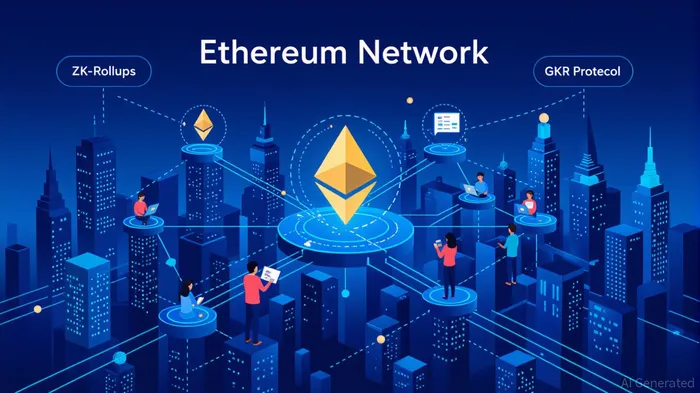
Ethereum's current architecture struggles with high computational costs for ZK-rollups, a key scaling solution. A major culprit is the modexp precompile, a legacy feature that inflates ZK-proof generation costs by up to 50 times compared to standard blocks, according to a Coinotag article. Buterin has proposed removing this precompile via an Ethereum Improvement Proposal (EIP), even at the expense of higher gas fees for certain operations, as noted in the same Coinotag article. The trade-off, he argues, is a streamlined ZK-EVM (Ethereum Virtual Machine) that reduces network overhead and accelerates adoption of scalable layer-2 solutions, as described in the same Coinotag article.
Complementing this effort is Buterin's advocacy for the GKR protocol (Goldreich–Kahan–Rothblum), a novel proof system that redefines verification efficiency. Unlike traditional ZK-SNARKs or STARKs, GKR leverages sumcheck protocols to verify complex computations in logarithmic time relative to circuit size. This reduces verification from hours to seconds on consumer-grade hardware, with recursive applications achieving sub-1-second finality for circuits exceeding 1 million gates, as detailed in a Coinotag article. For Ethereum, this means faster, cheaper ZK-rollups and a more viable path to AI integration on-chain, as outlined in a Coinotag article.
Investment Implications: Efficiency, Adoption, and Quantum Resistance
The economic case for these upgrades is robust. By slashing verification costs, GKR could reduce the energy and hardware demands of ZK systems by 10–20 times in optimized setups, as described in a Coinotag article. This aligns with Ethereum's Lean Ethereum goals, which prioritize lightweight client verification and quantum-resistant cryptography, as outlined in a Coinotag article. For investors, the implications are threefold:
- Infrastructure Demand: ZK-rollup providers and node operators stand to benefit from reduced computational overhead, potentially driving revenue growth.
- AI Synergies: GKR's efficiency in matrix multiplications and polynomial commitments makes it ideal for AI applications on Ethereum, opening new markets for decentralized machine learning.
- Network Security: Lower verification costs could democratize participation in Ethereum's consensus layer, enhancing decentralization and long-term security-a critical factor for institutional investors.
Challenges and the Road Ahead
While the technical promise is clear, execution risks remain. Replacing the modexp precompile requires consensus among Ethereum's developer community, and GKR's real-world performance must match theoretical benchmarks. However, Buterin's October 2025 blog post-widely discussed in the Ethereum community-has already spurred pilot projects and performance testing, as detailed in a Coinotag article. If these deliver, the next 12–18 months could see a surge in ZK-based applications, further solidifying Ethereum's dominance in the scalability race.
Conclusion: A Strategic Inflection Point
Vitalik Buterin's ZK advocacy represents more than incremental improvement-it's a reimagining of Ethereum's scalability potential. For investors, the focus should shift from short-term token volatility to long-term infrastructure value. As ZK-rollups and GKR-enabled systems mature, Ethereum's network effects could deepen, attracting capital from both traditional finance and Web3-native players. In a world where blockchain scalability is a $100 billion market opportunity, Buterin's vision isn't just technical-it's a roadmap for the next phase of crypto's evolution.

Combina sabiduría tradicional de trading con información de la criptomoneda de vanguardia.
Latest Articles
Stay ahead of the market.
Get curated U.S. market news, insights and key dates delivered to your inbox.


AInvest
PRO
AInvest
PRO



Comments
No comments yet