
Vitalik Buterin's ZK Advancements and the Investment Potential of Ethereum's Layer-2 Ecosystem


 Aime Summary
Technical Foundations: Vitalik's ZK-Driven Roadmap
Vitalik Buterin has identified the modexp precompile-a legacy feature for modular exponentiation-as a critical bottleneck for ZK-EVM scalability. By replacing it with standard EVM bytecode, Ethereum could reduce ZK-proof generation times by up to 50% while simplifying the ZKZK-- ecosystem, as noted in a Coinotag article. Though this change may increase gas costs by 15–25%, the trade-off is justified by the low usage of modexp (primarily in RSA verification or bridge security), which can transition to advanced systems like SNARKs, according to a CryptoFrontNews report. This optimization aligns with Ethereum's broader goal of enabling ZK-rollups to process transactions at enterprise-grade speeds, a prerequisite for mass adoption.
Simultaneously, Buterin has highlighted ZKsync's Atlas upgrade as a blueprint for L2 scalability. The upgrade enables 15,000+ transactions per second (TPS), one-second finality, and near-zero fees by redefining the L1-L2 liquidity relationship, as described in a Coinfomania piece. By eliminating the need for separate liquidity pools, Atlas reduces friction for users and institutional applications, such as Real-World Assets (RWAs), positioning ZK-based L2s as the backbone of Ethereum's future.
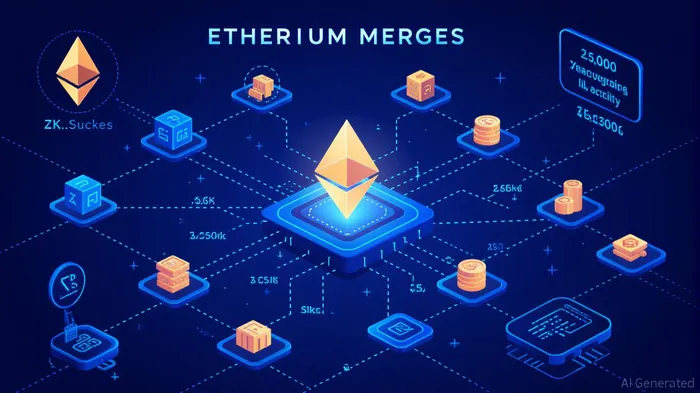
Market Dynamics: ZK L2s as Post-Merge Growth Engines
The Ethereum Dencun upgrade in March 2024 further amplified the economic viability of ZK L2s by introducing "blob" data objects, slashing L2 data posting costs by 90–98%, according to a The Standard piece. This has triggered a surge in L2 adoption, with networks like Base and ArbitrumARB-- processing more transactions than Ethereum's base layer. For instance, Coinbase's Base L2 recorded 109 million transactions in a 30-day period in 2024, underscoring the shift in user activity to L2s, as reported in the same The Standard article.
Financially, ZK L2s are becoming self-sustaining ecosystems. ZKsync's tokenomics redesign, for example, ties ZK token value to network revenue through buybacks and burns, creating a deflationary mechanism, as noted in a Coinotag article. Projected staking yields of 5–10% annually further incentivize long-term participation, while the token's transition from governance to utility aligns its value with platform usage. Meanwhile, Zama's acquisition of KKRT Labs (Kakarot) aims to process 10,000+ confidential transactions per second, unlocking applications in privacy-preserving DeFi and stablecoin payments, according to a Blockchain Magazine report.
Project Comparisons: ZKsync, StarkNet, and Scroll
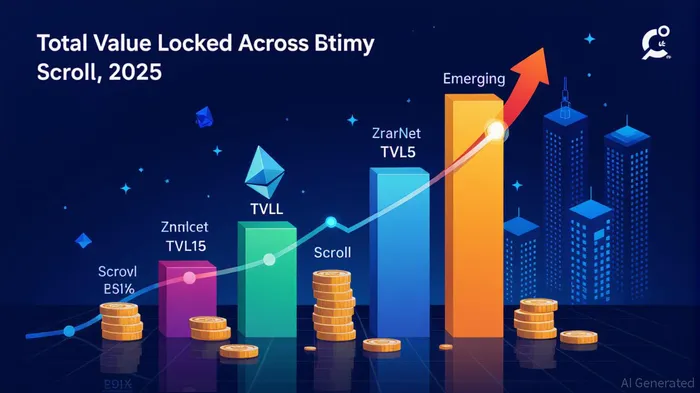
In Q3 2025, ZKsync's Atlas upgrade demonstrated enterprise-grade performance, with a sequencer capable of 43,000 TPS and Airbender's $0.0001 per transfer proving cost, according to a Zeeve blog. Its modular architecture, supporting EVM and future WASM/RISC-V compatibility, positions it as a hub for composability across L2s. StarkNetSTRK--, meanwhile, prioritized decentralization with its Grinta upgrade, introducing a multi-sequencer architecture and 4-second block times, as described in a StarkNet blog. The network's TVL tripled in Q3 2025, with BTCFi activity driving $150 million in stablecoin value and 650 BTC staked, as reported in the same StarkNet blog. Scroll, though less detailed in the analysis, remains a key player in EVM-compatible ZK-rollups.
Investment Implications
The synergy between technical innovation and economic design in ZK L2s suggests robust long-term potential. For Ethereum, the growth of L2s could drive aggregate fees and ETH value, as L2 activity enhances network utility. However, challenges like modexp inefficiencies and competition among L2s necessitate careful evaluation. Investors should prioritize projects with clear tokenomics, enterprise partnerships, and technical differentiation-ZKsync's Atlas and StarkNet's Grinta exemplify this.
Conclusion
Vitalik Buterin's ZK advancements and the maturation of L2 solutions like ZKsyncZK-- and StarkNet are redefining Ethereum's scalability narrative. For investors, the post-Merge ecosystem offers a unique opportunity to capitalize on the convergence of cryptographic efficiency, economic incentives, and real-world adoption. As ZK-based L2s continue to outperform Ethereum's base layer in throughput and cost, their financial potential-backed by tokenomics innovation and institutional traction-will likely shape the next phase of blockchain growth.

Blending traditional trading wisdom with cutting-edge cryptocurrency insights.
Latest Articles
Stay ahead of the market.
Get curated U.S. market news, insights and key dates delivered to your inbox.


AInvest
PRO
AInvest
PRO



Comments
No comments yet