
Vitalik Buterin's Endorsement of ZKsync and Its Implications for Layer 2 Scalability


 Aime Summary
Vitalik Buterin's Endorsement: A Strategic Validation
Vitalik Buterin has consistently emphasized incorruptibility as Ethereum's most vital feature, ensuring data integrity and trust without centralized control, according to a Coinotag report. His recent praise for ZKsync underscores the project's role in advancing this principle while addressing scalability bottlenecks. According to the Coinotag report, Buterin described ZKsync's work as "a lot of underrated and valuable work" within the Ethereum ecosystem. This endorsement is not merely symbolic; it reflects a strategic alignment between ZKsync's architecture and Ethereum's long-term goals.
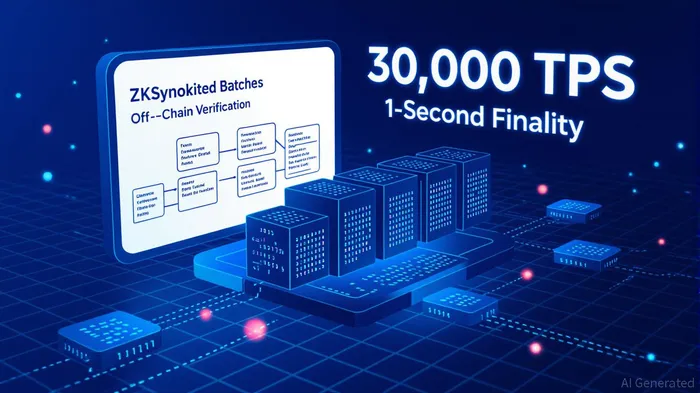
ZKsync leverages zero-knowledge (ZK) rollups to batch transactions off-chain while maintaining on-chain security. The recent Atlas upgrade has pushed its throughput to 30,000 transactions per second (TPS) with 1-second finality, a leap forward in efficiency, according to the Coinotag report. Buterin's advocacy extends beyond ZKsync itself: he has proposed replacing Ethereum's modexp precompile, a legacy feature that inflates computational costs for ZK proofs by up to 50 times, as noted in a Coinotag article. By advocating for this change, Buterin signals his commitment to optimizing Ethereum's cryptographic infrastructure, directly benefiting ZK-rollups like ZKsync.
Technical Foundations and Competitive Edge
ZKsync's technical roadmap positions it as a formidable contender in Ethereum's L2 landscape. The Atlas upgrade not only boosts transaction speed but also enhances programmability, enabling complex smart contracts and decentralized applications (dApps) to operate with minimal latency, as reported by Coinotag. As of Q4 2025, ZKsync has processed 1.2 billion transactions, a testament to its reliability and adoption, according to the Coinotag report.
However, ZKsync faces stiff competition from established L2s like ArbitrumARB-- and Optimism, which hold significant total value locked (TVL) due to early market entry and developer ecosystems, as noted in a TokenMetrics analysis. Newer projects such as LineaLINEA--, which launched with $1.8 billion in TVL, further intensify the rivalry, as reported by TokenMetrics. Despite this, ZKsync's focus on privacy, low fees, and Ethereum compatibility differentiates it. Its use of ZK proofs ensures data integrity without sacrificing speed, a critical advantage in enterprise and DeFi use cases.
Security and Governance: A Prerequisite for Trust
For any blockchain project, security is non-negotiable. ZKsync has undertaken rigorous audits in 2025, including reviews by Spearbit and OpenZeppelin, as detailed in the ZKsync documentation. The ZKsync Security Council (ZKSC) has also demonstrated agility, recovering from the April 2025 airdrop exploit and implementing emergency upgrades, according to the ZKsync Security Council report. These measures, combined with a new funding model prioritizing rapid response times, underscore the project's commitment to robust governance, as detailed in the ZKsync Security Council report.
Investors must, however, remain cautious. While ZKsync's technical milestones are impressive, sustained performance under real-world conditions-such as high transaction volumes or adversarial attacks-will determine its long-term viability, according to the Coinotag report.
Investment Potential: Balancing Innovation and Risk
ZKsync's investment appeal lies in its alignment with Ethereum's scaling priorities and its technical execution. Buterin's endorsement, coupled with the Atlas upgrade, has positioned ZKsync as a key player in the L2 "arms race." However, success hinges on several factors:
1. Adoption Rates: Widespread developer and user adoption is critical. ZKsync's 1.2 billion transactions indicate traction, but competing projects are also innovating, according to the Coinotag report and TokenMetrics.
2. Regulatory Clarity: As L2s handle more value, regulatory scrutiny could impact growth trajectories.
3. Ethereum Upgrades: The proposed removal of modexp and other EIPs will directly influence ZKsync's efficiency, as noted in the Coinotag article.
From a risk-reward perspective, ZKsync offers high upside if it secures a dominant position in Ethereum's L2 ecosystem. Yet, its reliance on Ethereum's roadmap and the volatile nature of crypto markets necessitates a measured approach.
Conclusion: A Cornerstone of Ethereum's Future?
Vitalik Buterin's endorsement of ZKsync is more than a vote of confidence-it's a strategic endorsement of ZK-rollups as the future of Ethereum scalability. With its technical advancements, security rigor, and alignment with Ethereum's vision, ZKsync is well-positioned to capture significant market share. However, investors must weigh its potential against the competitive landscape and evolving regulatory environment. For those with a long-term horizon and a tolerance for innovation-driven risk, ZKsync represents a compelling case study in blockchain's next phase of growth.

Blending traditional trading wisdom with cutting-edge cryptocurrency insights.
Latest Articles
Stay ahead of the market.
Get curated U.S. market news, insights and key dates delivered to your inbox.






Comments
No comments yet