
Vitalik Buterin's Endorsement of ZKsync: A Catalyst for Institutional Adoption of Zero-Knowledge Scaling


 Aime Summary
ZKsync's Atlas Upgrade: A Technical and Institutional Breakthrough
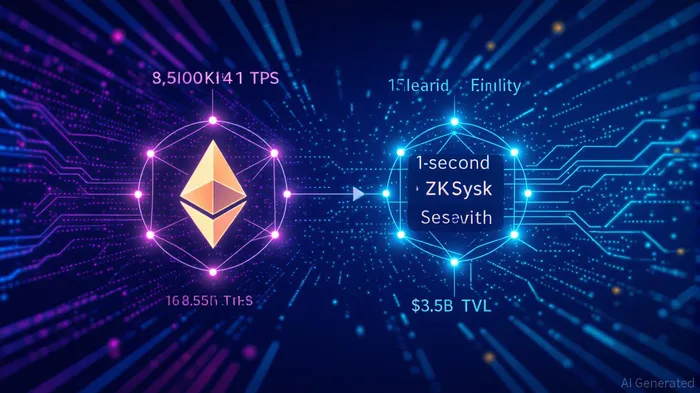
ZKsync's Atlas upgrade, launched in 2025, has redefined Layer-2 (L2) scalability by enabling over 15,000 transactions per second (TPS), one-second finality, and near-zero fees. More critically, it allows ZKsync-based chains to directly access Ethereum's liquidity in real time, eliminating fragmented liquidity pools and enhancing cross-chain efficiency. This innovation aligns with Ethereum's broader vision of ZK-based scaling, as emphasized by Buterin, who has long advocated for ZK technology as the future of blockchain scalability.
The upgrade's impact is already evident in market metrics. ZKsync's total value locked (TVL) surged to $3.5 billion in Q3 2025, driven by reduced gas fees (70% lower post-Atlas) and real-world asset (RWA) tokenization capabilities. Institutional adoption has followed suit, with partnerships like Deutsche Bank's cross-chain settlement solution and Sony's Ethereum-based L2 initiatives reflecting growing confidence in ZKsync's enterprise-grade infrastructure.
Institutional Adoption and Tokenomics: A Self-Reinforcing Cycle
ZKsync's transition of its ZK token from a governance asset to a value-accruing one has further accelerated institutional interest. Buybacks and burns, combined with Buterin's endorsement, triggered a 50% price surge in the ZK token. This shift mirrors broader trends in institutional-grade blockchain infrastructure, where token utility and scarcity drive adoption.
The platform's transaction volume also tells a story of enterprise traction: ZKsync processed 1.2 billion transactions by Q4 2025, a figure that underscores its appeal to businesses requiring high throughput and security. The upcoming Fusaka upgrade, targeting 30,000 TPS, is expected to solidify ZKsync's dominance in the competitive L2 landscape.
Market Projections and Investment Opportunities
Experts predict the ZK Layer-2 market will grow at a 60.7% compound annual growth rate (CAGR), reaching $90 billion by 2031. This growth is fueled by Ethereum's "Lean Ethereum" strategy, which prioritizes ZK rollups for cost efficiency, and the cost-saving benefits of ZK technology for institutions.
Investors should also note the strategic alignment between ZKsync and global financial institutions. Deutsche Bank's use of ZKsync for cross-chain settlements and the influx of $15 billion from BitcoinBTC-- ETFs into ZK-based ecosystems highlight the platform's role in bridging traditional finance and blockchain. These developments suggest that ZK infrastructure is notNOT-- just a speculative play but a foundational asset in the evolution of decentralized finance.
Conclusion: A Defining Moment for ZK Infrastructure
Vitalik Buterin's endorsement of ZKsync is more than a celebrity stamp of approval-it is a validation of ZK technology's readiness for institutional adoption. With technical milestones like the Atlas and Fusaka upgrades, coupled with a $3.5 billion TVL and a 60.7% CAGR growth forecast, ZKsync represents a high-conviction investment opportunity. For investors seeking exposure to the next phase of Ethereum's scalability story, ZK infrastructure is no longer on the periphery-it is at the core of the blockchain revolution.

Blending traditional trading wisdom with cutting-edge cryptocurrency insights.
Latest Articles
Stay ahead of the market.
Get curated U.S. market news, insights and key dates delivered to your inbox.


AInvest
PRO
AInvest
PRO



Comments
No comments yet