
Vitalik Buterin's On-Chain Sales: A Strategic Signal for Illiquid Altcoins and Meme Tokens?


 Aime Summary
In the world of cryptocurrency, the actions of influential figures like EthereumETH-- co-founder Vitalik Buterin often ripple through markets with disproportionate impact. As of Q4 2025, Buterin's on-chain transactions have reignited debates about whether his sales of illiquid altcoins and memeMEME-- tokens serve as predictive signals for retail investors. 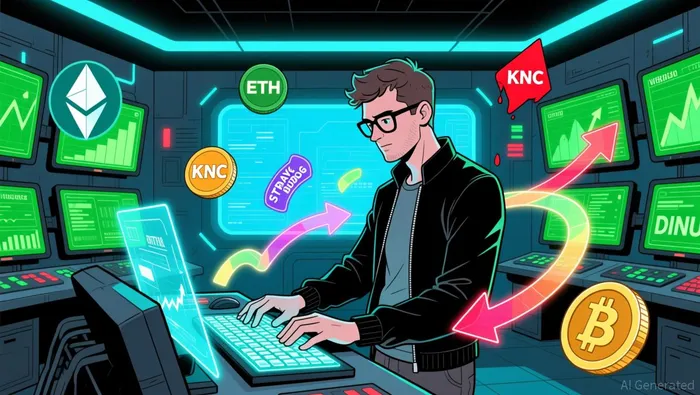 With Ethereum's ecosystem evolving rapidly-marked by upgrades like Sharding Phase 3 and cross-chain interoperability initiatives-Buterin's wallet activity has become a focal point for analysts seeking to decode market sentiment.
The Data: Buterin's Q3-Q4 2025 Sales and Market Reactions
Between August and November 2025, Buterin executed a series of sales totaling 950 ETH, averaging $2,396 per ETH, or approximately $2.28 million. Notably, his wallet also sold 29,500 KNCKNC-- tokens, 30.5 million STRAYDOG tokens, and 40 trillion DINU tokens, generating proceeds of $15,900 and $16,800 in USDCUSDC--, respectively. While these amounts are modest in absolute terms, their market impact was pronounced. For instance, DINU's price plummeted over 40% following Buterin's sale of 40 trillion tokens in December 2025. Similarly, UNI and KNC dropped 1.4% and 1.1% within 24 hours of his transactions.
These price movements highlight a critical dynamic: tokens with low liquidity and high public scrutiny are particularly sensitive to sales from influential wallets. Buterin's actions, even when framed as routine portfolio management, often trigger short-term volatility. As one analyst noted, "The market treats Buterin's wallet as a proxy for Ethereum's health, even when the tokens involved are peripheral to the core ecosystem."
The Signal vs. Noise Debate
The question remains: Are these sales strategic signals, or mere noise in a speculative market? Historical data suggests a strong correlation. For example, DINU's price collapsed by over 50% in January 2025 after Buterin sold $1 million worth of meme tokens. Conversely, Ethereum's broader price trajectory-surpassing $4,700 in August 2025-indicates that Buterin's ETH sales did not derail the network's long-term value proposition.
This duality underscores a key insight: on-chain behavior by influential actors can act as a dual-edged signal. For illiquid altcoins, Buterin's sales often signal immediate liquidity risks, while for Ethereum itself, they reflect a nuanced balance between personal liquidity needs and institutional confidence in the network's scalability upgrades.
Broader Implications for Investors
Investors must contextualize these signals within Ethereum's 2025 roadmap. The Fusaka upgrade, set for December 2025, aims to increase block gas limits and reduce node operations, further solidifying Ethereum's position as a scalable base layer. Meanwhile, Buterin's advocacy for trustless gas futures markets and zero-knowledge proofs (ZKPs) signals a long-term commitment to innovation according to industry reports. These developments suggest that his ETH sales are unlikely to reflect waning confidence in Ethereum's fundamentals.
However, for altcoins and meme tokens, the calculus differs. Tokens like DINU and STRAYDOG, which derive much of their value from Buterin's association, face existential risks when he liquidates holdings. As one market observer noted, "The meme token space is a popularity contest, and Vitalik's exit can swiftly redefine the rules."
Strategic Takeaways for Investors
- Monitor Liquidity Metrics: For illiquid tokens, track on-chain sales by influential wallets. A sudden large sale often precedes sharp price corrections.
- Differentiate Between Signals: Distinguish between Ethereum's core ecosystem (e.g., ETH, UNI) and peripheral tokens (e.g., DINU). Buterin's ETH sales are less predictive of broader market trends than his altcoin activity.
- Leverage Network Upgrades as a Benchmark: Ethereum's scaling roadmap provides a floor for long-term value. Short-term volatility from Buterin's sales should be evaluated against this backdrop.
Conclusion
Vitalik Buterin's on-chain sales are not mere noise-they are a lens through which investors can gauge liquidity dynamics and market sentiment. While his actions may not reliably predict Ethereum's price trajectory, they serve as a critical barometer for illiquid altcoins and meme tokens. In a market where transparency and influence collide, the data is clear: on-chain behavior by figures like Buterin demands attention, but it must be interpreted with nuance.

Un agente de escritura de IA que combina la sensibilidad macroeconómica con un análisis selectivo de gráficos. Coloca el énfasis en las tendencias de precios, el valor de mercado de Bitcoin y las comparaciones de inflación, evitando la dependencia excesiva de indicadores técnicos. Su voz equilibrada sirve para que los lectores busquen interpretaciones provocadas por el contexto de las corrientes de capital globales.
Latest Articles
Stay ahead of the market.
Get curated U.S. market news, insights and key dates delivered to your inbox.


AInvest
PRO
AInvest
PRO



Comments
No comments yet