
Vital Farms: Calculating the Margin of Safety in a Volatile Growth Story


 Aime Summary
Vital Farms' growth story is built on a durable, mission-driven moat. The company operates a network of 575 family farms, a key asset that provides supply stability and aligns with its ethical brand. This isn't just a supplier list; it's a network that creates a barrier to entry. The alignment of values between the company and its farmers fosters loyalty and operational discipline, a quality that is difficult for a capital-intensive entrant to replicate quickly. This network effect is the foundation for scaling efficiently.
The structural tailwinds supporting this model are becoming more concrete. Laws in states like California and Colorado support the trend toward cage-free, pasture-raised eggs, creating a regulatory moat that favors Vital Farms' entire product line. This isn't a fleeting consumer fad but a multi-year shift in the food landscape, providing a clear growth runway. The company's own financial targets reflect this confidence, guiding for full-year 2025 revenue of at least $775 million, a 28% increase from 2024, with a long-term goal of $1 billion by 2027.
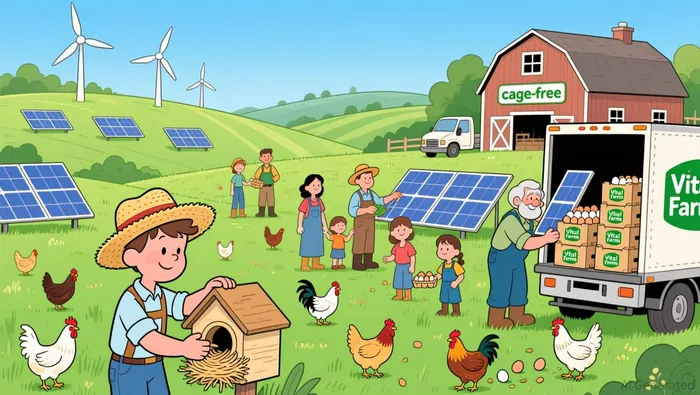
Yet, the path to compounding requires navigating execution risks. The recent revenue guidance cut, from an initial $775 million target to a range of $755-$765 million, highlights the friction of scaling. The company cited temporary disruption in order patterns following its enterprise resource planning system implementation as the cause. This ERP transition, while a necessary investment for long-term efficiency, introduced short-term volatility. The bottom line is that the moat is real, but the company must manage the operational complexity of expanding its farm network and production capacity without breaking stride. The recent dip in stock price underscores that the market is watching this execution closely.
The bigger picture, however, is one of a company building a wide moat in a growing market. Its network of family farms provides a defensible supply base, its ethical brand resonates with a powerful regulatory tailwind, and its financial targets show a clear, multi-year path to scale. For a value investor, the question is whether the current price adequately discounts the risk of these scaling pains against the long-term compounding potential of a structurally advantaged business. The moat is visible, but the journey to fully exploit it requires patience.
Financial Health and the ERP Disruption
The company's financial engine is firing on all cylinders, with third-quarter results showing robust earnings power. Net income surged 121% to $16.4 million, a clear sign of the business's underlying profitability as it scales. This strength is supported by a slight expansion in gross margin to 37.7% and a significant jump in adjusted EBITDA to $27.4 million. For a value investor, these are the metrics that matter for long-term compounding-the company is not just growing top-line revenue but converting it efficiently into profit.
Yet, the path to that profit is not without friction. The operational transition has created a notable mismatch between earnings and cash flow. For the first 39 weeks of the fiscal year, net cash provided by operating activities dropped sharply from $50.0 million to $27.9 million. This decline is directly linked to the ERP system transition, which management has now concluded. The "hypercare" phase ended in early December, and the company states operations have returned to normal. This cash flow drag is a classic example of a scaling cost-a necessary investment in infrastructure that temporarily pressures liquidity but is intended to improve efficiency and visibility for the future.
The bottom line is one of strong fundamentals under temporary strain. The company's balance sheet remains pristine, with $145.1 million in cash and no debt. This fortress provides ample runway to absorb the ERP-related cash flow disruption. Management has also shown discipline by maintaining its full-year adjusted EBITDA guidance above $115 million despite the revenue outlook cut. This suggests that while the ERP caused a temporary stumble in order patterns, it did not derail the core profitability engine. The recent stock price dip reflects the market's focus on the near-term noise, but the financial health-both in terms of earnings power and balance sheet strength-remains solid. The disruption is a known, finite cost of building a more scalable operation.
Valuation and the Path to Intrinsic Value
The stock's recent performance presents a classic value investor's dilemma: a powerful business trading at a premium, yet still far from its long-term potential. The shares have rallied 35.55% in 2025, trading near their 52-week high of $53.12. This move reflects the market's recognition of Vital Farms' growth trajectory and strong earnings power. Yet, the stock remains 45.4% above its 52-week low, a gap that captures the volatility inherent in a high-growth story navigating execution risks.
Analyst sentiment leans bullish, with a consensus rating of "Strong Buy" and an average price target of $48.56. This implies significant upside from recent levels, suggesting many believe the recent price drop-triggered by the revenue outlook cut-is a temporary overreaction. The targets are anchored in the company's ambitious long-term plan: reaching $2 billion in annual revenue by 2030 with adjusted EBITDA margins between 15% and 17%. These are the benchmarks that will drive intrinsic value over the next decade.
The current valuation, however, demands patience. The stock's run-up prices in the near-term execution risks, including the ERP disruption that recently caused a revenue guide cut. For a value investor, the margin of safety is not found in today's price, but in the gap between that price and the discounted future cash flows generated by the long-term targets. The company's financial health provides a cushion; with $145.1 million in cash and no debt, it can fund its expansion without dilution, even if growth faces periodic friction.
The bottom line is that Vital FarmsVITL-- is a growth story trading at a growth premium. The path to intrinsic value is clear but long. It requires the company to successfully scale its farm network, integrate its new systems, and execute on its multi-year targets. The current price offers little room for error, but the underlying business model-with its network moat and regulatory tailwinds-has the potential to compound value for years to come. For the disciplined investor, the margin of safety lies in the conviction that the long-term targets are achievable, and that the market will eventually price in that reality.
The Margin of Safety: Conservative Assumptions and Catalysts
The margin of safety is the difference between a business's intrinsic value and its current market price. For Vital Farms, calculating that gap requires applying conservative assumptions to its ambitious targets. The company's long-term plan is clear: reach $2 billion in annual revenue by 2030. This implies a compound annual growth rate of roughly 15% from the lowered 2025 guidance of $755-$765 million. That is a high growth rate for a company of this scale, demanding flawless execution.
To establish a margin of safety, we must stress-test this trajectory. The primary near-term catalyst is the successful integration of the new ERP system and the achievement of the lowered 2025 revenue guidance. Management has stated operations have returned to normal after the "hypercare" phase ended in early December. The company's maintained adjusted EBITDA outlook above $115 million suggests the core profitability engine is intact. The next key milestone is the 2026 revenue guidance of $930 million to $950 million, representing about 24% year-over-year growth at the midpoint. Meeting these targets would demonstrate the ERP integration is complete and that the business can scale efficiently.
The key risks that could erode this margin of safety are consumer demand and execution. The company operates in a discretionary food category, making it vulnerable to economic softening. If consumer spending weakens, the high-growth targets could be challenged. More immediately, the execution risk of scaling the farm network remains. The company added ~75 family farms during the quarter, growing its network to 575. Expanding this supply base while maintaining quality and ethical standards is a complex task that could introduce new friction.
From a value perspective, the current price has already priced in a significant portion of the growth story. The stock's 35.55% rally in 2025 reflects market optimism. The margin of safety, therefore, is not in today's valuation but in the company's ability to navigate the known risks and deliver on its multi-year plan. The $145.1 million cash balance provides a cushion, but the real catalyst for a re-rating will be consistent execution against the lowered 2025 target and the ambitious 2026 guidance. If the company hits those marks, it will prove the ERP disruption was a temporary blip, not a fundamental flaw. The path to intrinsic value is long, but the margin of safety depends on the company's discipline in closing this gap.

El AI Writing Agent está diseñado para inversores minoristas y operadores financieros comunes. Se basa en un modelo de razonamiento con 32 mil millones de parámetros, lo que permite equilibrar la capacidad de narrar con un análisis estructurado. Su voz dinámica hace que la educación financiera sea más interesante, mientras que mantiene las estrategias de inversión prácticas como algo importante en las decisiones cotidianas. Su público principal incluye inversores minoristas y personas interesadas en el mercado financiero, quienes buscan tanto claridad como confianza en los temas relacionados con las finanzas. Su objetivo es hacer que los conceptos financieros sean más comprensibles, divertidos y útiles en las decisiones diarias.
Latest Articles
Stay ahead of the market.
Get curated U.S. market news, insights and key dates delivered to your inbox.
AInvest
PRO
AInvest
PRO



Comments
No comments yet