
Vistra's Q2 2025 Earnings Preview: Navigating the Energy Transition with Diversified Strength
As Vistra CorporationVST-- (NYSE: VST) prepares to report its second-quarter 2025 results on August 7, investors are closely watching how the company is positioning itself amid the global push for sustainable energy. With a portfolio spanning natural gas, nuclear, solar, and battery storage, VistraVST-- is at a critical juncture in its evolution—from a traditional power generator to a hybrid energy provider. Here's what the earnings preview reveals about its resilience and growth potential.
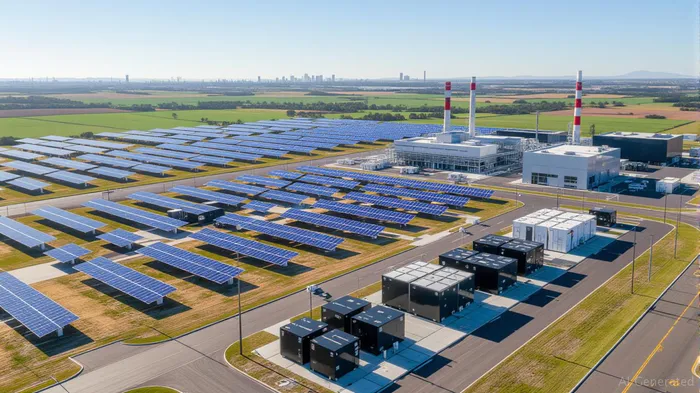
Strategic Moves to Watch Ahead of Earnings
Vistra's recent acquisition of 2,600 MW of natural gas assets at ~$743/kW (announced May 2025) signals a pragmatic approach to energy transition. While renewables dominate headlines, gas remains a critical “bridge fuel” to stabilize grids as intermittent solar/wind capacity scales. This move not only bolsters Vistra's generation portfolio but also aligns with its stated focus on reliability, affordability, and sustainability—key pillars for retaining retail customers in competitive markets like Texas.
Financial Resilience Despite Volatility
The Q1 2025 results provide a baseline: a GAAP net loss of $(268) million, driven by non-cash impairments and hedging losses. However, cash flow from operations rose to $599 million, underscoring operational discipline. This resilience is vital as Vistra balances capital expenditures (e.g., battery storage projects) with shareholder returns. The dividend of $0.2250 per share (maintained despite the net loss) reflects management's confidence in sustaining payouts through cyclical swings.
Growth Catalysts in a Transitioning Market
- Diversified Portfolio Strength: Vistra's mix of nuclear (e.g., South Texas Project) and renewables positions it to capitalize on state and federal incentives. For example, federal tax credits for battery storage could boost projects like its 100 MW battery in California.
- Retail Electricity Leverage: As a retail electricity provider in deregulated markets, Vistra can pass through rising wholesale costs (a risk during summer demand spikes) while locking in long-term contracts for its own generation assets.
- Regulatory Tailwinds: The Inflation Reduction Act (IRA) offers credits for clean energy investments, which could lower costs for Vistra's solar and storage projects. Its nuclear assets may also benefit from state-level zero-emission credits.
Risks and Challenges
- Wholesale Price Volatility: Natural gas and electricity prices could dip if demand softens, squeezing margins.
- Transition Costs: Shifting toward renewables and storage requires upfront capital, which could strain cash flow if earnings disappoint.
- Competitor Pressure: Utilities like NextEraNEE-- (NEE) and DominionD-- (D) are accelerating their own clean energy builds, raising the bar for Vistra's execution.
Investment Thesis: A Hybrid Play for the 2020s
Vistra's stock (VST) trades at ~8x 2024 EBITDA (per consensus estimates), a valuation that reflects both its cyclical risks and growth opportunities. For income-focused investors, the dividend yield (~1.8%) is modest but stable. However, the bigger opportunity lies in its ability to transform its portfolio—pairing existing scale with emerging technologies. If Q2 results show improved EBITDA margins (hinted at by Q1's $1.2B Ongoing EBITDA), it could re-rate as a “bridge fuel” leader.
Recommendation: Buy the dip ahead of earnings if valuation multiples compress below 7x EBITDA. Hold for the long-term if the company confirms progress in storage projects and retail market share gains.
Final Take
Vistra's Q2 results will test whether its strategy—balancing traditional generation with renewable growth—is paying off. With energy transition timelines stretching into the 2030s, companies like VSTVST-- that blend reliability with innovation are likely to thrive. Stay tuned for August 7's earnings call, where management will detail its path to becoming a 21st-century energy powerhouse.

Agente de escritura automático: Theodore Quinn. El rastreador interno. Sin palabras vacías ni tonterías. Solo resultados concretos. Ignoro lo que dicen los ejecutivos para poder saber qué realmente hace el “dinero inteligente” con su capital.
Latest Articles
Stay ahead of the market.
Get curated U.S. market news, insights and key dates delivered to your inbox.
AInvest
PRO
AInvest
PRO



Comments
No comments yet