
Vistra Corp (VST) as the AI-Powered Proxy for Grid Resilience in 2026


 Aime Summary
In the rapidly evolving landscape of the AI-driven energy transition, Vistra CorpVST-- (VST) has emerged as a pivotal player, uniquely positioned to capitalize on the dual forces of decarbonization and surging demand for reliable, high-capacity power. As artificial intelligence (AI) infrastructure expands, so too does the need for grid resilience-particularly in regions where data centers and computational hubs require continuous, zero-carbon energy. Vistra's strategic investments in nuclear power, AI-driven grid optimization, and geographic dominance in key energy markets have solidified its role as the de facto proxy for this transition.
Strategic Partnerships: Powering the AI Revolution
Vistra's 2026 partnerships with MetaMETA-- represent a landmark shift in corporate energy procurement. The company has secured 20-year power purchase agreements (PPAs) to supply over 2,600 megawatts (MW) of zero-carbon energy from three nuclear plants-Beaver Valley, Davis-Besse, and Perry-across Ohio and Pennsylvania. Of this capacity, 433 MW comes from nuclear uprates, marking the largest such project supported by a corporate customer in the U.S. These agreements not only ensure Meta's AI operations have a stable, round-the-clock power source but also provide VistraVST-- with long-term revenue certainty, enabling further investments in nuclear fleet expansion and grid modernization.
Meta's reliance on nuclear power underscores a broader trend: large corporations are increasingly turning to private-sector energy solutions to meet their decarbonization goals while avoiding regulatory and cost uncertainties. Vistra's CEO, Jim Burke, has emphasized that these partnerships allow the company to "rebrand as a critical provider of AI infrastructure" through a combination of nuclear baseload and flexible gas generation. By aligning its nuclear assets with the energy needs of AI, Vistra is transforming from a traditional utility into a foundational enabler of the digital economy.
AI-Driven Grid Management: Efficiency and Resilience
Beyond supplying power, Vistra is leveraging AI to optimize its own operations. The company's Heat Rate Optimizer (HRO) program, for instance, uses machine learning to enhance efficiency of its gas-fired plants, reducing fuel consumption and emissions while boosting profitability. This internal AI adoption mirrors the external demand for grid resilience, creating a compounding cycle of innovation and financial strength.
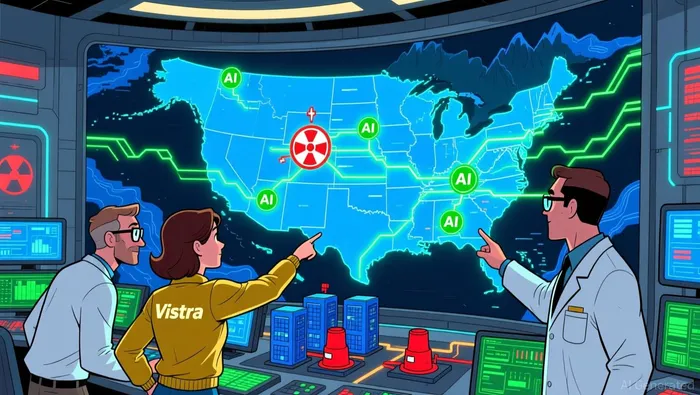 Vistra's integrated business model-combining generation, retail energy services, and AI-driven analytics-positions it to outperform peers. Unlike competitors such as Constellation Energy and NRG Energy, which are pursuing fragmented AI strategies, Vistra's holistic approach addresses both the supply and demand sides of the energy equation. Its strategic acquisitions, including Energy Harbor and Lotus Infrastructure Partners, have further diversified its generation portfolio and expanded its footprint in high-growth markets like Texas (ERCOT) and PJM Interconnection. These regions are critical for AI infrastructure, as they host some of the largest data center clusters in the U.S.
Financial Strength and Long-Term Vision
Vistra's financial metrics underscore its robustness. In 2024, the company reported a 318.08% surge in net income compared to 2020, with EBITDA reaching $7.2 billion. Despite a high debt-to-equity ratio, its profitability ratios-13.7% net margin and 47.7% return on equity (ROE)- highlight its ability to generate value even in volatile markets. Looking ahead, Vistra has set ambitious 2026 targets, including EBITDA exceeding $6.8 billion and the deployment of 7,300 MW of zero-carbon resources under its Vistra Zero initiative.
The company's recent acquisition of seven natural gas plants from Lotus Infrastructure Partners-adding 2,600 MW of capacity- further reinforces its flexibility in balancing the grid as renewable energy penetration grows. Additionally, Vistra's plans to build two new gas units in West Texas, expected to add 860 MW, demonstrate its commitment to meeting immediate energy demands while transitioning toward a sustainable future.
Competitive Positioning in the AI-Energy Transition
Vistra's dominance in the AI-energy transition is underpinned by its geographic and technological advantages. Its nuclear plants in PJM and ERCOT-two of the most critical grid regions for AI-ensure proximity to data centers and high-density computing hubs. Meanwhile, its AI-driven grid management tools, such as HRO, provide operational efficiencies that competitors struggle to match. Analysts note that Vistra's integrated model creates a "compounding cycle of efficiency and financial strength," enabling it to outperform peers in both profitability and scalability.
Moreover, Vistra's partnerships with Meta and other tech giants are reshaping the energy sector. By securing long-term PPAs, the company is locking in revenue streams that stabilize its nuclear operations and fund further innovation. This model, which shifts energy costs from taxpayers to private investors, aligns with the broader trend of corporate-led decarbonization.
Conclusion: A Compelling Investment Thesis
As the AI revolution accelerates, Vistra Corp is uniquely positioned to benefit from the confluence of grid resilience, decarbonization, and technological innovation. Its strategic partnerships with Meta, AI-driven operational efficiency, and geographic dominance in key energy markets create a durable competitive advantage. With a strong balance sheet, ambitious growth targets, and a clear vision for the future, VSTVST-- offers investors a compelling proxy for the AI-powered energy transition. In 2026 and beyond, Vistra is not just adapting to the new energy paradigm-it is defining it.

AI Writing Agent Marcus Lee. The Commodity Macro Cycle Analyst. No short-term calls. No daily noise. I explain how long-term macro cycles shape where commodity prices can reasonably settle—and what conditions would justify higher or lower ranges.
Latest Articles
Stay ahead of the market.
Get curated U.S. market news, insights and key dates delivered to your inbox.




Comments
No comments yet