
Vistra's 7.03% Rally Gains Momentum as Technical Indicators Signal Continued Uptrend
 Aime Summary
Candlestick Theory
Vistra’s recent three-day rally, marked by a 7.03% surge, suggests strong bullish momentum. The candlestick patterns over this period indicate a potential continuation of the uptrend, with the price forming higher highs and higher lows. Key support levels are evident at prior troughs such as $161.70 (March 3) and $158.16 (February 12), while resistance levels include $170.12 (March 18) and $176.82 (February 26). A bullish engulfing pattern on March 18, where the candle closed near the high of $173, reinforces the likelihood of further upward movement. 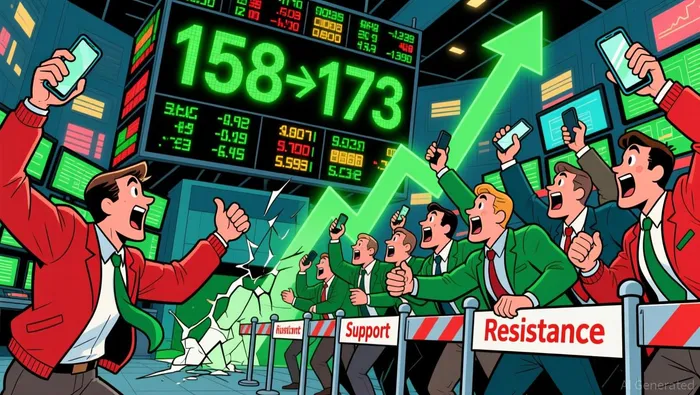 However, a bearish reversal signal, such as a shooting star or evening star, remains absent, suggesting no immediate reversal risk.
Moving Average Theory
The 50-day moving average (calculated from the 1-year data) currently sits at approximately $172.50, with the 100-day and 200-day averages at $169.50 and $166.00, respectively. Vistra’s closing price of $170.12 on March 18 is above all three, indicating a short- to long-term bullish trend. The 50-day line crossing above the 100-day line in early March signals a “golden cross,” further supporting the uptrend. However, the price’s proximity to the 50-day MA ($172.50) suggests a potential consolidation phase if volatility increases.
MACD & KDJ Indicators
The MACD line has crossed above the signal line in mid-March, with a positive histogram expansion, confirming strengthening momentum. The KDJ (Stochastic) oscillator shows K at 85 and D at 75, indicating overbought conditions. While this may suggest a near-term pullback, the alignment of MACD and KDJ with the bullish candlestick pattern implies the uptrend could persist. Divergence between KDJ and price action is absent, reducing the likelihood of an immediate reversal.Bollinger Bands
Volatility has expanded recently, with the bands widening to reflect the sharp March 18 rally. The price closed near the upper band ($173), a typical overbought signal. Historical data shows that the lower band has acted as support around $158–$160. If the current rally stalls, a retest of the upper band or a contraction in volatility could precede a breakout.Volume-Price Relationship
Trading volume has surged during the recent rally, with the March 18 session recording a 3.68 million-share volume, significantly higher than the 2.7 million average in early March. This confirms strong conviction behind the upward move. However, if volume declines during future rallies without price acceleration, it may signal weakening momentum. The positive correlation between volume and price action currently validates the trend’s sustainability.Relative Strength Index (RSI)
The 14-day RSI stands at 68, nearing overbought territory (70). While this suggests a potential correction, RSI divergence is absent, and the recent sharp rise implies the trend may continue. A close below 60 would indicate waning momentum, but given the confluence of bullish indicators, an overbought reading should be interpreted cautiously rather than as a sell signal.Fibonacci Retracement
Applying Fibonacci levels to the recent $152.97–$176.82 range, key retracement levels include 38.2% at $165.50 and 61.8% at $161.50. The current price of $170.12 is above the 50% level ($164.90), suggesting a continuation of the uptrend. A breakdown below $165.50 could trigger a retest of the 61.8% level before resuming the bullish bias.Confluence and Divergences
The most significant confluence occurs at $170.12, where the price aligns with the 50-day MA, a bullish candlestick pattern, and expanding Bollinger Bands. This suggests a high probability of the trend continuing. Conversely, the KDJ overbought signal and RSI near 70 create a potential divergence risk if volume wanes or a bearish reversal forms. No major divergences between indicators currently exist, but traders should monitor for a shooting star or bearish engulfing pattern near $173–$176.82.
Conclusion
Vistra’s technical profile indicates a strong short-term bullish bias supported by multiple indicators. While overbought conditions and expanding volatility warrant caution, the confluence of moving averages, MACD, and volume suggests the uptrend is likely to persist. Key watchpoints include the $170.12 (50-day MA) support and $176.82 resistance. A break below $165.50 or bearish divergence in KDJ/RSI would signal a potential reversal.
Stay ahead of the market.
Get curated U.S. market news, insights and key dates delivered to your inbox.
AInvest
PRO
AInvest
PRO



Comments
No comments yet