
VistaGen's Q2 2026 Earnings Call: Contradictions Emerge on Top Line Data Timelines, PALISADE Enrollment, and CMPV Eligibility
 Aime Summary
Guidance:
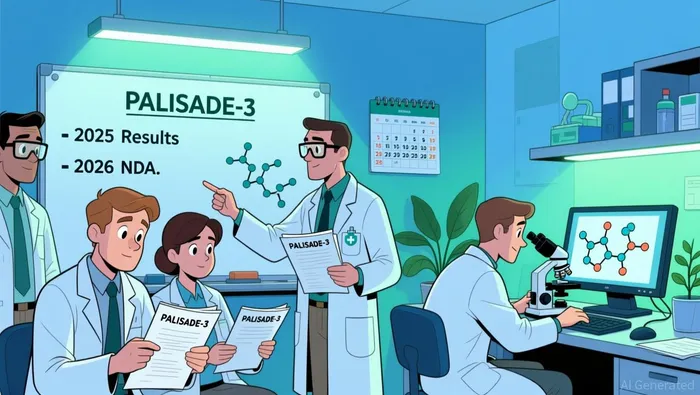
- Top-line PALISADE-3 results to be released before the end of this calendar year.
- PALISADE-4 top-line results expected in the first half of 2026.
- If PALISADE-3 is positive and required pre-NDA elements are complete, an NDA submission could occur around mid-2026.
- $77.2M cash, cash equivalents and marketable securities as of Sept 30, 2025; believed sufficient to cover the ongoing U.S. registration-directed PALISADE program including potential NDA submission.
- Ongoing open-label extension and preparations to advance other pherine programs (itruvone, PH80).
Business Commentary:
* Milestone in PALISADE Program: - The last patient completed the randomized double-blind portion of the PALISADE-3 Phase III trial, with top line results expected by the end of 2025. - This milestone is attributed to the dedicated and experienced clinical investigators, clinical site staff, and contract research organization, who showed enthusiasm and attention to detail throughout the study.- Financial Stability and Cash Burn:
- As of September 30, 2025, Vistagen Therapeutics had
$77.2 millionin cash, cash equivalents, and marketable securities. The company believes current cash covers all known aspects of their ongoing U.S. registration-directed PALISADE program, including potential NDA submission if the PALISADE program is successful.
Board of Directors and Strategic Leadership:
- Mr. Paul Edick joined the Board of Directors at a pivotal time for Vistagen, bringing decades of experience with successful FDA approvals, commercial launches, and strategic transactions.
- This addition will provide valuable leadership as Vistagen prepares for its next phase of growth, following the retirement of Dr. Jerry Jin, who served on the Board from 2016 until September 2025.
- Pipeline and Product Development:
- Vistagen is continuing preparations to advance its broader pherine pipeline, including itruvone for major depressive disorder and PH80 for menopausal hot flashes.
- Both areas represent important unmet needs, and the company is motivated to bring forward innovative nonsystemic neurocircuitry-focused potential treatments to address these needs.
- Top Line Data Readout and Timing:
- The top line data readout from the PALISADE-3 study is expected by the end of 2025, with results including the primary efficacy endpoint (CGI-I) and secondary endpoints (PGI-C).
- The timing is based on the company's projection and previous experiences, and the guidance remains consistent with the initial anticipated timeline.

Sentiment Analysis:
Overall Tone: Positive
- Management repeatedly described momentum and near-term milestones as "potentially transformative," emphasized confidence in delivering top-line PALISADE results this calendar year, highlighted $77.2M in cash to fund the registration program, and welcomed a new board member with regulatory/commercial experience.
Q&A:
- Question from Andrew Tsai (Jefferies): You previously said expect 6–8 weeks after last visit for top-line release — is that still the case or could it come earlier? For the top-line analysis, how should we think about discontinuation rates, protocol violations, and safety — will top line reflect close to enrolled numbers? Also, what were the top reasons for screen failures in PALISADE-3 and are they different from PALISADE-2?
Response: Top-line results will be released before year-end and will include primary (CGI-I), secondary (PGI-C) and customary safety data from the randomized double-blind public speaking challenge; screening/attrition were as modeled and the study met its target enrollment (end target 236).
- Question from Paul Matteis (Stifel): Assuming one of PALISADE-3 or PALISADE-4 is positive, is there anything else gating registration or filing, and how soon could you file?
Response: Standard NDA components (pivotal data, repeat-dose and open-label safety, human factors, preclinical repro/carc studies) and FDA interactions remain, and if PALISADE-3 is positive and everything aligns, an NDA submission could be possible around mid-2026.
- Question from Myles Minter (William Blair): Would fasedienol be eligible for the commissioner’s priority review voucher (CMPV)? Also, clinicaltrials.gov shows termination of sites in Arkansas and Kansas — were those performance related or just due to completing enrollment/wind-down?
Response: Management does not currently expect fasedienol to meet typical CMPV criteria but will reassess if frameworks change; sites were closed mainly for enrollment performance or as part of a planned wind-down toward study completion.
- Question from Elemer Piros (Lucid Capital Markets): Any indications on usage patterns from PALISADE-2 or the OLE up to 1 year? Do you see differences in open-label entry rates between PALISADE-2 and PALISADE-3 (what percentage enter OLE)? What minimal effect size on SUDS/CGI would be clinically meaningful? And have you thought about commercialization strategy (go alone vs partner)?
Response: Open-label data show utilization concentrated during weekdays/work hours (less on weekends); company declined to give OLE entry percentages, aims to replicate PALISADE-2 clinical and statistical effects (assessed across SUDS, CGI-I and PGI-C), and is maintaining optionality on commercialization with in-house capabilities and potential strategic partnerships.
Contradiction Point 1
Top Line Data Release Timeline
It impacts investor expectations regarding the timing of key data release, which could affect the company's development and regulatory milestones.
Will the top-line data readout occur within 6-8 weeks post-last visit? Could it arrive earlier? - Lin Tsai (Jefferies)
20251114-2026 Q2: Our guidance is that we'll see top line results released before the end of this calendar quarter, so by the end of this calendar year. - [Shawn Singh](CEO)
How many weeks until the top line data is reported? - Lin Tsai (Jefferies LLC, Research Division)
2025Q4: From database lock to top line data, it typically takes around 6 weeks, with a range of 6 to 8 weeks. - [Shawn K. Singh](CEO)
Contradiction Point 2
PALISADE Study Eligibility and Enrollment Challenges
It involves the company's strategy for managing enrollment and eligibility requirements in the PALISADE studies, impacting clinical trial execution and regulatory submissions.
What were the primary reasons for patient screening failures in PALISADE-3, and do they differ from PALISADE-2? - Lin Tsai (Jefferies)
20251114-2026 Q2: The reason that we made enhancements to the PALISADE-3 and 4 studies was to make sure that there's very high-quality assessment for subject eligibility. - [Shawn Singh](CEO)
What caused the modest delay in PALISADE-4's timeline? - Julian Pino (Stifel, Nicolaus & Company, Incorporated, Research Division)
2025Q4: Regarding PALISADE-4, enhancements were made to limit variability and improve study execution, leading to more stringent subject eligibility requirements and a secondary subject eligibility review. - [Shawn K. Singh](CEO)
Contradiction Point 3
Enrollment Completion and Timeline
It involves the expected timeline for completion of enrollment in the PALISADE-3 study, which is critical for the company's clinical development plans and investor expectations.
Assuming success with either PALISADE-3 or -4, what is blocking registration/filing? How soon can you file? - Matthew (Stifel)
20251114-2026 Q2: We are on track to complete enrollment this quarter with top line results released before the end of this year. - [Shawn Singh](CEO)
What is the current enrollment status for PALISADE-4? Will you adjust PALISADE-4's design based on PALISADE-3 findings? - Myles Minter (William Blair & Company L.L.C, Research Division)
2026Q1: We expect to complete enrollment this quarter with top line results expected to be reported in Q4. - [Joshua Prince](COO)
Contradiction Point 4
CMPV Eligibility
It involves the company's stance on the eligibility of fasedienol for the Commissioner's Priority Review Voucher (CMPV), which could potentially impact regulatory strategies and resource allocation.
Assuming either PALISADE-3 or PALISADE-4 works, are there other factors gating registration or filing? How soon can you file? - Matthew (Stifel)
20251114-2026 Q2: While we don't expect that fasedienol falls within the typical scope of the CMPV programs, we believe the magnitude of unmet need is significant. If regulatory pathways evolve or additional guidance creates a relevant framework, we'll evaluate it at the appropriate time. - [Shawn Singh](CEO)
What other metrics are measured in the open-label phase besides safety? Can you comment on the Neuphoria program in SAD? - Unidentified Analyst (Lucid)
2026Q1: The CMPV program was certainly something we looked at. While we're not looking for it now, we're on the radar for it. If we need an additional tool, we'll use CMPV if it's available. - [Joshua Prince](COO)
Contradiction Point 5
Screen Failures and Study Execution
It addresses the reasons behind screen failures in the PALISADE-3 study, which can impact study recruitment and conduct.
What were the primary reasons for patient screen failures in PALISADE-3, and do they differ from PALISADE-2? - Lin Tsai (Jefferies)
20251114-2026 Q2: The reason that we made enhancements to the PALISADE-3 and 4 studies was to make sure that there's very high-quality assessment for subject eligibility. We've seen generally what we've expected to see and as we've modeled forward for not only screen fail, but also attrition rates throughout the course from enrollment through randomization through the end of the study. - [Shawn Singh](CEO)
Can you elaborate on the design of PALISADE-4 and the causes for slower patient recruitment? - Myles Minter (William Blair & Company L.L.C, Research Division)
2026Q2: PALISADE-3 is actually a very straightforward study with 3 arms. The primary objective is to evaluate the superiority of 50 milligram fasedienol versus placebo, and we have a 25 milligram fasedienol active control. The reason we have active control is because -- we've done a large Phase 2 study, PALISADE-2, where we compared fasedienol against placebo, and we wanted to better understand the relative efficacy of fasedienol versus a different active control. - [Shawn Singh](CEO)

Descubre qué cosas son las que los ejecutivos no quieren revelar durante las llamadas de conferencia.
Latest Articles
Stay ahead of the market.
Get curated U.S. market news, insights and key dates delivered to your inbox.
AInvest
PRO
AInvest
PRO



Comments
No comments yet