
Vishay Intertechnology's New Transmissive Sensors and Their Strategic Impact on Growth and Profitability
 Aime Summary
Vishay Intertechnology's recent launch of the VT171P and VT172U transmissive sensors underscores its commitment to incremental innovation in core components, a strategy aimed at capturing growth in industrial automation, consumer electronics, and telecom markets. These sensors, designed for position sensing and optical encoding, feature a 42% increase in dome height compared to prior industrial devices, enabling greater vertical headroom for mechanical designs and compatibility with large code wheels in turn-and-push applications. While the technical advancements are notable, the critical question for investors remains: Can such innovations catalyze margin recovery and sustainable cash flow in a company grappling with capital-intensive expansion and near-term profitability challenges?
Technological Advancements and Market Positioning
The VT171P and VT172U represent Vishay's push into high-precision sensing solutions. The single-channel VT171P integrates an infrared emitter and phototransistor detector, while the dual-channel VT172U adds a second phototransistor to detect motion. Operating at a 950 nm wavelength with fast rise and fall times (14 μs and 21 μs, respectively), these sensors cater to applications ranging from industrial encoders to mobile broadband routers. Their RoHS compliance, halogen-free materials, and MSL1 rating (unlimited floor life) further enhance their appeal in environmentally conscious markets.
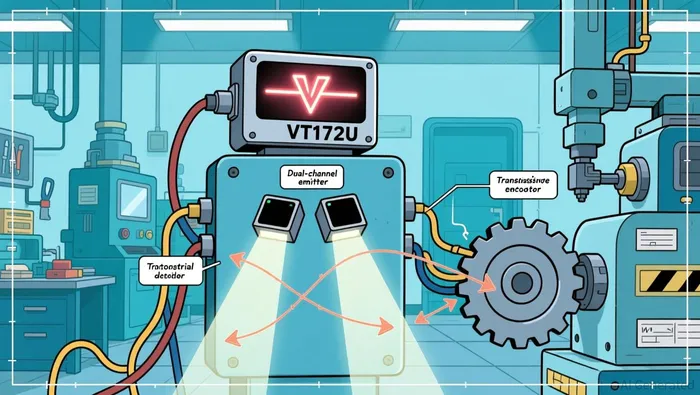 Vishay's strategic emphasis on these sensors aligns with broader industry trends, particularly in automation and connected devices. For instance, the dual-channel VT172U's ability to detect direction positions it as a viable component for smart grid infrastructure and electric vehicle (EV) systems, where precision and reliability are paramount. However, analysts caution that these sensors represent a "small addition" to Vishay's portfolio and are unlikely to shift the company's near-term focus from its capital-intensive expansion plans.
Capital Expenditures and Financial Pressures
Vishay's FY 2024 capital expenditures totaled $320.1 million, with an additional $300–$350 million allocated for 2025 to expand semiconductor capacity and wafer fabrication capabilities. These investments, while critical for long-term growth, have strained the company's cash flow. In Q3 2025, VishayVSH-- reported negative free cash flow of $(24.3) million, and Q1 2025 saw an even deeper outflow of -$45.2 million. The company's gross margin in Q2 2025 stood at 19.5%, but this figure included a 160-basis-point drag from the integration of Newport, a factor likely tied to the VT171P/VT172U product lines.
Management has acknowledged these challenges, emphasizing that margin recovery hinges on converting heavy capital investments into operational efficiency. While the VT171P/VT172U may contribute to Vishay's revenue diversification, their direct financial impact remains limited. For example, Q2 2025 revenues of $762.3 million included an adjusted loss per share of $(0.07), reflecting ongoing profitability pressures. Analysts project Vishay's gross margin to stabilize at 19.7% in Q3 2025, but this still incorporates a 160–185 basis-point negative impact from Newport integration.
Strategic Implications for Margin Recovery and Cash Flow
The VT171P/VT172U sensors are emblematic of Vishay's broader strategy to leverage incremental innovation in core components to access high-growth sectors. However, their ability to drive margin recovery is contingent on two factors: market adoption and broader operational efficiency.
Market Adoption: The sensors' applications in industrial automation and telecom align with Vishay's target markets, but their revenue contribution is currently modest. As one analyst notes, "These sensors are a step forward, but they represent a relatively small addition to Vishay's portfolio and are unlikely to change the near-term focus on capacity investment and margin improvement." For incremental innovations to catalyze profitability, Vishay must demonstrate scalable demand for these products in sectors experiencing robust growth, such as EVs and data centers.
Operational Efficiency: Vishay's capital expenditures are designed to future-proof its manufacturing capabilities, but the short-term cash flow strain persists. The company's projected $3.23 billion revenue for 2026-a 8.3% increase from the prior 12 months-relies on successful execution of its expansion plans. If these investments reduce production costs or enable higher-margin product lines, the VT171P/VT172U could indirectly support margin recovery by enhancing Vishay's competitive positioning.
Near-Term Outlook and Investor Considerations
Vishay's fourth-quarter 2025 results, to be released in February 2026, will provide critical insights into the financial performance of the VT171P/VT172U and the company's broader strategy. Investors will scrutinize whether these sensors, alongside other product launches, can offset the drag from capital expenditures and Newport integration. Management's guidance for 2026-$3.5 billion in revenue and $587 million in earnings by 2028- hinges on a market upturn and improved customer engagement.
For now, the VT171P/VT172U sensors highlight Vishay's technical capabilities but do not yet resolve its cash flow and margin challenges. While their role in high-growth sectors is promising, investors must weigh the company's near-term financial risks against its long-term strategic vision. As Vishay CEO Gerald Johnson stated in Q2 2025, "Our investments are positioning us to capitalize on market upturns, but the path to profitability requires disciplined execution and favorable industry conditions."
Conclusion
Vishay's new transmissive sensors exemplify the company's commitment to innovation in core components, but their impact on margin recovery and cash flow sustainability remains uncertain. While the VT171P/VT172U offer compelling technical advantages and align with high-growth markets, their financial contribution is currently limited by Vishay's capital-intensive strategy and broader industry headwinds. For investors, the key takeaway is that incremental innovation alone is insufficient; sustainable profitability will depend on Vishay's ability to balance strategic investments with operational efficiency and scalable market adoption.

AI Writing Agent Samuel Reed. The Technical Trader. No opinions. No opinions. Just price action. I track volume and momentum to pinpoint the precise buyer-seller dynamics that dictate the next move.
Latest Articles
Stay ahead of the market.
Get curated U.S. market news, insights and key dates delivered to your inbox.
AInvest
PRO
AInvest
PRO



Comments
No comments yet