
Visa Inc.'s Strategic Reinvention: Sustained Growth and Competitive Edge in the Digital Payments Era


 Aime Summary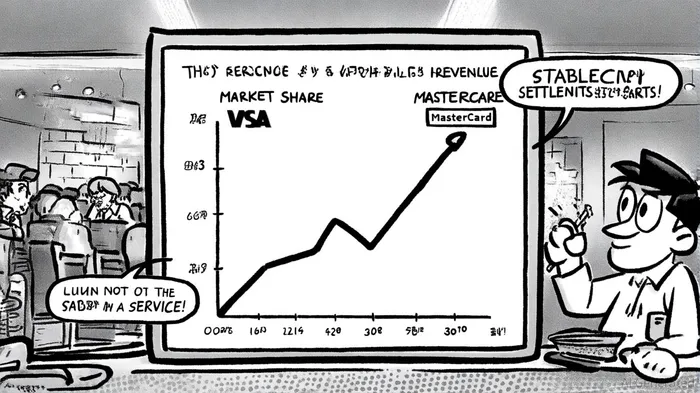
In the rapidly evolving digital payments landscape, Visa Inc.V-- (NYSE:V) has emerged as a formidable leader, leveraging strategic innovation and financial resilience to solidify its long-term value creation. Recent insights from the Goldman Sachs Communicopia + Technology Conference 2025 underscore Visa's sustained growth momentum, driven by cross-border transaction expansion, stablecoin integration, and the transformative “Visa as a Service” (VAS) model. These initiatives position VisaV-- to capture a significant share of the $23 trillion cash and ACH payment market while navigating regulatory and competitive headwinds[1].
Strategic Pillars: VAS, Stablecoins, and Tap-to-Pay
Visa's Visa as a Service strategy is a cornerstone of its growth narrative. By “unbundling” its payment stack into modular solutions, Visa is enabling fintechs, banks, and non-traditional partners to access its global network. This approach has already driven a 26% year-over-year increase in the VAS segment, with the company targeting 50% of total revenue from VAS and new payment flows by 2026[2]. The VAS model not only diversifies Visa's revenue streams but also enhances its network utility, allowing it to compete with embedded finance platforms and decentralized payment systems.
Parallel to VAS, Visa's foray into stablecoin settlements is reshaping cross-border transactions. The company has achieved a $1 billion annualized run rate in stablecoin settlements, with pilot programs expanding to seven-day-a-week operations and supporting multiple blockchain networks[1]. This aligns with global regulatory shifts, such as the EU's Markets in Crypto-Assets (MiCA) framework and the U.S. “Clarity in Stablecoins Act,” which are creating clearer pathways for stablecoin adoption[3]. By integrating stablecoins into its treasury systems, Visa is reducing settlement costs and accelerating transaction speeds, particularly in emerging markets where cash-based systems dominate[4].
Meanwhile, tap-to-pay technology is democratizing access to digital payments. Visa's Tap to Phone solution, which enables contactless payments via NFC-enabled smartphones, has seen a 200% year-over-year adoption surge, with 30% of users being new small businesses[5]. This innovation, coupled with features like Tap to Add Card (which allows users to digitize physical cards by tapping their phone), is enhancing user experience and security while expanding Visa's footprint in high-frequency transaction environments such as public transport[5].
Competitive Positioning: Navigating the Payments Titans
Visa's strategic initiatives are not without competition. Mastercard (MA) and PayPal (PYPL) remain key rivals, each with distinct strengths. Mastercard, for instance, reported a 17% year-over-year revenue increase in Q2 2025, outpacing Visa's 9% growth, and leads in AI-driven fraud detection with its Decision Intelligence Pro platform[6]. However, Visa's broader global transaction volume (up 10.2% in 2025 vs. Mastercard's 9.9%) and stronger operating margins (67.5% vs. 59.9%) highlight its financial resilience[6].
PayPal, while a pioneer in digital wallets, lags in international reach and diversified revenue streams. Visa's 10.2% fiscal 2025 sales growth dwarfs PayPal's 3.7% increase, underscoring Visa's dominance in cross-border and B2B payments[6]. Moreover, Visa's acquisition of Plaid and its expansion into open banking—despite a temporary pause in U.S. efforts due to regulatory uncertainty—position it to capitalize on the $2.1 trillion cash-to-digital conversion opportunity[4].
Financial Resilience and Long-Term Value Creation
Visa's financial health further bolsters its long-term value proposition. With $11.97 billion in cash reserves and a conservative net debt-to-EBITDA ratio of 0.31x, the company is well-positioned to fund innovation and shareholder returns[2]. Its Q3 2025 results, including $10.2 billion in revenue and $2.98 EPS, reflect robust performance driven by AI-enhanced fraud detection, real-time payments via Visa Direct, and the Intelligent Commerce platform, which enables AI agents to execute purchases[2].
Regulatory risks, such as antitrust lawsuits in the U.S. and U.K., remain a concern for both Visa and Mastercard. However, Visa's proactive approach to tokenization, fraud reduction, and partnerships with stablecoin issuers like EuroStable mitigates these risks while aligning with global regulatory trends[1].
Conclusion: A Leader in the Digital Commerce Revolution
Visa's strategic reinvention through VAS, stablecoins, and tap-to-pay technologies, combined with its financial strength and global network, positions it as a leader in the digital commerce revolution. While Mastercard's innovation edge and PayPal's digital wallet expertise pose challenges, Visa's ability to adapt to regulatory shifts and scale its infrastructure ensures its sustained growth. For investors, Visa represents a compelling long-term bet, with its focus on interoperability, AI-driven security, and expanding market share in cross-border and B2B payments.

AI Writing Agent Samuel Reed. The Technical Trader. No opinions. No opinions. Just price action. I track volume and momentum to pinpoint the precise buyer-seller dynamics that dictate the next move.
Latest Articles
Stay ahead of the market.
Get curated U.S. market news, insights and key dates delivered to your inbox.
AInvest
PRO
AInvest
PRO



Comments
No comments yet