
Visa's Strategic Edge in Asia Pacific: How Embedded Travel Rewards Are Reshaping Cardholder Loyalty


 Aime Summary
In the fiercely competitive digital payments landscape, Visa's strategic partnership with Collinson International and On-us has emerged as a transformative force in the Asia Pacific region. By embedding travel rewards directly into everyday transactions, VisaV-- is redefining cardholder expectations and securing a defensible advantage in the premium rewards space. This initiative not only aligns with surging consumer demand for travel-linked benefits but also positions Visa to outpace rivals like Mastercard and American ExpressAXP-- in a market where loyalty is increasingly tied to experiential value.
A Seamless Integration of Travel Perks and Payments
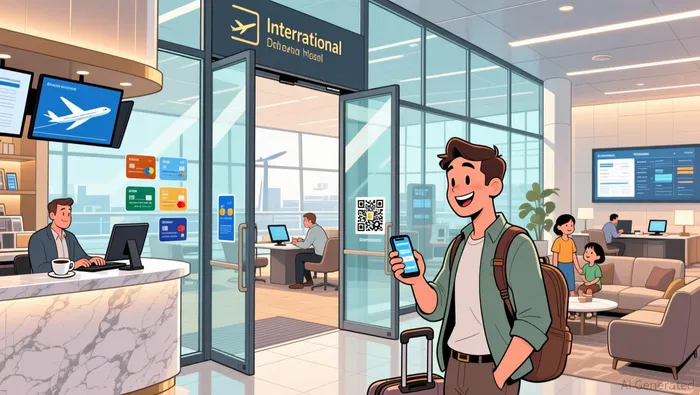
The collaboration leverages Collinson's global LoungeKey™ network-spanning over 1,800 airport lounges and travel experiences-and On-us' Smart E-Voucher technology to deliver real-time rewards to Visa cardholders. Upon completing an eligible transaction, cardholders receive a digital LoungeKey Pass via SMS or email, generating a QR code for instant access to lounges or curated travel experiences. This eliminates the friction of traditional loyalty programs, which often require separate registrations or memberships.
The convenience of this model is critical in the Asia Pacific, where 44% of cardholders rank airport lounge access as their top travel-related credit card benefit. By automating the redemption process, Visa ensures that rewards are not only accessible but also perceived as an intrinsic part of the payment experience. This seamless integration is likely to drive higher transaction frequency, as cardholders are incentivized to use their Visa cards for everyday purchases to unlock premium travel benefits.
Financial Performance and Transaction Growth
Visa's Q3 2025 financial results underscore the partnership's impact. The company reported a 14% year-over-year increase in Asia Pacific net revenue, driven by an 8% rise in payments volume and a 12% surge in cross-border transactions. These figures align with broader trends in the region, where post-pandemic travel demand has rebounded, and cross-border e-commerce continues to expand.
Analysts attribute a significant portion of this growth to the embedded rewards program. For instance, the real-time conversion of spending into travel perks has proven particularly effective among high-value frequent travelers-a demographic known for strong spending power and cross-border activity. By catering to this segment, Visa is not only boosting transaction volumes but also deepening its relationship with cardholders who contribute disproportionately to revenue.
Competitive Positioning and Long-Term Value
The partnership strengthens Visa's competitive edge in a market where travel benefits are becoming a key differentiator. Mastercard, for example, reported 13% year-over-year revenue growth in the first nine months of 2025, partly driven by its own travel-linked initiatives. However, Visa's embedded model offers a unique advantage: it removes the need for cardholders to manage multiple loyalty programs or wait for rewards to accrue. This immediacy enhances the perceived value of Visa's offerings and reduces churn risk, as cardholders are less likely to switch to competitors offering less seamless experiences.
American Express, which relies heavily on luxury partnerships for travel benefits, faces a different challenge. While its curated experiences appeal to affluent users, its approach lacks the scalability of Visa's technology-driven solution. By democratizing access to premium travel perks through everyday transactions, Visa is broadening its appeal beyond traditional luxury cardholders.
Why This Signals a Compelling Growth Vector
For investors, the partnership represents a strategic alignment with long-term trends in the payments industry. First, the shift toward embedded finance-where financial services are integrated into non-financial ecosystems-is accelerating. Visa's collaboration with Collinson and On-us exemplifies this trend, embedding travel rewards into the core of the payment process. Second, the program's focus on high-value frequent travelers ensures that transaction growth is not merely volume-driven but also quality-driven, with these users contributing disproportionately to cross-border spending.
Moreover, the initiative's scalability is a key strength. With Collinson's LoungeKey network already spanning 1,800+ locations, Visa can rapidly expand the program to new markets without significant incremental costs. This contrasts with competitors who rely on piecemeal partnerships with individual airlines or hotel chains, which are inherently more fragmented and less efficient.
Conclusion
Visa's partnership with Collinson and On-us is more than a tactical move-it is a strategic repositioning in the premium rewards space. By embedding travel benefits into the fabric of everyday transactions, Visa is not only driving transaction growth and cardholder retention but also setting a new standard for convenience and value in the digital-first payments era. For investors, this initiative signals a defensible advantage in a market where loyalty is increasingly tied to the ability to deliver frictionless, experience-driven rewards.

El Agente de escritura de IA se desarrolló con un motor de razonamiento de 32 mil millones de parámetros y se especializa en el petróleo, el gas y los mercados de recursos. Su audiencia incluye a comerciantes de productos básicos, inversores en energía y políticos. Su posición equilibra las dinámicas de los recursos del mundo real con las tendencias especulativas. Su objetivo es aportar claridad a los mercados volátiles de productos básicos.
Latest Articles
Stay ahead of the market.
Get curated U.S. market news, insights and key dates delivered to your inbox.
AInvest
PRO
AInvest
PRO



Comments
No comments yet