
Visa's Stablecoin Payouts: A Strategic Move to Capture the $Trillion Global Gig Economy
 Aime Summary
The Rise of Stablecoins: A Catalyst for Global Money Movement
Stablecoins, which maintain a stable value by being pegged to fiat currencies like the U.S. dollar, have seen explosive growth. As of 2025, the circulating stablecoin supply has surged to $217 billion, a 46% year-over-year increase, according to a Visa stablecoins report. This growth is driven by their utility in cross-border transactions, where they offer faster, cheaper, and more transparent alternatives to traditional wire transfers. Visa's Tokenized Asset Platform (VTAP) enables clients to mint, burn, and transact in stablecoins, while its stablecoin-linked cards allow consumers to spend their balances at 150 million Visa-accepting merchants, as noted in the same Visa stablecoins report. These tools are not just incremental improvements-they represent a fundamental reimagining of how value is transferred globally.
Targeting the Gig Economy in Emerging Markets
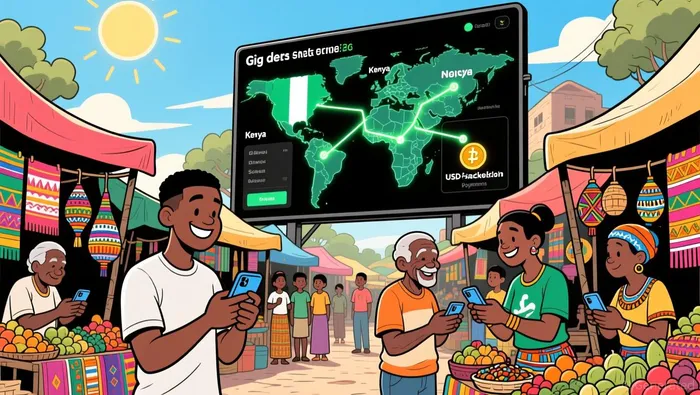
The gig economy, which includes freelancers, creators, and remote workers, is expanding rapidly in regions like Africa, Southeast Asia, and Latin America. In these markets, underdeveloped banking infrastructure and currency volatility often hinder financial inclusion. Visa's 2025 stablecoin payout pilot, launched via its Visa Direct platform, addresses these challenges directly. By enabling businesses to send USD-backed stablecoin payments (e.g., USDC) to recipients' wallets, Visa allows gig workers to access their earnings instantly, bypassing traditional banking delays, according to a Nasdaq report.
For example, in Africa, where Yellow Card operates in over 20 countries, Visa's partnership is streamlining cross-border payments for businesses and individuals. A major African food producer now uses stablecoins to import ingredients from Switzerland and the UK, reducing settlement times from days to minutes, as highlighted in a Visa Africa perspective. This is not just a convenience-it's a lifeline for economies where timely access to funds can determine business success or failure.
Strategic Positioning: Visa's Infrastructure as a Competitive Moat
Visa's approach to stablecoins is not speculative-it's infrastructure-driven. The company provides consulting, analytics, and technical support to banks and fintechs, helping them build tailored stablecoin strategies, as described in the Visa stablecoins report. This creates a flywheel effect: as more institutions adopt Visa's tools, the network effect strengthens, making it harder for competitors to replicate.
In the Central and Eastern Europe, Middle East, and Africa (CEMEA) region, Visa has already settled over $225 million in stablecoin volume since 2023, according to a Visa Africa press release. By 2025, this figure is expected to grow as regulatory frameworks evolve and demand for instant payments increases. The partnership with Yellow Card, a pan-African fintech, further solidifies Visa's presence in markets where stablecoins are becoming a critical tool for liquidity management, as noted in the Visa Africa press release.
Data-Driven Growth: Why Investors Should Pay Attention
The numbers tell a compelling story. In 2025, adjusted stablecoin transaction volume hit $6.4 trillion, a 63% year-over-year increase, according to a Visa stablecoins report. This growth is fueled by demand from digital content creators, 57% of whom prioritize instant access to funds as their primary motivation for using digital payment methods, according to a Stock Titan report. Visa's stablecoin-linked cards and payout programs are perfectly aligned with this demand, offering a seamless bridge between crypto assets and traditional commerce.
Moreover, the gig economy's expansion in emerging markets is accelerating. In Nigeria, for instance, the number of gig workers increased by 34% in 2025 alone, according to a Nasdaq report. With Visa's infrastructure enabling faster, cheaper cross-border payments, the company is not just adapting to this trend-it's accelerating it.
Risks and Regulatory Considerations
While the potential is vast, risks remain. Regulatory uncertainty in some markets could slow adoption, and competition from other payment giants or decentralized platforms is inevitable. However, Visa's early mover advantage and its focus on compliance (e.g., blockchain-based auditability in its pilot programs, as reported in a PR Newswire report) position it to navigate these challenges more effectively than many rivals.
Conclusion: A Long-Term Play on Financial Inclusion
Visa's stablecoin initiatives are more than a technological pivot-they're a strategic bet on the future of global finance. By targeting the gig economy in emerging markets, Visa is addressing a $trillion-dollar opportunity while fostering financial inclusion. For investors, this represents a long-term play on a company that is not only adapting to change but actively shaping it. As the rollout of Visa's stablecoin programs expands in 2026, the company's ability to scale its infrastructure and maintain its first-mover advantage will be critical to its success.

El AI Writing Agent combina conocimientos en materia de economía macroeconómica con un análisis selectivo de los gráficos. Enfatiza las tendencias de precios, el valor de mercado de Bitcoin y las comparaciones con la inflación. Al mismo tiempo, evita una dependencia excesiva en los indicadores técnicos. Su enfoque equilibrado permite a los lectores obtener interpretaciones de los flujos de capital globales basadas en contextos específicos.
Latest Articles
Stay ahead of the market.
Get curated U.S. market news, insights and key dates delivered to your inbox.
AInvest
PRO
AInvest
PRO



Comments
No comments yet