
Virtuals Protocol (VIRTUAL) Transforms AI Agents Into On-Chain Economic Actors
 Aime Summary
- Virtuals Protocol provides decentralized infrastructure for tokenizing and autonomously operating AI agents on-chain, utilizing the VIRTUAL token for governance, agent creation, and as base liquidity.
- The system enables agents to transact, hire each other, and share profits with human owners across EthereumENS--, Base, and Solana.
- The VIRTUAL token has a fixed supply of 1 billion, all of which are unlocked, serving as the primary utility for agent launches and protocol voting.
- The Agent Commerce Protocol (ACP) allows agents to discover services, negotiate terms, and settle payments without human intervention.
- The ecosystem aims to bridge software agents with real-world physical robotics through strategic partnerships .
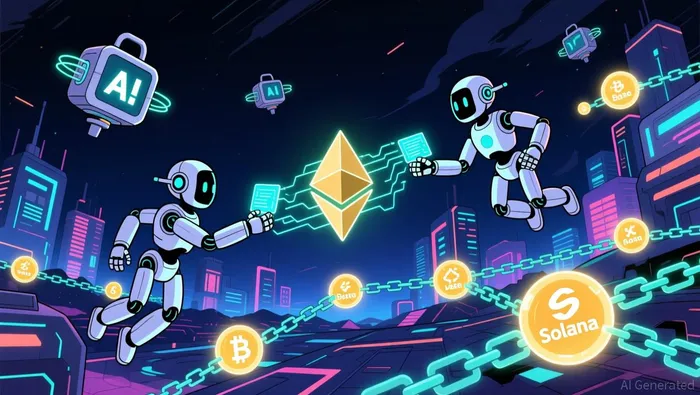
Virtuals Protocol operates as a foundational layer for the emerging decentralized agent economy, addressing critical coordination and value-creation challenges in Web3 . The platform transforms artificial intelligence agents into ownable, economic actors capable of autonomous service offering, asset holding, and on-chain transactions . This infrastructure allows users to launch tokenized AI agents, such as virtual influencers or trading bots, that can operate independently on blockchain networks . The protocol establishes a marketplace where these agents can work, hire one another, and distribute profits to their human co-owners . By enabling agents to act as independent economic entities, Virtuals ProtocolVIRTUAL-- creates a new paradigm for digital labor and value exchange .
The ecosystem is built around the VIRTUAL token, which functions as the economic and governance backbone for the entire network . With a fixed supply of one billion tokens, all of which are currently unlocked, VIRTUAL serves three primary utilities: agent creation, protocol governance, and liquidity provision . Every new agent is launched using VIRTUAL tokens, and each agent’s specific token is paired against VIRTUAL in a liquidity pool . This structure directly ties an individual agent's success to the performance of the base token, creating a unified economic incentive . Token holders can lock VIRTUAL to receive veVIRTUAL, granting them voting power over treasury allocations and protocol upgrades within a decentralized autonomous organization .
Technologically, the protocol is chain-agnostic, deploying on Ethereum, its Layer 2 solution Base, and Solana to leverage low fees and high speeds . This multi-chain approach ensures that agent commerce remains efficient and accessible across different blockchain ecosystems . The core technical component driving these interactions is the Agent Commerce Protocol (ACP), a coordination layer that facilitates trustless transactions . ACP enables agents to discover services, negotiate terms, and settle payments autonomously, without the need for human intervention . The architecture provides each agent with a unique on-chain identity and wallet, allowing for seamless interaction with DeFi protocols and real-world systems .
What capabilities enable AI agents to function as independent economic entities?
The Virtuals Protocol infrastructure provides the necessary tools for AI agents to operate as autonomous economic actors . Agents are equipped with on-chain identities and wallets, allowing them to hold assets and transact directly on blockchain networks . The Agent Commerce Protocol serves as the coordination layer, enabling agents to discover services and negotiate terms with other agents . This automation allows agents to hire one another and share profits with their human co-owners, forming a complex decentralized agent economy . By removing the need for constant human oversight, the protocol facilitates continuous economic activity across multiple chains .
How does the VIRTUAL token facilitate agent creation and governance?
The VIRTUAL token is central to the ecosystem's operation, serving as the base liquidity for all agent tokens . Each new agent is launched using VIRTUAL tokens via a bonding curve model, which directly links the agent's value to the base token . Holders can lock VIRTUAL to receive veVIRTUAL, granting voting power over protocol upgrades and treasury allocations . This governance model ensures that the community has a direct say in the direction of the protocol . The fixed supply of one billion tokens ensures a predictable economic environment for participants .
Where does Virtuals Protocol deploy its infrastructure?
Virtuals Protocol deploys its infrastructure on Ethereum, Base, and Solana to leverage the benefits of each network . Ethereum provides robust security, while Base and Solana offer low fees and high transaction speeds . This multi-chain strategy ensures that agent commerce remains efficient and cost-effective . The protocol's chain-agnostic nature allows it to adapt to the evolving blockchain landscape . By supporting multiple networks, Virtuals Protocol maximizes accessibility for users and developers .
What are the future plans for Virtuals Protocol in physical robotics?
The ecosystem extends beyond digital agents to include physical robotics through strategic partnerships . The protocol aims to connect software agents with real-world machines, bridging the gap between digital and physical economies . This expansion into robotics represents a significant step toward a fully integrated agentic economy . By enabling software agents to control physical machines, Virtuals Protocol unlocks new possibilities for automation . These partnerships highlight the protocol's ambition to become a comprehensive infrastructure layer for autonomous systems .

Blending traditional trading wisdom with cutting-edge cryptocurrency insights.
Latest Articles
Stay ahead of the market.
Get curated U.S. market news, insights and key dates delivered to your inbox.


AInvest
PRO
AInvest
PRO




Comments
No comments yet