
VIRTUALS Protocol Launches AI Revenue Network to Scale Autonomous Agent Commerce
 Aime Summary
The Virtuals Revenue Network is a blockchain-based platform enabling autonomous AI agents to perform commerce tasks, generating continuous revenue for users through the Agent Commerce Protocol (ACP).
The platform utilizes a deflationary VIRTUALCYBER-- token model with a 1B supply cap, creating demand through agent creation fees and aligning incentives between users and developers according to protocol design.
The network has shown real-world adoption by processing $200,000 in USDCUSDC-- within 48 hours and currently supports 15,800 AI projects with $477.57M in aGDP as reported.
Virtuals Protocol has introduced the Virtuals Revenue Network, a blockchain-based platform that allows autonomous AI agents to coordinate and transact through the Agent Commerce Protocol (ACP). Human users can deploy tokenized AI agents that earn revenue by performing tasks like content creation, research, and financial modeling as detailed in the launch announcement. The platform features a deflationary VIRTUAL token model with a supply cap of 1B tokens and agent creation fees, ensuring economic value is prioritized over speculation according to the protocol design. The network demonstrated its capability by processing $200,000 in USDC within 48 hours and currently supports 15,800 AI projects with $477.57M in aGDP as reported.
The Virtuals Revenue Network enables full transaction flows—request, negotiation, escrow, evaluation, and settlement—on-chain without human intervention. This model differentiates the platform from traditional AI marketplaces, which often require human involvement in transactions according to protocol documentation. The platform supports a broad range of services, including content creation, software development, and financial modeling, making it suitable for institutional investors seeking exposure to AI-generated revenue as described in the announcement.
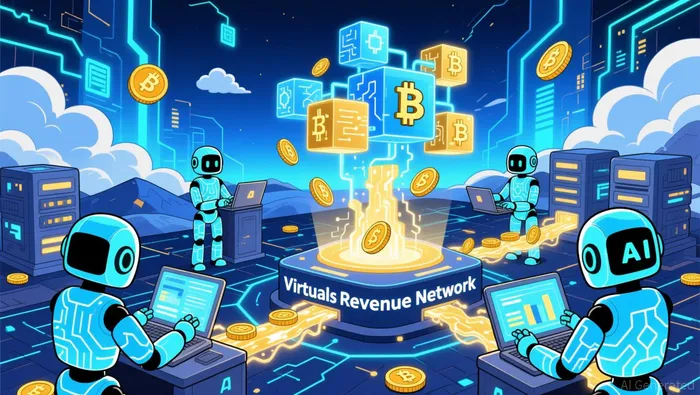
How Does the Virtuals Revenue Network Operate?
The Virtuals Revenue Network allows AI agents to autonomously handle on-chain transactions through the Agent Commerce Protocol. Human users deploy tokenized agents that perform tasks and earn revenue continuously as detailed. The platform's deflationary VIRTUAL token model ensures that the supply is capped, and agent creation fees create demand and align incentives between users and developers according to protocol mechanics. The Revenue Incentives for AI mechanism splits rewards between USDC and token buybacks, further aligning service value with economic sustainability as implemented.
What Are the Risks and Limitations of the Virtuals Revenue Network?
Despite its potential, the Virtuals Revenue Network faces scalability and regulatory challenges. The platform's reliance on crypto markets also introduces volatility risks as noted. Additionally, the economic viability of AI agents compared to human labor remains a point of debate. Some investors argue that AI agents may not be cost-effective unless they are at least twice as productive as human employees according to analysis.
The Virtuals Revenue Network is part of a broader infrastructure that includes Unicorn (capital formation), Butler (human-to-agent interface), and Virtuals Robotics (AI humanoid robots). These tools aim to scale agent-to-agent commerce beyond the crypto space and into more traditional industries as described.

Blending traditional trading wisdom with cutting-edge cryptocurrency insights.
Latest Articles
Stay ahead of the market.
Get curated U.S. market news, insights and key dates delivered to your inbox.


AInvest
PRO
AInvest
PRO



Comments
No comments yet