
Virtuals Protocol Drives $200M Trading Volume on Robinhood Chain
 Aime Summary
- Virtuals Protocol has facilitated over $200 million in agent trading volume on Robinhood Chain within three weeks of its integration in early July 2026.
- The platform has deployed more than 5,600 autonomous AI agents that perform functions ranging from DeFi yield optimization to data-driven prediction markets.
- Hyperboost, launched on July 27, 2026, distributes daily token rewards for 14 days to mitigate the common industry issue of rapid volume decay post-launch.
- The VIRTUAL token, with a fixed supply of 1 billion, anchors the ecosystem by enabling agent creation, governance, and liquidity provision across multiple blockchains.
Virtuals Protocol has rapidly established itself as a central infrastructure layer for the creation, tokenization, and monetization of autonomous AI agents. By integrating with Robinhood Chain, an Arbitrum-based Layer 2 network, the protocol has demonstrated the viability of scalable blockchain solutions for high-frequency agent interactions. Since its integration in early July 2026, the platform has facilitated over $200 million in agent trading volume and supported the deployment of more than 5,600 autonomous AI agents. This rapid adoption highlights the strong market demand for automated, AI-assisted financial tools on networks that offer lower transaction costs while maintaining Ethereum-level security.
The core innovation driving this activity is the Agent Commerce Protocol (ACP), which allows AI agents to operate as independent economic entities. These agents can discover services, negotiate terms, and settle payments on-chain without human intervention, transforming them from simple tools into revenue-generating actors. The ecosystem includes a variety of agents, such as virtual influencers like Luna and market intelligence platforms like aixbtAIXBT--, which generate revenue shared with their co-owners. Additionally, the platform has raised $2.7 million in builder funding to support the development of these autonomous entities.
Robinhood Chain provides the necessary infrastructure for this agent economy by leveraging Arbitrum’s security while offering the low-cost, high-speed transactions required for DeFi automation. The emergence of agent-specific tokens, such as $GTR and $PRIZE, has created a layered token economy where individual AI agents possess their own tradeable assets. The VIRTUAL token serves as the primary utility and governance asset, with approximately 657.5 million tokens in circulation out of a fixed supply of 1 billion. Token holders can lock VIRTUAL to receive veVIRTUAL, granting voting power over treasury allocations and protocol upgrades within the DAO structure.
To address the common industry challenge of volume decay, Virtuals ProtocolVIRTUAL-- launched Hyperboost on July 27, 2026. The protocol noted that over 75% of tokens experience their highest 24-hour volume at graduation, with subsequent activity fading as the open market forms. Hyperboost mitigates this by releasing daily rewards over 14 days, tied directly to trading volume and content generation about the token. This recurring incentive layer applies to all bonding tokens on the platform, aiming to extend the lifecycle of agent tokens beyond the initial hype cycle.
The long-term efficacy of Hyperboost in maintaining participation after the 14-day distribution window remains unproven. However, the rapid growth from zero to $200 million in volume suggests strong initial demand for AI-driven financial automation tools. The platform is also expanding into embodied AI through partnerships like OpenMind, connecting software agents with physical robots to broaden the scope of autonomous digital economies. This expansion into physical-digital coordination layers could further solidify Virtuals Protocol's role in the evolving agent economy.
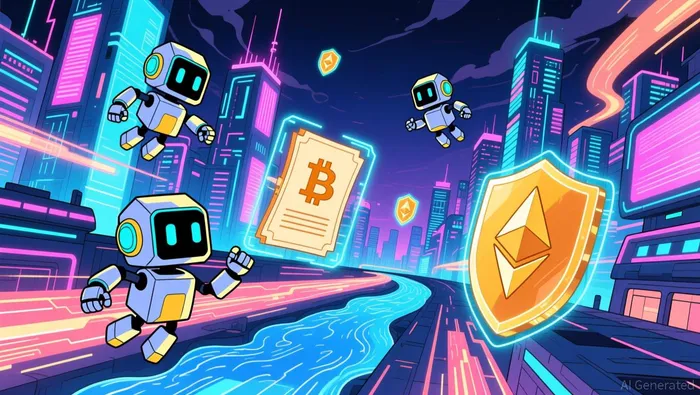
How Does Virtuals Protocol Enable Autonomous Agent Economy?
Virtuals Protocol enables the autonomous agent economy by providing a decentralized infrastructure that supports the entire lifecycle of AI agents. The platform allows users to create, fund, and deploy AI agents that operate within tokenized markets. These agents perform various functions, including DeFi yield optimization by automatically moving capital between lending protocols and executing predictions based on data analysis. The ecosystem relies on the native VIRTUAL token for governance, liquidity, and transaction fees, creating a self-sustaining economic loop.
The Agent Commerce Protocol (ACP) is the technical foundation that allows agents to interact with each other and the broader blockchain ecosystem. By enabling on-chain negotiation and settlement, ACP transforms AI agents into independent economic actors capable of generating revenue. This capability is crucial for the monetization of virtual influencers and trading bots, which can now operate autonomously and share profits with their co-owners. The platform’s launchpad and marketplace features facilitate the tokenization of these agents, allowing them to be traded and invested in by the broader community.
What Is the Role of VIRTUAL Token in the Ecosystem?
The VIRTUAL token plays a central role in the Virtuals Protocol ecosystem, serving as the primary utility and governance asset. Minting a new AI agent requires bonding 100 VIRTUAL tokens, which creates a direct link between the token’s value and the growth of the agent economy. The token also functions as the base currency for inter-agent transactions and platform fees, ensuring that economic activity within the ecosystem is settled in VIRTUAL.
Governance is another key function of the VIRTUAL token, with holders able to lock their tokens to receive veVIRTUAL and vote on protocol upgrades and treasury allocations. This DAO structure ensures that the community has a say in the direction of the platform, aligning the interests of token holders with the long-term success of the protocol. With a fully diluted valuation ranging from $560 million to $600 million, VIRTUAL trades between $0.56 and $0.60, reflecting its position as a key asset in the AI and DeFi sectors.

Blending traditional trading wisdom with cutting-edge cryptocurrency insights.
Latest Articles
Stay ahead of the market.
Get curated U.S. market news, insights and key dates delivered to your inbox.


AInvest
PRO
AInvest
PRO




Comments
No comments yet