
Virgin Galactic's Q3 2025: Flight Cadence Delays, Fuselage Issues, and Carbon Part Risks
 Aime Summary
Date of Call: November 13, 2025
Financials Results
- Revenue: $0.4M in Q3 2025, primarily attributable to future astronaut access fees
Guidance:
- Flight Test program expected to begin in Q3 2026; first spaceflight and start of commercial service expected in Q4 2026.
- Open first tranche of sales in Q1 2026; tranche-based pricing expected and management expects prices to be higher than the prior published $600,000.
- Q4 2025 revenue forecast ~ $0.3M; Q4 2025 free cash flow expected negative $90M–$100M.
- Cash balance $424M at end of Q3; CapEx peaked in Q1 2025 and is expected to decline through Q3 2026 before rising with commercial ops.
- Target steady state with 2 SpaceShips: ~125 flights/year, ≈$450M revenue and ≈$100M adjusted EBITDA; cash-positive expected within ~2–3 months after commercial start, subject to flight rate and ticket mix.
Business Commentary:
* SpaceShip Development Progress: - Virgin Galactic reported significant progress in its SpaceShip program, with the expected dates for Flight Test and the first spaceflight remaining unchanged for Q3 and Q4 2026 respectively. - The progress is driven by the successful manufacturing and delivery of key components such as the oxidizer tank qualified for 500 flights, and the lower skin of the forward fuselage, which was delivered earlier than expected.- Financial Performance and Capital Expenditures:

- The company reported
revenueof approximately$400,000for Q3 2025, primarily from future astronaut access fees.Total operating expensesdecreased by19%to$67 million, andnet lossimproved by15%to$64 million. This was due to reduced R&D expenses as spending shifted towards capital investments, with
capital expendituresincreasing to$51 million.Launch Vehicle Upgrade and Flight Capacity:
- The launch vehicle, Eve, completed an upgrade program, achieving the ability to fly SpaceShips on successive days and targeting an average availability of 3 to 4 flights a week.
This upgrade aims to support the company's goal of performing
125 space missions per yearwith its first two SpaceShips.Commercial Readiness and Sales Strategy:
- Virgin Galactic plans to open the first tranche of sales opportunities for future space missions in Q1 2026, with expectations of selling a quantity of seats at a price, and then reassessing for future tranches.
- The focus on operational readiness and hiring a Chief Growth Officer is aimed at supporting the company's preparation for commercial operations.
Sentiment Analysis:
Overall Tone: Positive
- Management repeatedly stated strong program progress ("We remain full steam ahead"), confirmed key parts arrived on schedule, and kept Flight Test Q3 2026 / first flight Q4 2026 timing. CFO highlighted improved metrics: OpEx down 19%, net loss improved 15%, adjusted EBITDA improved 11%, and $424M cash balance—supporting a constructive outlook.
Q&A:
- Question from Greg Konrad (Jefferies LLC): You mentioned opening the first tranche of sales in Q1 2026. Any observations on the size of that tranche or how you're thinking about flight price on reopening?
Response: Expect tranche-based sales with prices higher than the prior published $600,000; management will sell set quantities then reset prices upward (stair-step pricing).
- Question from Greg Konrad (Jefferies LLC): How are you thinking about the ramp in flight cadence and implications for 2027 given backlog winding down in 2027?
Response: Plan a prudent ramp from ~1 flight/week to ~3 flights/week over the first 2–3 months after first spaceflight, targeting ~125 flights/year (~12/month).
- Question from Oliver Chen (TD Cowen): Regarding the Q3 2026 flight test plan and Q4 commercial launch, how do you prioritize risk factors that could yield variability? Also, does the qualified oxidizer tank benefit margins/costs? Thoughts on avionics opportunity?
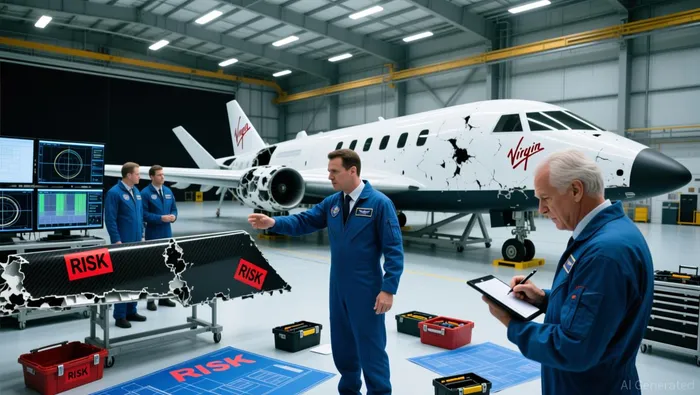
Response: Primary remaining schedule risk is receipt of a few fuselage skins expected in December; otherwise confident in Q3 flight test and Q4 first flight (tank and avionics validate reusability/economics but the immediate critical path is parts delivery).
- Question from Oliver Chen (TD Cowen): The operating expenses were better than expected — was that in line with your expectations and the capitalization of costs?
Response: Yes — Q3 OpEx and cash flow were in line with guidance; trend is converting OpEx into CapEx as manufacturing costs are capitalized, continuing until CapEx ramps down mid‑2026.
- Question from Michael Leshock (KeyBanc Capital Markets): On competitive differentiation and TAM for research flights versus parabolic flights or ISS access — what differentiates your research offering and how big could that market get?
Response: Key differentiators are the ability to carry researchers with experiments, superior microgravity quality versus parabolic flights, and frequent repeatable flights — creating a distinct research market demand aligned with private astronaut capacity.
- Question from Michael Leshock (KeyBanc Capital Markets): Is weather a limiting factor for flight cadence and do you have assumptions for launch‑eligible days per year?
Response: Weather is manageable — site is favorable (~sunny ~85% of days); operations are scheduled with flexibility and Eve's cadence provides buffer; management has baked yield loss (≈25 flights) into assumptions.
- Question from Louis Raffetto (Wolfe Research): For the Purdue research mission, should we expect research revenue to be typical or different from prior stated pricing?
Response: No reason to expect different — revenue should be consistent with prior stated pricing.
- Question from Louis Raffetto (Wolfe Research): As cash flow trends into next year, do you still see a path to positive free cash flow as ops start up?
Response: Yes — reaching positive free cash flow depends on timing, flight rate and ticket‑mix; management expects cash‑positive roughly 2–3 months after commercial service begins if target rates and pricing materialize.
Contradiction Point 1
Flight Cadence Ramp and Expectations
It involves differing expectations and timing for the ramp-up of flight cadence, which influences operational planning and customer expectations.
Can you comment on the size of the first tranche of sales in Q1 2026 or your pricing strategy upon reopening? - Greg Konrad(Jefferies LLC, Research Division)
2025Q3: The initial ramp will be prudent, starting with 1 flight per week, then 2, and eventually up to 3 flights per week. This progression will occur over the first 2 to 3 months of operation. - Michael Colglazier(CEO)
Will ticket sales for private astronaut flights reopen in Q1 2026? - Myles Alexander Walton(Wolfe Research)
2025Q2: We expect to be on track to operationalize around mid-year. As we get into the second half of the year, that's when we're going to start building flight cadence. - Michael A. Colglazier(CEO)
Contradiction Point 2
Impact of Fuselage Skin Issue on Flight Schedule
It relates to the impact of a particular issue on the flight schedule, which is crucial for operational planning and customer expectations.
What is the size of the first tranche of sales opening in Q1 2026, and how do you approach pricing upon reopening? - Greg Konrad(Jefferies LLC, Research Division)
2025Q3: The initial ramp will be prudent, starting with 1 flight per week, then 2, and eventually up to 3 flights per week. This progression will occur over the first 2 to 3 months of operation. - Michael Colglazier(CEO)
Can you provide the current status and required adjustments for the fuselage skin issue? - Gregory Arnold Konrad(Jefferies)
2025Q2: The fuselage part issue wasn't on the critical path, and the impact on private astronaut flights is minimal. The research flight delay is estimated to be less than a quarter, and private astronaut flights are still planned for the fall of 2026. - Michael A. Colglazier(CEO)
Contradiction Point 3
Flight Cadence and Backlog Strategy
It involves the company's strategy for managing flight cadence and customer backlog, which directly impacts revenue projections and customer experience.
How are you planning for the increase in flight cadence as the astronaut backlog advances in 2027? - Greg Konrad(Jefferies LLC, Research Division)
2025Q3: The initial ramp will be prudent, starting with 1 flight per week, then 2, and eventually up to 3 flights per week. This progression will occur over the first 2 to 3 months of operation. - Michael Colglazier(CEO)
Given the future flight cadence, how will you assess the size of the initial reopened sales wave and determine the ideal backlog? - Greg Konrad(Jefferies)
2025Q1: A one to two year backlog is appropriate. We aim for 6 times 125 people signed up a year in advance, aligning with the targeted flight rate of 125 flights per year. - Michael Colglazier(CEO)
Contradiction Point 4
Ramp in Flight Cadence and Customer Experience
It involves differing expectations for the ramp-up of flight cadence and the customer experience, which could impact operational efficiency and passenger satisfaction.
Can you provide any observations on the size of the first tranche of sales in Q1 2026 or your approach to pricing upon reopening? - Greg Konrad(Jefferies LLC, Research Division)
2025Q3: The initial ramp will be prudent, starting with 1 flight per week, then 2, and eventually up to 3 flights per week. This progression will occur over the first 2 to 3 months of operation. - Michael Colglazier(CEO)
How quickly can you scale flights beyond the first private astronaut mission in 2026 and what is the baseline fleet model for 2027? - Greg Konrad(Jefferies)
2024Q4: The company will prudently ramp up flights in 2027 after reaching the desired pace, ensuring the best customer experience. Mike: The flight testing program will combine development and operational tests, allowing for visible progress and efficient transition to commercial service. - Michael Colglazier(CEO), Michael Moses(President)
Contradiction Point 5
Carbon Parts Availability
It involves the availability of critical carbon parts for SpaceShip production, which affects the timeline for commercial operations and revenue generation.
How do you prioritize risk factors affecting Q3 2026 flight test and Q4 commercial launch expectations? - Oliver Chen(TD Cowen, Research Division)
2025Q3: Critical path risks include obtaining the remaining carbon parts for the SpaceShip, which are expected by December. - Michael Colglazier(CEO)
What caused the Wye Gateway shift to 2023, which aligns with prior guidance? Does this shift constitute a material delay? - Romit Shah(Morningstar Research Services LLC)
2025Q1: We've made progress on the 3D printing of the carbon fiber parts and, as we said earlier, we're on track to receive delivery of those parts in Q4. - Michael Colglazier(CEO)

Discover what executives don't want to reveal in conference calls
Latest Articles
Stay ahead of the market.
Get curated U.S. market news, insights and key dates delivered to your inbox.




Comments
No comments yet