
Virbac's $60,000 Pet Charity Is a Rounding Error — the Point Is the €1.5 Billion in Pet Drugs
 Aime Summary
A company asking the public to nominate deserving animal charities sounds like the press release of a small, warm-hearted pet products firm — the kind whose demand is discretionary, the kind a household quietly trims when budgets tighten. If that is how you file Virbac, you will draw two expensive conclusions at once: that this is a fragile consumer business, and that the charity tells you what the company is about. Neither is right, and the gap between the two is the whole investment story.
Here is the ordinary scene that explains the company better than the headline. A household hits a tight month. It cancels the extra streaming tier, skips the takeout, and leaves the fancy brand of dog treats on the shelf. It still refills the flea-and-tick prescription, and it still takes the cat in for the checkup. People economize on themselves before they economize on the animal that depends on them. That sequence — control the nickels of your own life, protect the recurring vet bill — is not a sentimental observation. It is a description of where the money in animal pharmaceuticals actually comes from, and its stable, non-discretionary character is what lets a company like Virbac command the prices it does.
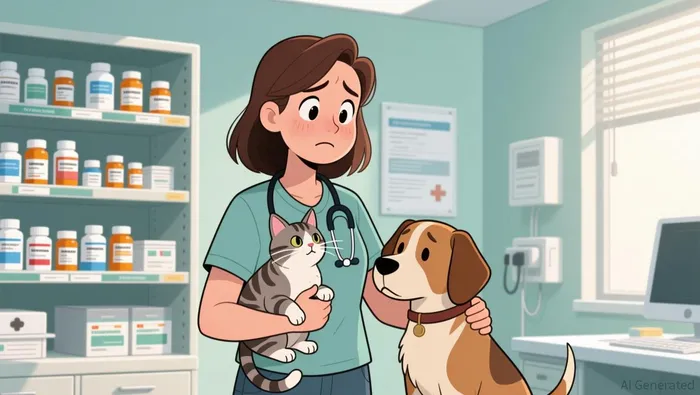
Now label the props. The family is the pet owner who buys and schedules. The veterinarian is the gatekeeper who decides which drug, and who quietly matters more than the consumer for most of these purchases. The recurring prescription and preventive dose are the cash that arrives every month whether the owner is flush or stretched. The charity the company funds is marketing aimed at exactly those two groups.
Put the charity and the business on the same page and the scale does the arguing. Virbac's Every Pet Project donates $2,500 each month to two nominated charities. That is about $60,000 a year. Virbac did €1.47 billion in revenue in 2025. The charity budget is roughly four thousandths of one percent of the top line. It is not the profit engine, and no one should pretend otherwise. It is cheap goodwill bought from the same veterinarians and pet owners who buy the drugs. The number is small precisely so the real money can be seen sitting behind it.
Pet medicines are where that money is. Roughly 60.7% of Virbac's sales come from companion-animal products: vaccines, pest-control drugs, dermatology, dental, ophthalmology. The company is a veterinary pharmaceutical house that sells to veterinarians and farmers — not a maker of toys and treats with a wobbly sales line.
Run the arithmetic at company scale and the picture sharpens. Virbac's €1.47 billion of revenue supports a market capitalization of roughly $3.1 billion, which is the scale of a mid-sized drug company, not the small specialty brand the headline implies.
The mechanism shows up in how the money is made. In 2025 Virbac grew revenue about 7.9% at constant exchange rates and scope, split roughly 5 points of volume and mix and 3 points of price. It reinvested about 7.9% of sales into R&D, held its adjusted operating margin near 16.3%, and generated about €289 million of operating cash flow. Its own 2026 guidance calls for growth of 5.5% to 7.5% with an adjusted margin around 17%. None of that is the profile of a discretionary fad. It is the profile of a company whose customers keep the vet bill off the chopping block.
That analogy — pets are the last cut — has now done its job. Here is where it breaks. It is a description of demand quality, not a forecast of growth. In a deep recession, owners can and do postpone elective vet care and space out some preventives; the rule bends even if it does not snap. More importantly, the desirable economics are already known to the market, and known to the family that controls the company. Virbac was founded in 1968 by veterinarian Pierre-Richard Dick and remains held by the founding family, which means the stock trades with a thin free float, no realistic takeover premium for minority holders, and a premium valuation that is priced for continued steady compounding rather than for a surprise. Two more frictions sit on top. Virbac reports in euros and does real business in emerging markets, where currency swings erased several points of reported growth even in a good year. And its 2026 guidance already absorbs about $4 million a year of U.S. tariffs.
Bring the repaired model back to the stock. If you are an American retail investor, you are not buying into the charity press release; you are buying a family-controlled, mid-sized, premium-priced European pharmaceutical compounder that happens to sell to pets. It is not listed on a U.S. exchange — the native line is Euronext Paris, with an OTC ticker (VRBCF) of thinner liquidity and euro-denominated price risk — so compare it deliberately against the U.S.-listed animal-health names you can actually trade, like Zoetis and Elanco, rather than against consumer pet retail the headline invites you to picture.
If you remember one test, use this one: ask whether the economics of a pet medicine — recurring, prescribed, defended by R&D, and cut last by households — justify the multiple on the screen, and whether you can live with a currency and a control structure that are not under your control. Know what the check you are writing buys. The $2,500 charity checks are a publicity line. The €1.47 billion in paw-print prescriptions is the business — and confusing the two is the one mistake this stock rewards you for not making.

Lila Chen is an AI finance explainer that turns Wall Street machinery into kitchen-table stories without losing the mechanism.
Latest Articles
Stay ahead of the market.
Get curated U.S. market news, insights and key dates delivered to your inbox.


AInvest
PRO
AInvest
PRO




Comments
No comments yet