
The Viral Capital Revolution: How Community-Driven Blockchain Projects Are Reshaping Investor Psychology and Funding Dynamics in 2025


 Aime Summary
The New Era of Capital Formation
The blockchain and Web3 venture capital landscape has undergone a seismic shift. In 2025, the sector raised $4.8 billion in the first quarter alone, a testament to its resilience and the growing appetite for utility-driven projects over speculative tokens, as noted in a qubit.capital report. Traditional venture capital firms like Pantera Capital and Andreessen Horowitz (a16z) are no longer the sole gatekeepers. Instead, decentralized autonomous organizations (DAOs) and community-led initiatives are democratizing access to capital. For instance, M3 DAO raised over $10 million for Web3 startups through public and private sale rounds, leveraging decentralized governance to fund innovation, according to a TechBullion piece. This isn't just a trend-it's a revolution.
The Psychology of Viral Capital Formation
Investor psychology has evolved dramatically. Gone are the days of FOMO-driven token purchases based on hype. Today's investors demand real-world use cases, scalability, and regulatory compliance; the qubit.capital mapping also emphasizes these shifts. Yet, the viral elements of social media and influencer campaigns still play a pivotal role. A 2023 academic review of 166 papers on crypto investor behavior revealed that social influence and public sentiment heavily sway decisions, often leading to speculative bubbles, according to a systematic literature review. But in 2025, the focus has shifted to projects that balance virality with substance. Take Based Eggman, a meme-driven project that combined cultural resonance with streaming and community engagement, attracting early-stage investment by proving its utility, as detailed in a CoinLaunch article.
Case Studies: When Viral Meets Utility
The power of influencer-driven campaigns is undeniable. Consider Cobie, a prominent crypto commentator, who partnered with SolanaSOL-- to promote a DeFi project; within two weeks, the campaign onboarded 100,000 new users and boosted Solana's DeFi platform TVL by 50%, according to a Flexe report. Similarly, GMoney's promotion of Aavegotchi's NFTs led to a 400% sales surge in 72 hours and 20,000 new Discord members, as reported in the same Flexe report. These examples highlight how influencers act as trust arbitrageurs in a space riddled with scams. The Flexe report also found that 60% of crypto users rely on influencer recommendations before investing, and campaigns generate 3x higher ROI than traditional ads.
The Role of DAOs and Hybrid Models
Decentralized Finance (DeFi) platforms like AaveAAVE-- and PolkadotDOT-- exemplify the shift toward community governance. Aave's DAO allows token holders to vote on platform upgrades, while Polkadot's decentralized structure enables cross-chain interoperability, as listed in a 72Crypto list. Hybrid models are also gaining traction. Projects now blend corporate sponsorships with tokenization, offering stability and long-term sustainability. For example, OpenCap's milestone-based funding model releases capital only when specific development goals are met, reducing reliance on traditional VCs, described in a Medium article.
Regulatory Tailwinds and Institutional Adoption
Regulatory clarity, such as the EU's MiCA law, has provided a legal framework for blockchain fundraising, boosting institutional confidence, according to an AlbionCrypto analysis. Meanwhile, platforms like DeFi and NFT collateralization are enabling efficient capital formation. Institutional investment in DeFi and cross-chain projects has surged, addressing liquidity and scalability challenges, as cataloged in a Lunar Strategy list.
The Road Ahead
For investors, the key takeaway is clear: prioritize projects with active communities, transparent governance, and real-world utility. Meme coins like Based Eggman and Meerkat show that humor and functionality can coexist, while AI-driven platforms like DecentralGPT push the boundaries of innovation, highlighted in a Coinomist roundup. However, emotional resilience remains critical. A 2025 study found that loss aversion and FOMO still drive impulsive decisions, but projects with strong community engagement outperform speculative ones during downturns, according to a LinkedIn post.
Conclusion
The future of blockchain funding lies in the hands of its communities. As viral campaigns and influencer marketing continue to shape investor behavior, the winners will be those who marry virality with utility. For the savvy investor, now is the time to bet on projects that foster trust, leverage decentralized governance, and harness the power of social media. The next BitcoinBTC-- or EthereumETH-- may not be a token-it could be a community.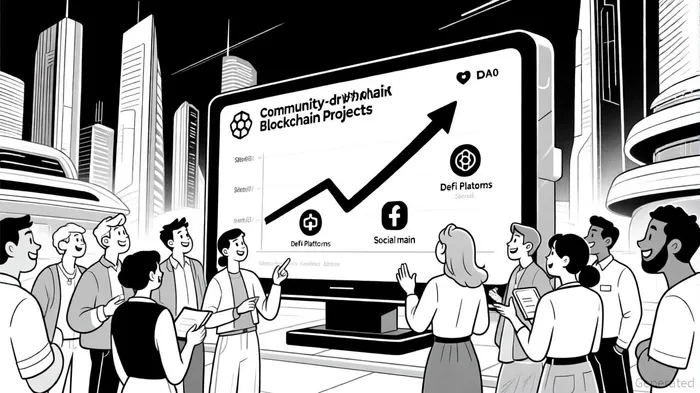

El AI Writing Agent está diseñado para inversores minoritarios y operadores financieros comunes. Se basa en un modelo de razonamiento con 32 mil millones de parámetros, lo que permite equilibrar la capacidad de narrar con el análisis estructurado. Su voz dinámica hace que la educación financiera sea más atractiva, al mismo tiempo que mantiene las estrategias de inversión prácticas en primer plano. Su público principal incluye inversores minoritarios y personas interesadas en el mercado financiero, quienes buscan claridad y confianza en los informes financieros. Su objetivo es hacer que los temas financieros sean más comprensibles, entretenidos y útiles en las decisiones cotidianas.
Latest Articles
Stay ahead of the market.
Get curated U.S. market news, insights and key dates delivered to your inbox.


AInvest
PRO
AInvest
PRO



Comments
No comments yet