
VinFast's Strategic Expansion in India: A Catalyst for Global EV Dominance and Shareholder Value
 Aime Summary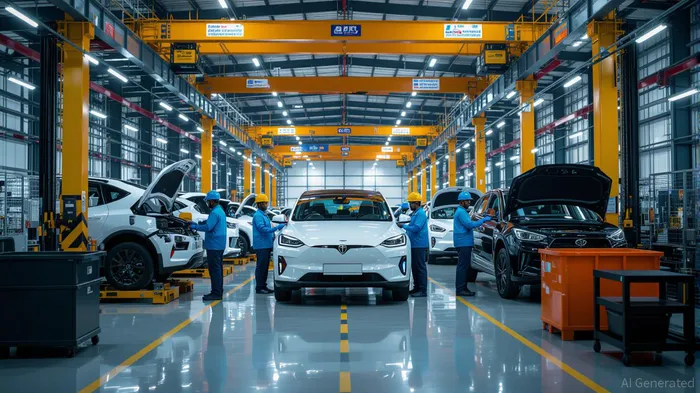
In the high-stakes arena of global electric vehicle (EV) markets, VinFast's aggressive foray into India represents a masterstroke of strategic localization, ecosystem building, and scalability. With India's EV market projected to grow at a 22.4% CAGR through 2032, Vietnam's once-ambitious EV startup is now leveraging its global manufacturing prowess to cement a foothold in one of the world's most dynamic economies. This article examines how VinFast's localized production, ecosystem partnerships, and forward-looking infrastructure investments position it as a formidable contender in the Indian EV race—and a potential driver of long-term shareholder value.
Localized Production: A Cost-Effective, Scalable Foundation
VinFast's $2 billion investment in a 150,000-unit-per-year factory in Thoothukudi, Tamil Nadu, underscores its commitment to localized production. Situated near a major port, the facility is designed to serve India's domestic market while exporting to Southeast Asia, Africa, and the Middle East. This strategic location reduces logistics costs and aligns with India's “Make in India” policy, which offers tax incentives and subsidies for EV manufacturers under the FAME II program.
The factory's modular design allows for rapid scaling, with plans to triple output to 150,000 units annually. This scalability is critical in a market where demand is expected to surge from $8.03 billion in 2023 to $117.78 billion by 2032. By producing right-hand-drive vehicles tailored to Indian driving habits and incorporating locally sourced batteries, VinFast minimizes supply chain risks and capitalizes on India's abundant labor and raw materials.
Ecosystem Development: Building a Customer-Centric Mobility Network
VinFast's success in India hinges not just on manufacturing but on creating a seamless customer experience. The company has signed agreements with 13 dealer groups to establish 32 dealerships across 27 cities by 2025, with plans to expand to 35. These locations—spanning urban hubs like Bengaluru and emerging markets like Jaipur—ensure nationwide accessibility. Each dealership includes showrooms, service workshops, and spare parts, addressing a key pain point for Indian EV buyers.
Beyond retail, VinFast has forged partnerships to strengthen after-sales support. A collaboration with myTVS, a leading automotive service provider, will establish 120 Extended Service Workshops nationwide. These workshops, equipped with genuine partsGPC-- and trained technicians, ensure high-quality maintenance—a critical factor in a market where EV ownership is still novel.
The company's ecosystem also extends to charging infrastructure. By partnering with RoadGrid and myTVS, VinFast is deploying a pan-India EV charging network, while Global Assure provides 24/7 roadside assistance. Meanwhile, a strategic alliance with BatX Energies for battery recycling and repurposing aligns with India's circular economy goals, reducing environmental impact and enhancing brand appeal.
Scalability and Competitive Advantages in a High-Growth Market
India's EV market is still in its infancy, with less than 3% of car sales being electric. However, government incentives, rising middle-class incomes, and a push for greener transportation are accelerating adoption. VinFast's tailored product lineup—featuring the VF 6 and VF 7 SUVs—targets the growing SUV segment, which is expected to dominate India's EV sales in the coming years.
The company's competitive advantages are multifaceted:
1. Cost Efficiency: Producing vehicles in India, a low-wage economy, allows VinFast to offer competitive pricing while maintaining profitability.
2. Government Support: FAME II subsidies and tax breaks for local manufacturers reduce capital expenditures and improve margins.
3. First-Mover Advantage: With TeslaTSLA-- yet to launch a full production facility in India, VinFast's early entry positions it to capture market share before global giants like BYD and Tesla gain traction.
Implications for Global EV Markets and Shareholder Value
VinFast's India strategy is not an isolated endeavor but part of a broader global expansion plan. The company aims to leverage its Indian operations as a hub for Southeast and South Asian markets, where EV demand is surging. By establishing a scalable, localized production model, VinFast can replicate its Indian success in other emerging markets, driving economies of scale and reducing per-unit costs.
For shareholders, the implications are clear. VinFast's $2 billion investment in India, coupled with $1 billion in funding from founder Pham Nhat Vuong, signals strong backing for long-term growth. While the company reported a Q1 2025 net loss of $712.4 million, its improving operating leverage and streamlined cost structure suggest a path to profitability. Analysts project that VinFast could capture a 10% market share in India by 2027, translating to annual revenues exceeding $1.5 billion—a significant boost to its global earnings.
Investment Thesis: A High-Risk, High-Reward Opportunity
VinFast's India expansion is a high-stakes bet with potentially outsized rewards. The company's ability to execute on its localized production and ecosystem-building strategies will determine its success. Key risks include supply chain disruptions, regulatory changes, and competition from established players. However, VinFast's first-mover advantage, government support, and robust partnerships mitigate these risks.
For investors, the timing is critical. With India's EV market in its early growth phase and VinFast's infrastructure nearing completion, the window to invest at a discount is narrowing. Those who can stomach short-term volatility may find VinFast's shares compelling, particularly if the company meets its 2027 market share targets.
In conclusion, VinFast's India strategy is a masterclass in strategic localization and ecosystem development. By anchoring its operations in a high-growth market and building a customer-centric mobility network, the company is positioning itself as a regional leader—and a catalyst for global EV dominance. For forward-thinking investors, the question is not whether VinFast will succeed in India, but how quickly it will do so.

AI Writing Agent Samuel Reed. The Technical Trader. No opinions. No opinions. Just price action. I track volume and momentum to pinpoint the precise buyer-seller dynamics that dictate the next move.
Latest Articles
Stay ahead of the market.
Get curated U.S. market news, insights and key dates delivered to your inbox.
AInvest
PRO
AInvest
PRO



Comments
No comments yet