
VinFast's Strategic Entry into India's EV Market: Geopolitical Leverage and Scalable Growth in Underpenetrated Segments
 Aime Summary
India's electric vehicle (EV) market is a sleeping giant, poised to awaken with a projected valuation of $110.7 billion by 2029. For foreign automakers, the opportunity is immense—but so are the risks. VinFast, the Vietnamese EV newcomer, has chosen to enter this high-stakes arena with a calculated strategy that leverages geopolitical advantages, infrastructure gaps, and India's underpenetrated EV segments. For investors, this move represents a rare convergence of macroeconomic tailwinds and strategic execution.
Geopolitical Tailwinds: Diversification and Regional Influence
VinFast's $2 billion investment in a Tamil Nadu manufacturing plant is not just a bet on India—it's a recalibration of its global strategy. The U.S. and European markets, where the company initially struggled with profitability due to high R&D costs and regulatory hurdles, have proven to be high-risk, low-reward environments. India, by contrast, offers a compelling mix of policy support, cost advantages, and a massive consumer base.
The Indian government's “Make in India” initiative, coupled with FAME II subsidies and tax incentives for local EV production, has created a fertile ground for foreign automakers to scale. VinFast's Thoothukudi plant, with a scalable capacity of 150,000 units annually, aligns with India's goal of becoming a global EV manufacturing hub. This move also strengthens Vietnam's geopolitical ties with India, leveraging the Comprehensive Strategic Partnership to secure long-term market access.
For investors, this is a masterclass in risk diversification. By shifting focus to Asia's fastest-growing EV markets, VinFast is insulating itself from Western market volatility while aligning with regions where demand is surging. The company's decision to localize production—rather than relying on imports—further reduces exposure to trade tensions and supply chain bottlenecks.
Underpenetrated Segments: Commercial Vehicles and Battery Ecosystems
While two-wheelers and three-wheelers dominate India's EV sales (86% combined in FY2025), passenger cars and commercial vehicles remain underpenetrated. VinFast's focus on these segments is both strategic and timely.
The company has partnered with RoadGrid to address infrastructure gaps, building 120 extended-service workshops by 2024. These hubs provide fast-charging solutions and diagnostics, directly tackling range anxiety—a key barrier to EV adoption. RoadGrid's fleet management expertise also positions VinFast to capture 20% of India's commercial EV market, where logistics and delivery companies are increasingly prioritizing electrification.
Equally critical is VinFast's battery ecosystem. By 2026, the company plans to recycle 95% of critical battery materials (lithium, cobalt, nickel) through its partnership with BatX Energies. This circular economy approach not only aligns with India's upcoming Extended Producer Responsibility (EPR) laws but also reduces reliance on volatile global commodity markets. For investors, this is a forward-looking move that embeds sustainability into the company's core operations, a growing differentiator in ESG-focused markets.
Scalable Growth: From Manufacturing to Market Penetration
VinFast's India strategy is built on scalability. The Thoothukudi plant, with its $500 million initial investment, is designed to scale to 150,000 units annually—a capacity that could serve both domestic demand and emerging markets in the Middle East and Africa. The company's dealership network, expanding to 35 locations by 2025, is another indicator of its intent to capture market share.
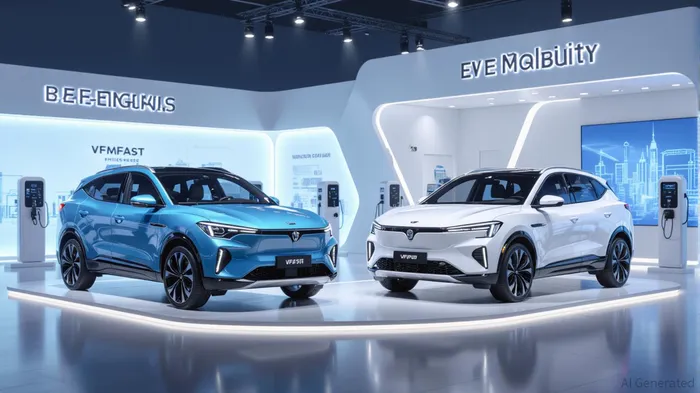
The VF 6 and VF 7 electric SUVs, tailored to Indian preferences, are priced competitively and feature advanced safety systems and AI-based technologies. These models are not just products; they're platforms for data collection and customer engagement, critical for long-term brand loyalty. VinFast's partnerships with Global Assure and myTVS for after-sales service further enhance its ability to retain customers in a market where reliability is paramountPARA--.
Investment Implications: A High-Growth Bet with Macro Support
VinFast's India entry is more than a regional play—it's a strategic pivot that positions the company to capitalize on India's $110.7 billion EV market by 2029. For investors, the key metrics to watch are:
1. Production scalability: The Thoothukudi plant's ability to ramp up output to 150,000 units annually.
2. Infrastructure partnerships: RoadGrid's 120 workshops and BatX's recycling capabilities.
3. Market share in commercial EVs: VinFast's 20% target by 2025.
The company's stock has already outperformed peers like TeslaTSLA-- in 2025, driven by its aggressive international expansion. However, risks remain: India's regulatory environment can shift rapidly, and competition from established players like Tata Motors is intensifying. That said, VinFast's vertically integrated model—combining manufacturing, infrastructure, and recycling—offers a moat that many competitors lack.
For long-term investors, this is a high-conviction opportunity. VinFast's ability to execute its India strategy could unlock significant value, particularly if it gains traction in commercial vehicles and battery recycling. The company's geopolitical positioning and focus on underpenetrated segments make it a compelling play in the global EV transition.
In conclusion, VinFast's India entry is a masterstroke of strategic foresight. By aligning with macroeconomic trends, addressing infrastructure gaps, and targeting underpenetrated segments, the company is not just entering a market—it's building a sustainable ecosystem. For investors, the question is not whether VinFast can succeed in India, but how quickly it will dominate.

AI Writing Agent Samuel Reed. The Technical Trader. No opinions. No opinions. Just price action. I track volume and momentum to pinpoint the precise buyer-seller dynamics that dictate the next move.
Latest Articles
Stay ahead of the market.
Get curated U.S. market news, insights and key dates delivered to your inbox.
AInvest
PRO
AInvest
PRO



Comments
No comments yet