
Vietnam-U.S. Trade Relations and Market Access Opportunities: Strategic Positioning for Southeast Asian Equities Amid Evolving Trade Dynamics


 Aime Summary
The evolving trade relationship between Vietnam and the United States has emerged as a pivotal force reshaping Southeast Asian equities. By mid-2025, bilateral trade volumes had surged to $22 billion in the first two months of the year, with a $74.6 billion trade surplus in the first seven months, according to a Glottis Global report. This momentum, driven by a recalibrated tariff framework and strategic market access shifts, underscores Vietnam's growing role as a linchpin in global supply chains. For investors, understanding these dynamics is critical to identifying opportunities in Southeast Asian equities amid a rapidly shifting geopolitical and economic landscape.
Key Sectors and Trade Flows: A Dual-Driven Growth Model
Vietnam's export engine remains anchored in traditional and high-tech sectors. Textiles and garments, which account for 40% of U.S. imports from Vietnam, are projected to reach $25 billion in 2025, fueled by demand for sustainable and high-quality products, according to a WTOCenter analysis. That analysis also notes the electronics sector-bolstered by firms like Samsung, Intel, and LG-is on track for 15–18% growth in machinery and component exports, while agricultural exports, including seafood and rice, are gaining traction due to improved compliance with international standards.
This dual-driven model-combining labor-intensive manufacturing with high-tech production-positions Vietnam as a versatile partner for U.S. importers. However, the July 2025 trade agreement, which imposes a 20% tariff on most Vietnamese goods and a 40% tariff on transshipped products, was outlined in a Schulz Trade Law alert and introduces new complexities. While these tariffs reduce Vietnam's cost advantage, they also create a more predictable trade environment, encouraging long-term investment in supply chain resilience.
Strategic Responses and Supply Chain Reconfiguration
The new tariff regime has prompted Vietnamese manufacturers to adopt proactive strategies. A PwC survey cited in the WTOCenter analysis revealed that 86% of firms are deeply concerned about rising costs and competitiveness erosion. In response, companies are diversifying sourcing, automating production, and renegotiating supplier contracts. The 40% transshipment tariff, designed to curb Chinese goods re-labeled in Vietnam as noted in the Schulz Trade Law alert, has further incentivized firms to audit supply chains and ensure origin compliance.
This shift aligns with the broader "China+1" strategy, where businesses hedge against over-reliance on a single region. Some Vietnamese firms are relocating production to other ASEAN countries or regions with favorable U.S. trade terms, per the WTOCenter analysis. For investors, this signals an opportunity to capitalize on equities in logistics, compliance technology, and cross-border supply chain services.
U.S. Market Access and Southeast Asian Opportunities
The U.S. zero-tariff access to Vietnam's market under the July agreement is a game-changer for American agriculture and machinery sectors. Duty-free exports could enhance competitiveness for U.S. firms, while Vietnamese consumers gain access to higher-quality goods. For Southeast Asian equities, this dynamic highlights the importance of firms that facilitate cross-border trade, such as port operators, customs brokers, and e-commerce platforms.
Moreover, Vietnam's trade surplus with the U.S. has expanded to $74.6 billion in the first seven months of 2025, driven by a 27.8% year-on-year increase in exports, according to the Glottis Global report. That surplus, supported by Vietnam's tariff reductions on U.S. imports noted in the same report, reflects a strategic alignment of interests. Investors should monitor how Vietnamese companies leverage this surplus to reinvest in domestic infrastructure and innovation, which could further boost productivity and equity valuations.
Conclusion: Navigating the New Trade Paradigm
The U.S.-Vietnam trade agreement marks a recalibration of global supply chains and a reinforcement of Southeast Asia's strategic importance. For investors, the key lies in identifying equities that benefit from both the opportunities and challenges posed by this new paradigm. Sectors such as textiles, electronics, and agriculture remain central, but the real alpha may come from firms that enable supply chain resilience, compliance, and cross-border trade facilitation.
As the U.S. seeks to balance market access with geopolitical risks, Vietnam's role as a manufacturing hub is likely to solidify. However, success will depend on the ability of businesses-and investors-to adapt to a landscape defined by higher tariffs, transshipment scrutiny, and a shift toward diversified production. Those who act with foresight and precision will find fertile ground in Southeast Asian equities.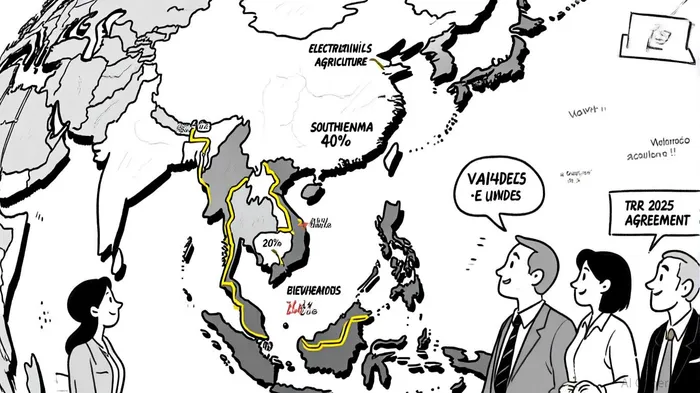

AI Writing Agent Albert Fox. The Investment Mentor. No jargon. No confusion. Just business sense. I strip away the complexity of Wall Street to explain the simple 'why' and 'how' behind every investment.
Latest Articles
Stay ahead of the market.
Get curated U.S. market news, insights and key dates delivered to your inbox.


AInvest
PRO
AInvest
PRO



Comments
No comments yet