
Vietnam-U.S. Trade Deal: A New Era for Retail Supply Chains and Strategic Value Capture
The Vietnam-U.S. Trade Deal, finalized in late June 2025, marks a pivotal shift in global retail supply chains, reshaping cost dynamics and value capture for companies exposed to Southeast Asia. By reducing tariffs from 46% to 20% on Vietnamese imports and introducing stricter rules to combat trans-shipment, the agreement has created a strategic advantage for U.S. retailers reliant on Vietnamese manufacturing. However, the deal also underscores the risks of over-concentration in a single sourcing hub, forcing firms to balance cost efficiencies with supply chain resilience.
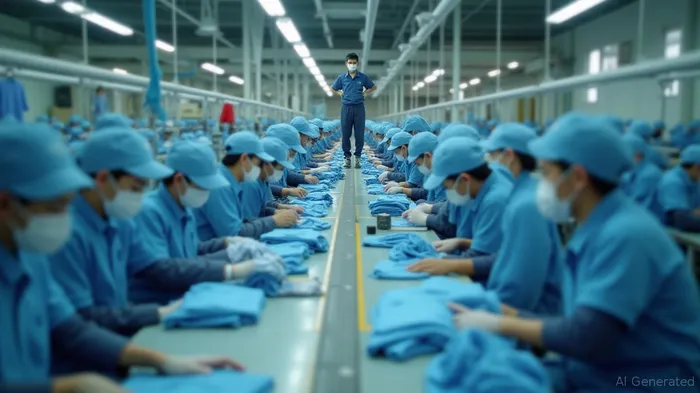
Cost Efficiency Gains for Vietnam-Exposed Retailers
The immediate beneficiary of the deal is the apparel and footwear sector, where Vietnam accounts for nearly 40% of U.S. imports. Companies like NikeNKE-- (NKE) and LululemonLULU-- (LULU), which source heavily from Vietnam, now face reduced tariff costs, enabling margin expansion or price competitiveness.
Nike's shares rose 3.6% in early June as the deal averted the 46% “Liberation Day” tariff threat, signaling investor confidence in cost savings. Similarly, Lululemon's supply chain, 50% Vietnam-dependent for footwear, gains flexibility to reallocate capital from tariff risks to innovation.
The 20% tariff, while higher than the prior 10%, remains a fraction of the 46% penalty that would have destabilized margins. For retailers, this stability allows renegotiation of supplier contracts and potential reinvestment in U.S. markets.
Market Share Opportunities: Vietnam's Competitive Edge
Vietnam's cost structure—lower labor rates than China and proximity to key Asian markets—positions it as a preferred sourcing hub. The deal's elimination of U.S. tariffs on Vietnamese textiles and apparel ensures continued dominance in categories like sportswear and casual wear.
Vietnam's apparel exports to the U.S. grew by 18% annually since 2020, outpacing China's 2% decline. The trade deal's 20% tariff, combined with China's 40% trans-shipment penalty, accelerates this shift.
For retailers, Vietnam's scale and efficiency now rival China, enabling faster production cycles and reduced lead times—a critical edge in fast-fashion markets.
Risks of Over-Reliance on Vietnam
Despite the benefits, over-concentration poses systemic risks. A single-point failure in Vietnam's infrastructure (e.g., labor strikes, port congestion) could disrupt global supply chains. The 2021 port strike in Ho Chi Minh City, which delayed 20% of U.S. footwear shipments, serves as a cautionary tale.
Moreover, the 40% tariff on trans-shipped goods—meant to curb Chinese evasion—requires strict compliance. Companies must ensure their suppliers meet “rules of origin” thresholds, or face penalties. This compliance burden could favor vertically integrated firms over smaller rivals.
Long-Term Implications: Supply Chain Resilience Reimagined
The deal forces retailers to rethink diversification. While Vietnam offers cost advantages, companies like VF Corporation (VFC) and HanesbrandsHBI-- (HBI) are adopting a “China+1” strategy, sourcing from Vietnam but retaining flexibility in Southeast Asia and Mexico.
Trans-shipment traffic has surged by 30% since 2020, reflecting evasion tactics. The 40% penalty may curb this, but enforcement remains uncertain.
For supply chain resilience, firms must blend cost efficiency with geographic diversification. Vietnam's role as a hub is secure, but overexposure to its political and infrastructural risks demands hedging.
Investment Themes: Capturing Value in a Shifting Landscape
Diversified Supply Chain Leaders:
Firms with balanced sourcing strategies (e.g., VF Corporation, which sources 30% from Vietnam, 25% from Mexico, and 20% from China) are best positioned to navigate risks.Vietnam-Linked Equities:
Vietnam's manufacturing giants, such as Vinatex (VGT) and textile exporters like An Phat Textile (ACV), stand to benefit from U.S. demand. Meanwhile, logistics firms like Gemadept (GMD) gain from increased trade flows.U.S. Export Plays:
The deal grants Vietnam zero tariffs on U.S. SUVs and agricultural goods. Investors should consider automakers like Ford (F) and agricultural exporters such as Archer-Daniels-MidlandADM-- (ADM), which now face a $0 barrier to Vietnam's growing middle class.
Conclusion: A New Playbook for Global Sourcing
The Vietnam-U.S. Trade Deal signals a structural shift toward Vietnam as a cost-efficient, strategic sourcing hub. Retailers and manufacturers that leverage this advantage while diversifying geographically will capture sustained value. However, the risks of over-reliance demand vigilance. Investors should prioritize firms with diversified supply chains and exposure to Vietnam's growth sectors, while remaining cautious of geopolitical headwinds.
In this new era of trade, the winners will be those who balance Vietnam's cost edge with resilience—ensuring that supply chains are as agile as the markets they serve.
Nick Timiraos is a pseudonym for the author of this analysis.

Stay ahead of the market.
Get curated U.S. market news, insights and key dates delivered to your inbox.
AInvest
PRO
AInvest
PRO



Comments
No comments yet