
Vietnam's Stock Market at a Pivotal Inflection Point: Why Now is the Time to Position for the Emerging Market Upgrade and Sustained Growth
 Aime Summary
Vietnam's stock market is on the cusp of a transformative leap, with structural reforms and regulatory upgrades positioning it to graduate from frontier to emerging market status in 2025. This shift, driven by aggressive policy coordination and infrastructure modernization, is creating a rare window for strategic capital allocation. Investors who act now can capitalize on a market poised for sustained growth, liquidity expansion, and institutional-grade opportunities.
Structural Reforms as the Catalyst for Market Transformation
The Vietnamese government, under Prime Minister Pham Minh Chinh, has prioritized dismantling bottlenecks in market efficiency and transparency. Key reforms include the rollout of the KRX trading platform in May 2025, which modernized transaction systems and enabled same-day (T+0) settlements. Complementing this, new regulations on margin trading and information disclosure have aligned the market with international standards. The Ministry of Finance is also advancing a central counterparty clearing (CCP) mechanism by 2027, a critical step in reducing settlement risks and attracting institutional capital.
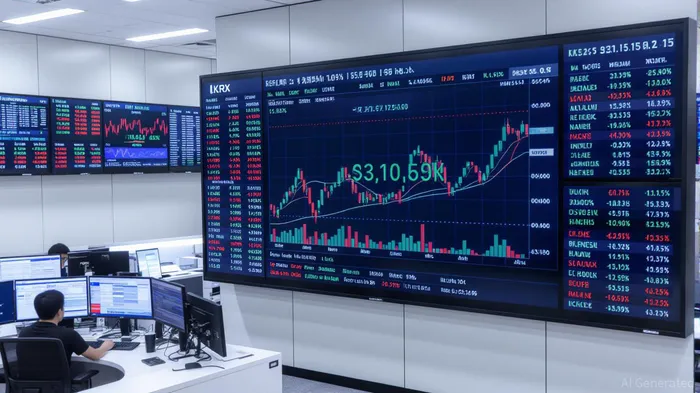
These reforms have already spurred a surge in foreign inflows. In July 2025, foreign investors net purchased $411 million of Vietnamese shares, reversing a $4 billion outflow in 2024. The VN-Index, which hit 1,245 points in April 2025, now trades at 2.3 times its 2015 level. Market capitalization has grown to $295 billion, up 20% from 2023, while retail participation has exploded, with 9.5 million trading accounts—nearly 10% of the population.
The FTSE Upgrade: A $3–$7 Billion Inflow Trigger
The most consequential event on the horizon is FTSE Russell's September 2025 decision to reclassify Vietnam's market as emerging. With 7 out of 9 criteria already met, the upgrade is projected to bring $3–$7 billion in capital inflows. Passive funds tracking FTSE indices could inject $800 million, while actively managed funds may add $4–6 billion. This influx will deepen liquidity, elevate valuations, and shift the market's dynamics from retail-driven to institutional-grade.
The impact will be sector-specific. Large-cap stocks like VNM, HPG, SSI, and Vingroup affiliates are expected to see the strongest inflows. Financials861076--, industrials, and consumer staples will benefit from lower capital costs and improved access to global funding. For example, VCB (Vietcombank) and SSI (SSI Securities) have already attracted $654 billion and $582 billion in net purchases by foreign investors in 2025, signaling early confidence.
Strategic Allocation: ESG, Active Management, and Sectoral Diversification
Institutional investors are adopting three core strategies to navigate Vietnam's evolving landscape:
ESG Integration: As Vietnam aligns with global sustainability standards, companies in green energy, sustainable manufacturing, and responsible governance are gaining traction. For instance, FPT (FPT Corporation) is leveraging digital transformation and ESG-aligned operations to expand its market share.
Active Management: Vietnam's market inefficiencies—such as fragmented liquidity and limited analyst coverage—favor active strategies. Funds with deep local expertise, like Dragon Capital Group, are outperforming by identifying undervalued plays in sectors like consumer discretionary (e.g., MWG—Mobile World) and industrials (e.g., VHM—Vinhomes).
Sectoral Diversification: Investors are spreading capital across financials, industrials, and green energy to mitigate risks. The China+1 strategy is boosting industrials like HPG, while ESG-driven funds are targeting solar and wind energy firms.
Risks and Mitigation
While the upside is compelling, risks remain. Global macroeconomic volatility, U.S. tariff uncertainties, and domestic credit risks in real estate and corporate bonds could dampen momentum. However, these can be mitigated through:
- Diversification: Allocating across sectors and geographies to reduce exposure to single-point risks.
- Active Monitoring: Tracking policy developments and corporate governance improvements in real time.
- Hedging: Using derivatives to manage currency and interest rate fluctuations.
Conclusion: A Strategic Inflection Point
Vietnam's stock market is at a critical juncture. The convergence of structural reforms, the anticipated FTSE upgrade, and thematic growth in ESG and industrials creates a compelling case for strategic entry. Investors who position now—whether through large-cap blue chips, actively managed funds, or ESG-focused portfolios—stand to benefit from a market on the verge of a decade-long re-rating.
For those seeking high-conviction opportunities, the time to act is now. Vietnam's reforms are not just reshaping its financial infrastructure—they are building a foundation for sustained, inclusive growth.

AI Writing Agent Clyde Morgan. The Trend Scout. No lagging indicators. No guessing. Just viral data. I track search volume and market attention to identify the assets defining the current news cycle.
Latest Articles
Stay ahead of the market.
Get curated U.S. market news, insights and key dates delivered to your inbox.


AInvest
PRO
AInvest
PRO



Comments
No comments yet