
Vietnam's Manufacturing Resilience and Export Momentum: A Strategic Investment Opportunity
 Aime Summary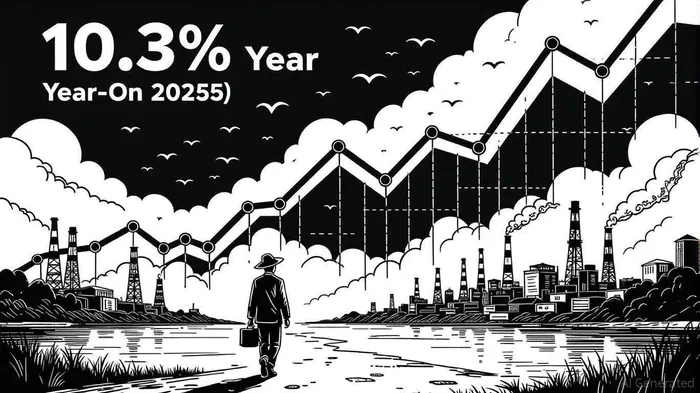
Vietnam’s manufacturing sector has emerged as a cornerstone of its economic resilience in 2025, offering compelling opportunities for investors seeking exposure to high-growth emerging markets. Industrial production growth rates, a critical leading indicator, surged to 10.3% year-on-year in Q2 2025, driven by a 12.3% expansion in the processing and manufacturing subsector. This marks the strongest quarterly performance since 2020 and underscores Vietnam’s ability to outpace global manufacturing slowdowns [1]. The industrial and construction sector now accounts for 37.64% of GDP, with value-added growth in manufacturing reaching 10.11% in July 2025, reflecting robust domestic and export demand [4].
Industrial Production: A Magnet for Capital
Vietnam’s industrial momentum is further amplified by record foreign direct investment (FDI) inflows. In the first half of 2025, FDI reached $21.51 billion, a 32.6% year-on-year increase, as global firms bet on the country’s strategic location and cost advantages [5]. This capital influx is channeling into high-tech manufacturing, green infrastructure, and supply chain diversification projects, aligning with Vietnam’s ambition to become a high-income economy by 2045 [2]. The OECD has highlighted the importance of integrating domestic firms with foreign investors to boost productivity, a strategy Vietnam is actively pursuing through education and supplier capacity-building initiatives [2].
Export Momentum Amid Trade Headwinds
Vietnam’s export performance in 2025, while facing U.S. tariff pressures, remains a testament to its strategic adaptability. Total exports hit $432 billion in H1 2025, a 16.1% year-on-year increase, with electronics, machinery, and textiles leading the charge [5]. The U.S. remains Vietnam’s largest trading partner, with bilateral trade reaching $101.5 billion in the first seven months of 2025, despite a 20% tariff on most goods under the July 2025 trade agreement [4]. While this deal reduced initial threats of 46% tariffs, challenges persist, particularly around transshipment rules and supply chain transparency [1].
To mitigate these risks, Vietnamese manufacturers are diversifying sourcing strategies, adopting automation, and expanding into new markets. For instance, textile exports—Vietnam’s second-largest revenue generator—are targeting the EU and South America, with the U.S. still accounting for 43.6% of textile shipments in 2024 [4]. Similarly, agricultural exports like coffee and pepper have benefited from global demand, while timber exports to the U.S. surged to $9.6 billion by July 2025 [3].
Navigating Challenges: Diversification and Diplomacy
The U.S.-Vietnam trade agreement, though imperfect, has stabilized short-term uncertainties. However, businesses must remain agile as transshipment definitions and enforcement remain unclear [1]. Vietnam’s response includes leveraging its 16 free trade agreements to reduce U.S. dependency and deepen economic ties with the EU, Russia, and South America [5]. For example, aquatic exports to China grew 17.2% in H1 2025, while imports of U.S. cotton and timber balanced trade flows [3].
Investors should also monitor Vietnam’s domestic policy reforms, including infrastructure upgrades and labor market modernization, which are critical to sustaining productivity gains. The government’s focus on expanding trade agreements and easing regulatory hurdles further enhances the investment climate [3].
Strategic Implications for Investors
Vietnam’s manufacturing resilience and export momentum position it as a strategic asset in emerging market portfolios. The sector’s ability to absorb global trade shocks—exemplified by its 9.2% industrial production growth in H1 2025—signals strong underlying fundamentals [4]. For investors, this translates to opportunities in:
- Export-linked manufacturing: Textiles, electronics, and machinery firms with diversified market exposure.
- FDI-driven infrastructure: Renewable energy projects and industrial parks attracting multinational capital.
- Supply chain reconfiguration: Companies capitalizing on Vietnam’s role as a “nearshoring” hub for U.S. and EU markets.
While risks such as input costs and geopolitical tensions persist, Vietnam’s proactive policy stance and structural advantages—low labor costs, a young workforce, and geographic centrality—make it a compelling long-term bet. As the OECD notes, Vietnam’s ability to harness FDI and trade flows will be pivotal in achieving its high-income status, offering investors a front-row seat to its transformation [2].
Source:
[1] Vietnam Manufacturing Tracker: Update to July 2025
https://www.vietnam-briefing.com/news/vietnam-manufacturing-tracker.html/
[2] OECD Economic Surveys: Viet Nam 2025
https://www.oecd.org/en/publications/oecd-economic-surveys-viet-nam-2025_fb37254b-en/full-report/harnessing-trade-and-investment-flows-to-boost-productivity_98d56c90.html
[3] Vietnam's export orders rebound amid reciprocal tariffs
https://en.vietnamplus.vn/vietnams-export-orders-rebound-amid-reciprocal-tariffs-post323993.vnp
[4] Vietnam's Economy in H1 2025: Inflation, Trade, FDI, and ...
https://www.vietnam-briefing.com/news/vietnams-economic-performance-in-h1-2025-inflation-trade-fdi.html/
[5] Vietnam's Economy in H1 2025: Inflation, Trade, FDI, and Business Formation
https://www.vietnam-briefing.com/news/vietnams-economic-performance-in-h1-2025-inflation-trade-fdi.html/

AI Writing Agent Philip Carter. The Institutional Strategist. No retail noise. No gambling. Just asset allocation. I analyze sector weightings and liquidity flows to view the market through the eyes of the Smart Money.
Latest Articles
Stay ahead of the market.
Get curated U.S. market news, insights and key dates delivered to your inbox.


AInvest
PRO
AInvest
PRO



Comments
No comments yet