
Vietnam's Economic Overhaul: A New Era of Growth Mirroring 1980s South Korea
 Aime Summary
Vietnam's economic transformation in the 2020s is unfolding with a striking resemblance to South Korea's 1980s industrialization boom—a period defined by top-down leadership, disciplined labor policies, and export-led growth. As the Southeast Asian nation accelerates its shift toward digitalization, green energy, and advanced manufacturing, investors are presented with a rare opportunity to capitalize on a market primed for rapid, structural growth.
The South Korea Parallel: Lessons from the 1980s
South Korea's 1980s economic reforms were a masterclass in strategic industrialization. The country transitioned from a government-led model to a market-oriented system, prioritizing price stability, SME development, and export diversification. By 1986, South Korea's domestic savings rate surpassed its investment rate, reducing foreign debt and enabling a current account surplus. The liberalization of trade and capital markets, though gradual, positioned the country as a global manufacturing hub.
Vietnam's current trajectory mirrors this blueprint. The government's Industrial Development Strategy through 2025 (with a vision to 2035) prioritizes three pillars: processing and manufacturing, electronics and telecommunications, and renewable energy. These sectors are underpinned by a National Digital Transformation Program targeting 25% of GDP from the digital economy by 2025 and a National Green Growth Strategy aiming for 6,000 MW of offshore wind power by 2030.
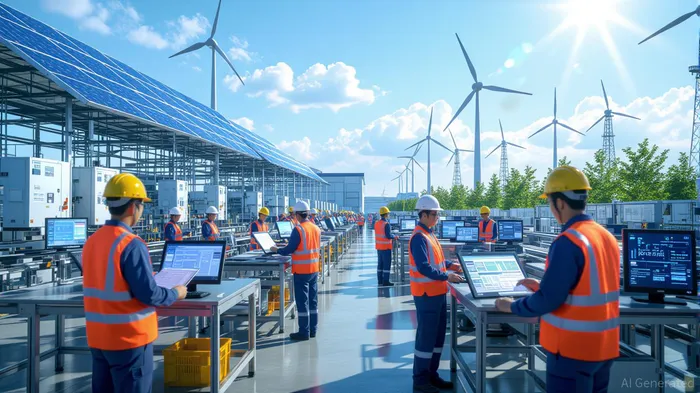
Actionable Opportunities in Vietnam's Priority Sectors
1. Manufacturing: The New “China +1” Powerhouse
Vietnam's manufacturing sector is projected to reach $108.7 billion in value added by 2025, driven by a 3.33% compound annual growth rate through 2029. With labor costs 50% lower than China's and a business-friendly regulatory environment, the country is attracting $261.4 billion in FDI since 2023. Tech giants like Samsung, IntelINTC--, and AppleAAPL-- are expanding operations, while Foxconn and Pegatron are relocating production lines.
Investment Insight: The CPTPP and EVFTA trade agreements provide access to 900 million consumers, making Vietnam a strategic hub for global supply chains. Investors should target electronics manufacturing, automotive components, and smart factory infrastructure.
2. Renewable Energy: A Green Growth Catalyst
Vietnam's renewable energy sector is set to become a Southeast Asian leader. The government offers marine area use fee exemptions for offshore wind projects and a 50% fee reduction for 12 years post-construction. With a target of 30,000–50,000 MW of offshore wind by 2050, the sector is attracting foreign capital for solar, wind, and green hydrogen projects.
Investment Insight: The National Green Growth Strategy aligns with global decarbonization trends. Investors should focus on wind turbine manufacturing, grid-connected storage systems, and green hydrogen export infrastructure.
3. Digital Economy: The Next Frontier
Vietnam's digital economy is projected to grow to $52 billion by 2025, with e-commerce, digital banking, and online gaming leading the charge. The National Digital Transformation Program includes incentives like streamlined licensing and favorable tax policies for digital tech zones.
Investment Insight: The rise of fintech startups, cloud infrastructure providers, and AI-driven logistics platforms offers high-growth opportunities. The government's push for green credit (10% of total debt by 2025) also opens avenues for sustainable tech investments.
Why Vietnam Resembles 1980s South Korea
- Top-Down Leadership: Vietnam's government is actively shaping industrial policy, much like South Korea's 1980s reforms.
- Labor Discipline: A 10.1% year-on-year wage increase in manufacturing (2025) reflects rising productivity, akin to South Korea's labor-intensive export model.
- Export-Led Growth: Vietnam's $219.83 billion in exports (H1 2025, +14.4% YoY) mirrors South Korea's export-driven surge in the 1980s.
Risks and Mitigation
While Vietnam's growth story is compelling, investors must navigate challenges such as infrastructure bottlenecks and regulatory complexity. However, the government's $21.51 billion FDI inflow (H1 2025) and $37 billion in textile exports (2024) demonstrate resilience. Diversifying across sectors and leveraging local partnerships can mitigate risks.
Conclusion: A Window of Opportunity
Vietnam's economic overhaul is a once-in-a-generation opportunity for investors. By aligning with the government's strategic priorities—manufacturing, renewable energy, and digital transformation—investors can replicate the success of South Korea's 1980s boom. As the country transitions from a labor-cost advantage to a technology-driven economy, early movers stand to gain outsized returns.
Investment Recommendation: Allocate capital to Vietnamese manufacturing ETFs, green energy infrastructure funds, and digital economy unicorns. Monitor policy developments and FDI flows to capitalize on this pivotal growth phase.

Stay ahead of the market.
Get curated U.S. market news, insights and key dates delivered to your inbox.


AInvest
PRO
AInvest
PRO



Comments
No comments yet