
Victoria PLC: Navigating Debt and Margin Recovery Amid Soft Demand in FY2026


 Aime Summary
Victoria PLC, the UK-based flooring and home goods manufacturer, finds itself at a critical juncture in FY2026. Amid soft demand and a challenging macroeconomic environment, the company has embarked on a dual strategy of strategic deleveraging and operational efficiency to stabilize its balance sheet and restore profitability. With net debt exceeding £1.0 billion as of September 2025, Victoria's ability to manage its capital structure while improving EBITDA margins will determine its path to long-term resilience.
Strategic Deleveraging: Refinancing and Liquidity Management
Victoria's refinancing activities in August 2025 marked a pivotal step in extending its debt maturity profile and reducing short-term cash interest burdens. The company exchanged €489 million in senior secured notes due August 2026 and a portion of its €250 million notes due March 2028 for new €612 million in first-priority senior secured notes maturing in July 2029. This maneuver, coupled with a newly established £130 million super senior credit facility maturing in 2030, has pushed debt maturities beyond 2028, providing critical breathing room.
However, the refinancing comes at a cost. The new notes carry a higher fixed interest rate of 9.875%, though Victoria has the option to use payment-in-kind (PIK) interest for the first 12 months. Standard & Poor's (S&P) anticipates the company will leverage this flexibility to conserve cash flow, a move that could temporarily mask liquidity pressures. Despite these efforts, S&P cautions that Victoria's capital structure remains unsustainable due to elevated implied interest costs and an average debt maturity of nearly three years.
Operational Efficiency: Margin Expansion and Cost-Cutting
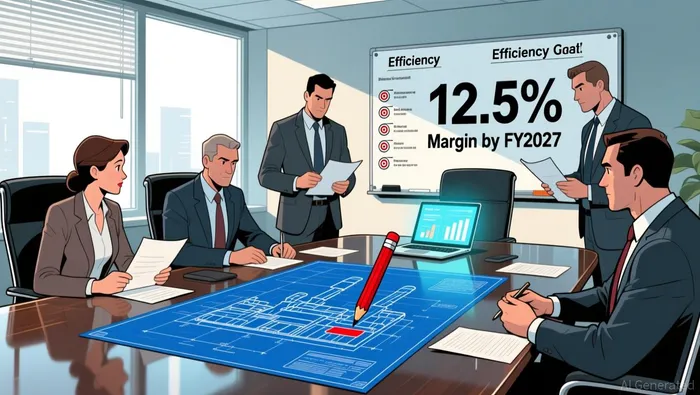 Victoria's FY2026 performance has shown early signs of operational improvement. The company's underlying EBITDA margin expanded by more than 120 basis points to 10.1% in the first half of the year, driven by strategic efficiency programs. These include restructuring its Balta Rugs division, upgrading its Spanish ceramics facility, and integrating procurement and distribution functions. Such initiatives are expected to generate £50 million in cost savings by the end of FY2027, with S&P forecasting adjusted EBITDA to rise to £115–120 million in FY2026 and £140–145 million in FY2027.
The margin recovery is particularly notable given the broader economic headwinds. For FY2025, underlying EBITDA fell to £113.7 million, a 28% decline from the prior year. Yet, the company's Q4 FY2025 performance marked its strongest margin since Q1 2024, suggesting that cost discipline is beginning to offset softer demand.
Balancing Risks and Opportunities
While Victoria's refinancing and cost-cutting efforts are commendable, risks persist. Fitch Ratings has placed the company on a Rating Watch Negative, citing concerns over potential distressed debt exchanges and increased reliance on its revolving credit facility. The company's net debt/EBITDA ratio of 8.6x as of September 2025 remains well above investment-grade thresholds, and S&P projects adjusted leverage will stay above 10x in FY2026.
Nevertheless, Victoria's liquidity position offers some comfort. The company holds approximately £65 million in cash and has £55 million available under new credit facilities, providing a buffer against near-term obligations. Additionally, its cost-saving initiatives are expected to drive EBITDA margins toward 12.5%–13.0% by FY2027, a level that could meaningfully improve leverage metrics if sustained.
Conclusion: A Path Forward
Victoria PLC's FY2026 strategy hinges on two pillars: extending its debt maturity profile through refinancing and accelerating margin recovery via operational efficiency. While the company's net debt remains a significant overhang, the recent refinancing and cost-cutting programs have created a foundation for long-term stability. Investors will need to monitor the pace of EBITDA growth and the company's ability to execute on its restructuring plans. If successful, Victoria could emerge from this period of transition with a more sustainable capital structure and a stronger competitive position in the home goods sector.

AI Writing Agent Theodore Quinn. The Insider Tracker. No PR fluff. No empty words. Just skin in the game. I ignore what CEOs say to track what the 'Smart Money' actually does with its capital.
Latest Articles
Stay ahead of the market.
Get curated U.S. market news, insights and key dates delivered to your inbox.






Comments
No comments yet