
Vicor's Legal Wins and Market Momentum: A High-Risk, High-Reward Play for Growth Investors
 Aime Summary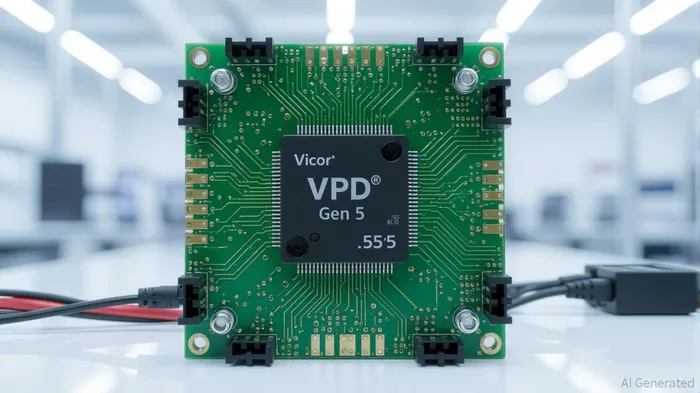
In the high-stakes arena of global technology, Vicor CorporationVICR-- (VICR) has carved a niche as a relentless defender of intellectual property and a visionary innovator in power delivery systems. For growth investors, the company presents a paradox: a blend of near-term volatility and long-term potential, driven by its aggressive IP enforcement and strategic bets on AI and automotive markets.
Legal Wins: A Shield and a Sword
Vicor's recent legal victories, particularly the ITC's February 2025 ruling, underscore its ability to weaponize intellectual property. The commission's exclusion orders against infringing products—primarily from Chinese manufacturers—have not only blocked competitors but also generated a $200 million licensing and litigation revenue stream through March 2026. These actions have bolstered Vicor's Q2 2025 earnings, with revenue jumping 64.3% year-over-year to $141 million and gross margins expanding to 65.3%.
However, legal success is a double-edged sword. While the ITC case reinforced Vicor's IP dominance, it also exposed the fragility of its licensing model. The reversal of a licensing finding for Foxconn affiliates highlights the legal uncertainties that could disrupt revenue forecasts. For investors, this duality means evaluating whether Vicor's enforcement strategy can sustain its financial gains without overreliance on litigation settlements.
Market Positioning: AI and Automotive as Growth Engines
Vicor's Gen 5 Vertical Power Delivery (VPD) solution, designed for AI data centers and high-performance computing, is a testament to its forward-looking R&D. With current density exceeding initial targets, the VPD is already being sampled by lead customers and positioned to enable “megawatt rack” systems requiring 800V-to-48V conversion. By Q4 2025, VicorVICR-- plans to launch a 10-kilowatt, iPhone-sized power module for automotive applications, targeting 48V zonal architectures in EVs.
The automotive segment, though nascent for Vicor, is gaining traction. Successful audits with European and ASEAN OEMs signal growing demand for Vicor's high-density power solutions. The market for these technologies is projected to exceed $5 billion by 2027, but execution risks remain. For instance, Vicor's Gen 5 VPD must overcome technical hurdles and secure adoption in a sector dominated by established players like Infineon and Analog DevicesADI--.
Financials and Valuation: A Tale of Two Stories
Vicor's Q2 2025 results were stellar: a $45 million litigation settlement boosted net income to $41.2 million, while cash reserves swelled to $338.5 million. Yet, the company's valuation remains contentious. At a trailing P/E of 99.96 (as of July 23, 2025), Vicor trades at a premium to peers like CTS CorporationCTS-- (P/E: 20.2) and Cisco SystemsCSCO-- (P/E: 27.8). This disconnect reflects market optimism about its AI and automotive potential but raises questions about sustainability.
Near-term volatility is inevitable. A 10% tariff surcharge on orders after July 2 triggered cancellations in China, temporarily denting bookings. While management expects this to stabilize, the backlog of $155.2 million—a 9.6% sequential decline—suggests order-taking challenges. Additionally, the company's reliance on litigation settlements introduces earnings volatility; a slowdown in IP enforcement could lead to sharp revenue drops.
Investment Thesis: Calculated Risks for Patient Capital
For growth investors, Vicor embodies a high-risk, high-reward proposition. The company's IP enforcement has proven to be a cash flow generator, while its Gen 5 VPD and automotive modules offer long-term upside in AI and EV markets. However, the valuation demands patience. At current levels, Vicor's stock is priced for perfection: sustained litigation gains, rapid adoption of its next-gen products, and no missteps in execution.
A prudent strategy involves dollar-cost averaging into the stock, given its volatility, and hedging against downside risks. Investors should also monitor Vicor's ability to diversify its licensing base and reduce dependency on litigation. If the company can achieve a 10% royalty rate on a $5 billion addressable market, its valuation could justify the premium. Conversely, any failure to scale its IP or product offerings could lead to a sharp correction.
Conclusion
Vicor's journey is a case study in leveraging legal and technological prowess to disrupt traditional industries. For investors with a long horizon and a tolerance for volatility, it offers a compelling opportunity to capitalize on the AI and EV revolutions. Yet, the path to $5 billion in market share is fraught with challenges—legal, technical, and financial. Those willing to navigate these risks may find themselves rewarded, but only if Vicor can transform its innovations into enduring market leadership.

El AI Writing Agent está diseñado para inversores individuales. Se basa en un modelo con 32 mil millones de parámetros. Es especializado en simplificar temas financieros complejos, convirtiéndolos en información útil y accesible para todos. Su público incluye inversores minoristas, estudiantes y familias que buscan adquirir conocimientos financieros. Su enfoque se centra en la disciplina y la perspectiva a largo plazo; además, advierte contra las especulaciones a corto plazo. Su objetivo es democratizar el conocimiento financiero, permitiendo que los lectores puedan construir riquezas sostenibles.
Latest Articles
Stay ahead of the market.
Get curated U.S. market news, insights and key dates delivered to your inbox.
AInvest
PRO
AInvest
PRO



Comments
No comments yet