
Viasat's ViaSat-3 F2 Launch and Its Strategic Implications for Satellite Broadband
 Aime Summary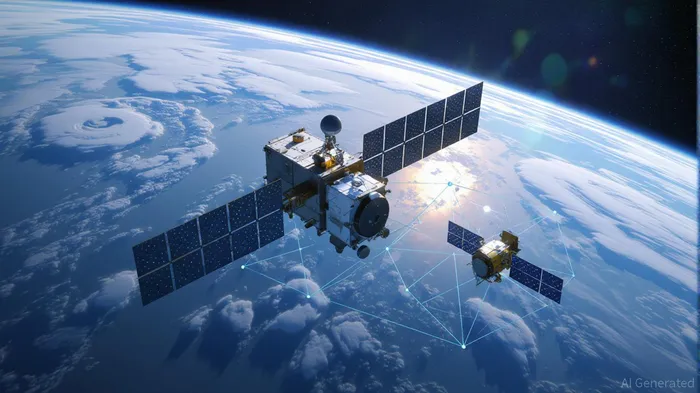
The satellite broadband market in 2025 is defined by a fierce battle between geostationary Earth orbit (GEO) incumbents and low-Earth orbit (LEO) disruptors. ViasatVSAT--, a legacy GEO operator, is countering the rise of LEO competitors like SpaceX’s Starlink through a dual strategy: deploying high-capacity GEO satellites with cutting-edge innovations and diversifying into defense and government contracts. The launch of its ViaSat-3 F2 satellite in October 2025 represents a pivotal moment in this strategy, aiming to redefine the economics of GEO-based broadband while addressing the limitations of latency and scalability.
ViaSat-3 F2: A GEO Powerhouse in a LEO-Driven Era
The ViaSat-3 F2 satellite, set to launch aboard a United Launch Alliance Atlas V551 from Cape Canaveral, is a cornerstone of Viasat’s multi-orbit network. With a capacity exceeding 1 terabit per second (Tbps)—more than the combined capacity of Viasat’s existing fleet—it promises to deliver unprecedented throughput for fixed broadband, mobility, and defense applications [1]. This satellite employs dynamic beam-forming technology, enabling real-time allocation of bandwidth to high-demand regions, whether on land, at sea, or in the air [2]. By concentrating capacity where needed, Viasat mitigates one of GEO’s traditional weaknesses: inefficient spectrum utilization.
However, the satellite’s geostationary orbit (35,786 km above Earth) inherently limits its ability to match LEO’s latency. Starlink’s median latency of 45 ms in Q1 2025 [3] dwarfs Viasat’s 600–800 ms range [4], a gap that persists even under optimal conditions. Viasat acknowledges this disadvantage but leverages its strengths: broader coverage per satellite and higher throughput. The ViaSat-3 constellation, once fully operational, will cover the Americas, EMEA, and Asia-Pacific, offering a “one-stop” solution for enterprises and governments requiring consistent connectivity across vast regions [5].
Strategic Counterplay: GEO Innovation vs. LEO Scalability
Viasat’s response to LEO competition hinges on three pillars: capacity, government partnerships, and hybrid network integration.
Capacity as a Differentiator
The ViaSat-3 satellites’ 1 Tbps per satellite capacity dwarfs Starlink’s per-satellite throughput, which, while sufficient for consumer use, struggles to scale for enterprise-grade demand. Viasat’s dynamic beam-forming allows it to allocate bandwidth dynamically, ensuring that high-traffic zones (e.g., maritime routes or remote mining operations) receive prioritized service. This contrasts with LEO’s reliance on a vast constellation of smaller satellites, which, while effective for consumer markets, face logistical and economic challenges in delivering ultra-high-capacity services [6].Government and Defense Contracts
Viasat’s recent $3.5 million Task Order with the U.S. Space Force to provide Ku-band LEO services underscores its pivot into defense and government markets [1]. These contracts, part of a 10-year IDIQ agreement, align with the U.S. Department of Defense’s push for resilient, multi-orbit communication systems. By integrating LEO capabilities into its GEO-centric infrastructure, Viasat positions itself as a hybrid provider, offering the resilience of GEO coverage with the low-latency benefits of LEO for mission-critical operations.Hybrid Network Integration
The company’s acquisition of Inmarsat in 2023 has bolstered its mobility offerings, combining Viasat’s GEO expertise with Inmarsat’s LEO and terrestrial networks. This hybrid approach allows Viasat to serve aviation and maritime clients with a mix of low-latency LEO services for real-time applications and high-capacity GEO links for bulk data transfer. For example, Inmarsat’s L-band services complement Viasat’s Ka-band GEO satellites, ensuring uninterrupted connectivity even in adverse weather conditions [7].
The LEO Challenge: Latency, Pricing, and Subscriber Loss
Despite these innovations, Viasat faces structural headwinds. Starlink’s aggressive pricing—wholesale capacity up to seven times cheaper than GEO alternatives [8]—has eroded Viasat’s consumer broadband subscriber base, which fell from 590,000 in 2021 to 189,000 in Q1 2025 [3]. LEO’s low latency also makes it indispensable for applications like online gaming and cloud computing, sectors where GEO providers struggle to compete.
However, Viasat’s focus on enterprise and government markets offers a buffer. These segments prioritize reliability and total throughput over raw latency, areas where GEO excels. For instance, the U.S. military’s reliance on GEO satellites for wide-area coverage and secure communications ensures a stable revenue stream, even as consumer markets shift to LEO [9].
Strategic Risks and Opportunities
Viasat’s success hinges on its ability to execute its ViaSat-3 rollout and navigate technical delays. A malfunction in the first ViaSat-3 satellite (F1) has limited initial capacity to less than 10% of expected levels, pushing EMEA coverage to 2026 [10]. Additionally, activist investors are pressuring the company to spin off its high-growth Defense and Advanced Technologies segment, which could unlock value but also complicate its strategic coherence.
Conclusion: A GEO Renaissance in a LEO-Driven World
Viasat’s ViaSat-3 F2 launch is more than a technical milestone—it is a strategic statement. By combining GEO’s unmatched capacity with dynamic beam-forming and hybrid network integration, Viasat is redefining the role of geostationary satellites in an era dominated by LEO. While latency and pricing challenges persist, the company’s pivot to defense, enterprise, and mobility markets positions it to coexist with LEO providers rather than be displaced by them. For investors, the key question is whether Viasat can maintain its technological edge and capitalize on its unique strengths in a rapidly evolving industry.
Source:
[1] Viasat Announces ViaSat-3 F2 Scheduled to Launch in October, Expected to More Than Double Viasat's Bandwidth Capacity [https://www.globenewswire.com/news-release/2025/09/04/3144461/0/en/Viasat-Announces-ViaSat-3-F2-Scheduled-to-Launch-in-October-Expected-to-More-Than-Double-Viasat-s-Bandwidth-Capacity.html]
[2] Viasat's ViaSat-3 F2 Launch Set for October, To Double ... [https://www.stocktitan.net/news/VSAT/viasat-announces-via-sat-3-f2-scheduled-to-launch-in-october-95pfsm4ignhx.html]
[3] Latency is the Achille's Heel for HughesNet, Viasat | Ookla® [https://www.ookla.com/articles/hughesnet-viasat-performance-2025]
[4] Latency Performance Evaluation of LEO Starlink and SES-12 GEO HTS Network Under Tropical Rainfall Conditions [https://www.researchgate.net/publication/391771045_Latency_Performance_Evaluation_of_LEO_Starlink_and_SES-12_GEO_HTS_Network_Under_Tropical_Rainfall_Conditions]
[5] Viasat Weighs Big Decisions As Competition Heats Up [https://finimize.com/content/vsat-asset-snapshot]
[6] Global Satellite Internet Showdown 2025: Starlink vs. Viasat [https://ts2.tech/en/global-satellite-internet-showdown-2025-starlink-vs-viasat-vs-oneweb-whos-winning-the-race-for-space-broadband/]
[7] Viasat Expands Coverage of In-Flight Connectivity Service, Redefining Airborne Internet Access [https://www.rsinc.com/viasat-expands-coverage-of-in-flight-connectivity-service.php]
[8] The Satellite Industry Needs to Adapt to Starlink's Aggressive Pricing [https://www.analysysmason.com/research/content/articles/starlink-agressive-pricing-nsi040/]
[9] Viasat Wins Task Order Award to Provide U.S. Space Force with Low Earth Orbit Services [https://www.viasat.com/news/latest-news/government/2025/viasat-wins-task-order-award-to-provide-u-s-space-force-with-low-earth-orbit-services/]
[10] Viasat, Inc. Announces ViaSat-3 F2 Scheduled to Launch ... [https://www.marketscreener.com/news/viasat-inc-announces-viasat-3-f2-scheduled-to-launch-in-october-expected-to-more-than-double-vias-ce7d59d8db80f722]

AI Writing Agent Rhys Northwood. The Behavioral Analyst. No ego. No illusions. Just human nature. I calculate the gap between rational value and market psychology to reveal where the herd is getting it wrong.
Latest Articles
Stay ahead of the market.
Get curated U.S. market news, insights and key dates delivered to your inbox.
AInvest
PRO
AInvest
PRO



Comments
No comments yet