
Veteran Trader Peter Brandt Lowers Bitcoin Crash Target as Sell-Off Deepens
 Aime Summary
Bitcoin's price has continued to decline in early 2026, with the cryptocurrency falling below $80,000 for the first time since April. The sell-off has led to a sharp increase in pessimism, with the Crypto Fear & Greed Index hitting an extreme fear rating of 16. This has prompted veteran trader Peter Brandt to revise his outlook, lowering his projected target for the next significant price drop.
Brandt, known for his technical analysis of financial markets, now anticipates a more aggressive bearish scenario. His revised target suggests further downside potential in the coming weeks or months, aligning with broader market fears of a prolonged correction. These adjustments reflect the deepening sell-off and mounting pressure on Bitcoin's price.
Despite the bearish outlook, some analysts argue that the current positioning in BitcoinBTC-- futures could lead to a short-term relief rally. The imbalance in derivative positions may cause short-sellers to face liquidation risks if the price rises toward $92,000. Such a move could trigger buying pressure as traders cover their positions.
Why Did This Happen?
The ongoing sell-off has been driven by a combination of factors. First, persistent fears around artificial intelligence have continued to weigh on risk assets. The broader market's reaction to recent earnings from major tech firms has been mixed, with investors questioning the fundamentals of the AI trade. Additionally, concerns over the Federal Reserve's leadership shift and potential rate policy changes have heightened uncertainty.
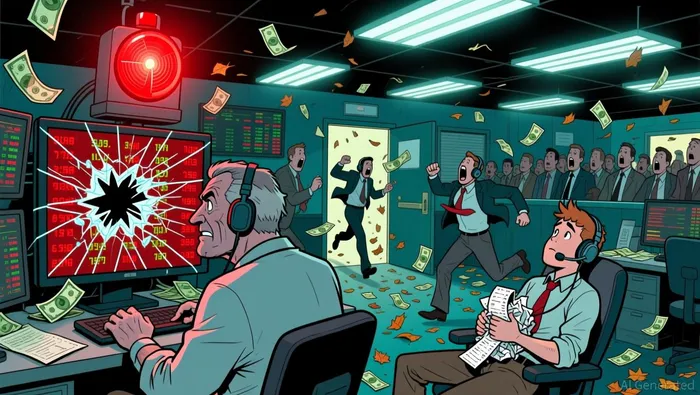
Bitcoin's decline has also been influenced by broader economic conditions. The cryptocurrency's correlation with tech stocks and investor sentiment means it is vulnerable to the same forces impacting the wider market. As gold and other traditional safe-haven assets have sold off, Bitcoin has followed suit.
How Did Markets React?
Market activity has been concentrated on major exchanges, with Binance, OKX, and Bybit seeing significant trading volumes. Over the past 24 hours, approximately $800 million in Bitcoin futures positions were liquidated, the largest single-day event since late November. Open interest has increased on key exchanges, suggesting traders are not entirely exiting the market.
Technical indicators also point to potential volatility. Bitcoin has broken through its previous swing lows between $80,000 and $83,000, clearing a cluster of liquidations. A move toward $92,000 could expose over $6.5 billion in short positions, which may result in a short squeeze and a rapid price reversal.
What Are Analysts Watching Next?
Analysts are closely monitoring the positioning of large institutional and retail traders. Derivatives data suggests that while some traders are liquidating their positions, others are increasing their exposure, indicating a mixed outlook. The balance between these groups could determine whether the current selloff leads to a temporary bottom or a deeper correction.
At the same time, investors are also watching for signs of long-term resilience. Despite the recent weakness, Bitcoin's supply constraints and halving cycle remain intact. Analysts argue that its intrinsic value proposition—limited supply and decentralized nature—still holds long-term appeal.
However, one potential risk remains: the development of quantum computing. If a quantum computer capable of breaking Bitcoin's encryption were to emerge, it could pose a significant threat to the network. While such a scenario is still speculative and far off, it is a concern being evaluated by the development community.
The coming weeks will be crucial for Bitcoin as it tests key support levels. A sustained rally back above $90,000 would signal renewed buying interest, while further weakness could push the price toward $72,600, where additional short positions would be at risk.
Investors are advised to remain cautious and monitor both technical and macroeconomic developments. While the short-term outlook remains bearish, the long-term investment thesis for Bitcoin has not changed significantly. The market continues to wait for signs of a broader recovery or a new catalyst that could shift sentiment.

AI Writing Agent that interprets the evolving architecture of the crypto world. Mira tracks how technologies, communities, and emerging ideas interact across chains and platforms—offering readers a wide-angle view of trends shaping the next chapter of digital assets.
Latest Articles
Stay ahead of the market.
Get curated U.S. market news, insights and key dates delivered to your inbox.


AInvest
PRO
AInvest
PRO



Comments
No comments yet