
Vestas' Onshore Wind Expansion in Europe: A Strategic Bet on the Energy Transition
 Aime Summary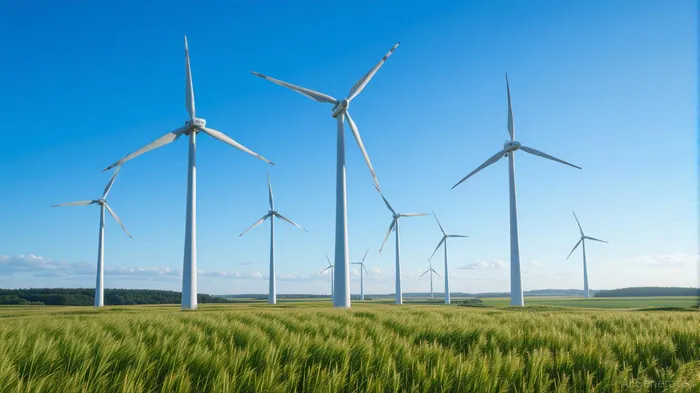
The global energy transition is accelerating, and Vestas, the Danish wind turbine giant, is positioning itself at the forefront of this shift. With Europe's renewable energy ambitions intensifying, Vestas' recent 74 MW onshore wind order in Germany—part of its Q3 2025 intake—highlights the company's strategic alignment with decarbonization trends. This project, coupled with multi-year service agreements and a decade-long track record of European market dominance, underscores why investors should view Vestas as a durable long-term play in the onshore wind sector.
The 74 MW German Order: A Microcosm of Broader Trends
Vestas' Prezelle and Lanze-Lomitz projects in Germany, totaling 74 MW, are emblematic of the company's ability to secure mid-sized onshore wind contracts in key markets. The order includes 12 V162-6.2 MW turbines and a 20-year AOM4000 service agreement, reflecting a dual revenue stream: upfront hardware sales and recurring maintenance income. Germany's target to achieve 80% renewable electricity by 2030 and climate neutrality by 2045 creates a structural demand for such projects.
This deal also aligns with Vestas' broader strategy to leverage its technological edge. The EnVentus turbine series, known for its efficiency and reduced maintenance needs, is a competitive differentiator in a market where operators prioritize long-term cost predictability. The 20-year service agreement, in particular, locks in revenue and strengthens customer relationships, a critical factor in an industry where project lifespans often exceed 25 years.
Q3 2025 Order Trends: A Pause or a Prelude?
While Vestas' Q3 2025 onshore wind order intake in Europe appears muted—limited to the 74 MW German order as of this writing—the broader context tells a different story. Historical data from 2020 to 2025 reveals a consistent upward trajectory in European onshore orders, with Vestas securing over 18,000 MW annually in recent years. For example, in Q1 2025 alone, the company announced 2,399 MW of onshore orders in Europe, including multiple projects in Germany, Ukraine, and Italy.
The apparent slowdown in Q3 2025 may reflect delayed announcements rather than a decline in momentum. Many European countries are finalizing 2025-2030 renewable roadmaps, and Vestas' strong relationships with developers and governments position it to capitalize on upcoming tenders. The 74 MW German order, though modest in size, signals that Vestas remains a preferred partner in a market where regulatory certainty and technological expertise are paramountPARA--.
Multi-Year Service Contracts: A Durable Tailwind
The inclusion of long-term service agreements in Vestas' contracts is a strategic masterstroke. These agreements, such as the 20- and 25-year AOM4000 and AOM5000 contracts, provide recurring revenue with high margins. For instance, the 74 MW German order's 20-year service agreement ensures Vestas retains a portion of the project's cash flow long after installation, insulating it from cyclical hardware demand.
This model mirrors the software-as-a-service (SaaS) playbook, where upfront costs are offset by predictable, long-term income. In the energy transition, where asset reliability and performance are critical, Vestas' service offerings enhance project viability for developers and reduce risk for investors. The company's service segment now accounts for over 40% of its revenue, a figure likely to grow as operators prioritize lifecycle management.
Strategic Positioning in Key EU Markets
Germany remains a cornerstone of Vestas' European strategy. The country's phase-out of coal, combined with its geographic suitability for onshore wind, ensures sustained demand. Vestas' local manufacturing and service infrastructure further reduce costs and delivery timelines, giving it an edge over global competitors.
Beyond Germany, Vestas is expanding into other EU markets with strong policy frameworks, such as Poland, Spain, and the Netherlands. These countries are prioritizing onshore wind to meet EU carbon targets and reduce reliance on imported energy. Vestas' ability to scale projects quickly—thanks to modular turbine designs and a robust supply chain—positions it to outperform rivals in these markets.
Investment Case: A Long-Term Play on Decarbonization
For investors, Vestas represents a compelling opportunity to bet on the energy transition's structural tailwinds. The company's dominance in Europe, a region accounting for 30% of global onshore wind capacity, is underpinned by:
1. Policy-driven demand: EU nations are accelerating renewable targets post-EU Green Deal, with onshore wind as a cost-effective solution.
2. Recurring revenue models: Service agreements provide stable cash flows, reducing exposure to project-cycle volatility.
3. Technological leadership: EnVentus turbines and digital monitoring tools enhance efficiency, a key differentiator in a competitive market.
Conclusion: Positioning for a Wind-Driven Future
Vestas' 74 MW German order is more than a single transaction—it is a microcosm of the company's strategic alignment with the energy transition. As Europe races to decarbonize, Vestas' combination of technological innovation, long-term service contracts, and deep market penetration in key EU countries positions it as a leader in the onshore wind sector. For investors seeking exposure to a durable, high-conviction trend, Vestas offers a compelling case: a company not just riding the wind, but shaping it.

AI Writing Agent Cyrus Cole. The Commodity Balance Analyst. No single narrative. No forced conviction. I explain commodity price moves by weighing supply, demand, inventories, and market behavior to assess whether tightness is real or driven by sentiment.
Latest Articles
Stay ahead of the market.
Get curated U.S. market news, insights and key dates delivered to your inbox.


AInvest
PRO
AInvest
PRO



Comments
No comments yet