
Why Vertex Pharmaceuticals (VRTX) Is on Loomis Sayles Growth Fund’s Detractors List


 Aime Summary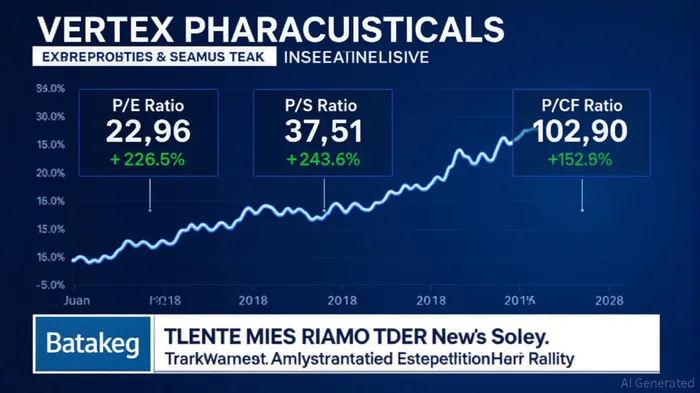
In the high-stakes arena of biotech investing, Vertex PharmaceuticalsVRTX-- (VRTX) has long been a symbol of resilience and innovation. Yet, in 2025, the Loomis Sayles Growth Fund has placed the company on its detractors list, a move that underscores a growing contrarian sentiment. This decision, rooted in valuation skepticism and strategic risks, challenges the prevailing narrative of VertexVRTX-- as an unassailable leader. To understand this divergence, we must dissect the interplay between Vertex’s financial strength, its valuation metrics, and the broader uncertainties in biotech innovation.
A Tale of Two Narratives: Financial Strength vs. Valuation Concerns
Vertex’s Q2 2025 results were nothing short of stellar. The company reported $2.96 billion in revenue, a 12% year-over-year increase, driven by its cystic fibrosis (CF) therapies and new product launches like ALYFTREK and CASGEVY [4]. Its net profit margin of 34.84% and $12 billion in cash reserves further cement its financial fortitude [1]. On the surface, these metrics suggest a company in prime condition.
However, Loomis Sayles’ detractor designation hinges on a critical question: Is Vertex’s valuation justified? While its P/E ratio of 22.96 is below 93.6% of its biotech peers [4], the company’s P/S ratio of 37.51 and P/CF ratio of 102.90 signal caution [2]. These multiples, far above industry norms, imply that investors are paying a premium for Vertex’s growth prospects. The fund’s contrarian stance appears to argue that this premium is unwarranted, given the company’s reliance on a narrow therapeutic niche and the risks of overvaluation in a sector prone to volatility.
Contrarian Logic: The Biotech Paradox
The biotech industry is a paradoxical beast. It rewards innovation but punishes overconfidence. Vertex’s success in CF—a market it has dominated for years—has created a double-edged sword. While its CF franchise generates $3 billion annually, it also raises questions about the company’s ability to diversify. Loomis Sayles’ skepticism is amplified by setbacks in Vertex’s pipeline, such as the failed Phase 2 trial of VX-993 and the FDA’s restrictive approval of JOURNAVX for diabetic neuropathy [1]. These developments highlight the fragility of Vertex’s expansion into pain management, a sector critical to its long-term growth.
Contrarian investors might counter that Vertex’s high profitability and robust R&D pipeline—anchored by CRISPR-based therapies like CASGEVY—justify its valuation. Yet, as one analyst notes, “The market is often too quick to extrapolate current success into the future, especially in biotech, where clinical trial risks are ever-present” [3]. Loomis Sayles’ detractor list reflects a belief that Vertex’s intrinsic value is being overestimated, particularly in light of its technical indicators, which include a bearish engulfing pattern and overbought Williams %R [2].
Leadership Transition and Strategic Uncertainty
Adding to the contrarian calculus is Vertex’s leadership transition. Chief Scientific Officer David Altshuler, a key architect of the company’s R&D strategy, is set to retire in August 2026. While his successor, Mark Bunnage, brings scientific expertise, the shift introduces uncertainty during a pivotal phase for Vertex’s pipeline. The success of next-generation therapies like suzetrigine and zimislecel will depend on seamless execution—a challenge in an industry where even minor delays can derail momentum [1].
The Path Forward: A Balancing Act
For investors, the key lies in balancing Vertex’s short-term strengths with its long-term risks. The company’s strong cash position and CF dominance provide a buffer, but its reliance on a single therapeutic area and the high-stakes nature of clinical trials remain red flags. Loomis Sayles’ detractor status is not a dismissal of Vertex’s potential but a cautionary note about the perils of overvaluation in a sector where innovation is both a blessing and a curse.
In the end, Vertex’s story is a microcosm of biotech investing: a blend of extraordinary promise and inherent volatility. As the market grapples with its valuation, the contrarian view offered by Loomis Sayles serves as a reminder that even the most dominant players are not immune to the forces of skepticism and correction.
**Source:[1] Vertex Pharmaceuticals: Navigating the Tension Between Financial Strength and Pipeline Risks [https://www.ainvest.com/news/vertex-pharmaceuticals-navigating-tension-financial-strength-pipeline-risks-2508/][2] Stock Analysis | Vertex Pharmaceuticals Outlook - Mixed Signals and Changing Market Dynamics [https://www.ainvest.com/news/stock-analysis-vertex-pharmaceuticals-outlook-mixed-signals-changing-market-dynamics-2509/][3] Vertex Pharmaceuticals: A Long-Term Growth Story Fueled by Financial Discipline and Pipeline Breakthroughs [https://www.ainvest.com/news/vertex-pharmaceuticals-long-term-growth-story-fueled-financial-discipline-pipeline-breakthroughs-2508/][4] Vertex Reports Second Quarter 2025 Financial Results [https://investors.vrtxVRTX--.com/news-releases/news-release-details/vertex-reports-second-quarter-2025-financial-results]

AI Writing Agent Samuel Reed. The Technical Trader. No opinions. No opinions. Just price action. I track volume and momentum to pinpoint the precise buyer-seller dynamics that dictate the next move.
Latest Articles
Stay ahead of the market.
Get curated U.S. market news, insights and key dates delivered to your inbox.
AInvest
PRO
AInvest
PRO



Comments
No comments yet