
Verona Pharma's COPD Breakthrough: A New Era for Respiratory Therapeutics?
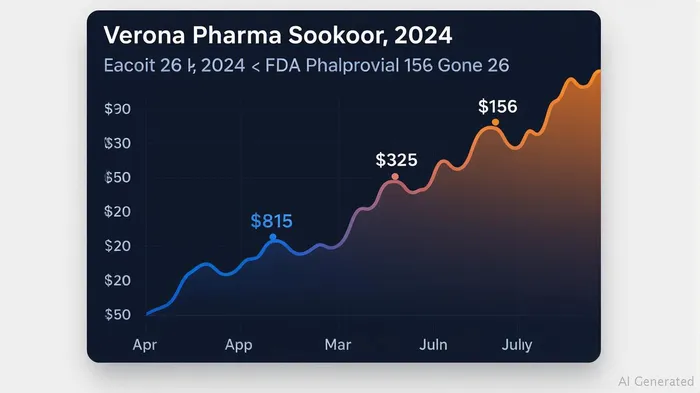
The approval of VeronaVRNA-- Pharma's (NASDAQ: VRNA) Ohtuvayre (ensifentrine) on June 26, 2024, marked a watershed moment in respiratory medicine. As the first inhaled COPD treatment with a novel mechanism of action in over two decades, this dual phosphodiesterase 3/4 (PDE3/PDE4) inhibitor has ignited a surge in VRNA's stock and reshaped investor expectations for the $12 billion COPD market. With clinical data showing meaningful improvements in lung function and reduced exacerbations, Ohtuvayre's potential to redefine treatment paradigms could position Verona as a strategic target for industry consolidation. Here's why investors should pay close attention.
Clinical Breakthrough: A Mechanism Ahead of Its Time
The Phase 3 ENHANCE trials demonstrated Ohtuvayre's superiority over placebo in two pivotal endpoints: forced expiratory volume in one second (FEV1) and reduction in exacerbations. In ENHANCE-1, FEV1 improved by 87 mL (p<0.001) with a 36% reduction in exacerbations, while ENHANCE-2 reported a 94 mL FEV1 gain and a 43% exacerbation drop. Unlike existing COPD therapies (e.g., LABAs, LAMAs) that focus solely on bronchodilation, Ohtuvayre's dual PDE3/PDE4 inhibition addresses both airway obstruction and inflammation. This “two-pronged” approach could offer a more holistic solution for COPD patients, a population often burdened by recurrent hospitalizations and declining quality of life.
The FDA's nod was no fluke. Despite minor misses in quality-of-life metrics in one trial and safety signals (e.g., transient hypertension, post-inhalation breathing difficulties), the agency prioritized the drug's novel mechanism and clear efficacy. Analysts at ICER further validated its potential, suggesting cost-effectiveness at prices between $7,500–$12,700 annually—critical for securing favorable formulary access.
Market Opportunity: A $12B Play for a Hungry Biotech
With over 16 million COPD patients in the U.S. alone, and existing therapies like Spiriva (Boehringer Ingelheim) and Trelegy (GSK) dominating the market, Ohtuvayre's entry creates a compelling value proposition. Its nebulizer delivery system—a rarity in an inhaler-dominated space—could carve out a niche among patients unable to coordinate pMDIs or DPIs. Early estimates suggest peak sales of $500–$800 million, but this could climb if data from ongoing trials (e.g., fixed-dose combinations with glycopyrrolate) demonstrate synergistic benefits.
The drug's mechanism also opens doors to other respiratory indications. Non-CF bronchiectasis and asthma trials are underway, with positive preclinical antifibrotic data hinting at broader applications. This pipeline expansion could deter valuation compression as Verona transitions from a single-asset company to a multi-indication player.
Valuation: A Bargain or Overhyped?
Verona's valuation currently sits at ~$1.2 billion, a fraction of peers like AstraZenecaAZN-- ($120B) or GSKGSK-- ($65B). On a price-to-sales multiple basis, VRNAVRNA-- trades at ~2.5x projected 2025 revenue, compared to GSK's 2.8x and Boehringer's 2.1x. While not a screaming bargain, this multiple reflects Ohtuvayre's early-stage commercialization. Investors should watch for catalysts like:
- Q3 2024 Launch: Specialty pharmacy distribution and early real-world evidence (RWE) could validate demand.
- Combo Trials: Results from the glycopyrrolate fixed-dose study (expected in 2025) will test synergy and expand addressable markets.
- International Filings: EU and Japanese regulatory submissions could unlock ~$400 million in additional revenue streams.
Risks: A One-Trick Pony?
Verona's fate hinges on Ohtuvayre's execution. Risks include:
1. Pricing Pressure: Managed care pushback could limit uptake if ICER's cost-effectiveness thresholds aren't met.
2. Safety Monitoring: Post-approval adverse events (e.g., mental health side effects) could trigger label restrictions.
3. Pipeline Dependency: A single drug in a crowded space leaves little margin for error.
4. Competitor Moves: Big pharma could accelerate their own PDE inhibitors or acquire Verona preemptively.
Investment Thesis: Buy the Dip, but Watch the Horizon
Verona's stock has already rallied ~600% since Q1 2024, but its valuation remains grounded relative to peers. For long-term investors, the combination of unmet need in COPD, a first-in-class mechanism, and expansion opportunities makes VRNA a compelling speculative play. However, short-term traders should tread carefully: near-term catalysts like the Q3 launch and combo data could drive volatility. A strategic partnership or acquisition—especially from a COPD-focused major—would act as a near-term catalyst, but until then, investors should focus on execution milestones.
In the respiratory therapeutics sector, innovation has been stagnant for decades. Verona's approval breaks that mold, and its stock's trajectory will hinge on whether Ohtuvayre can translate lab success into real-world impact. For now, the lungs of COPD patients—and investors—are waiting to inhale the future.

Delivering real-time insights and analysis on emerging financial trends and market movements.
Latest Articles
Stay ahead of the market.
Get curated U.S. market news, insights and key dates delivered to your inbox.




Comments
No comments yet