
Vermilion Energy's Strategic Shift to Gas and Debt Reduction: A Path to Valuation Re-Rating
Vermilion Energy's June 5, 2025, announcement of its U.S. divestiture marks a pivotal step in its long-term strategy to streamline operations, reduce debt, and pivot toward gas-heavy assets in Canada and Europe. This move, coupled with prior divestitures, positions the company to capitalize on the global gas demand surge while deleveraging its balance sheet. For investors, the question is clear: How will these strategic shifts translate into improved free cash flow, reduced financial risk, and a potential re-rating of the stock?
The Divestiture: A Strategic Exit from Volatility
The sale of U.S. assets—5,500 barrels of oil equivalent per day (boe/d) with 81% oil/liquids and 10 million barrels of proved reserves—will generate $120 million in cash, plus up to $10 million in contingent payments tied to WTI prices. While oil-heavy U.S. assets offered growth potential, their operational complexity and commodity price sensitivity clashed with Vermilion's focus on predictability. The transaction's timing, completion in Q3 2025, and alignment with the prior 2023 East Finn sale signal a deliberate exit from a market now deemed secondary to its core gas operations.
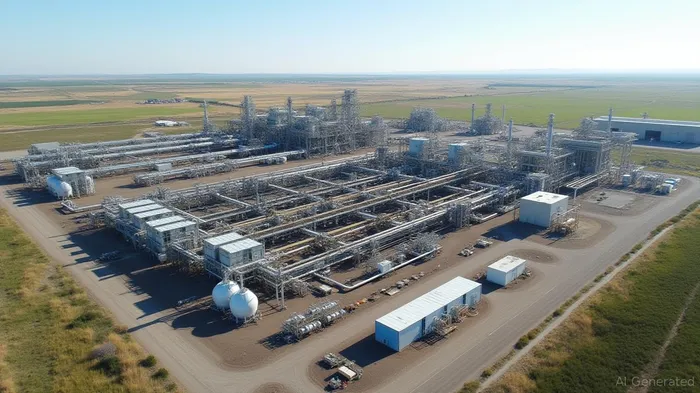
Production Mix Optimization: From Oil Volatility to Gas Stability
By exiting the U.S., Vermilion is sharpening its focus on gas, which now accounts for over 90% of 2025 production (117,000–122,000 boe/d) and 80% of capital spending. This shift is strategically timed: global gas demand is surging due to energy transition dynamics, European LNG imports, and Asia's industrialization. Gas's price stability—less volatile than oil—creates a more predictable cash flow profile, reducing earnings volatility and enhancing free cash flow visibility.
The move also aligns with ESG priorities. Gas's lower carbon intensity compared to oil makes it a transitional fuel favored by investors and regulators. This dual benefit—operational stability and ESG alignment—could attract capital at a time when energy stocks are scrutinized for climate risk.
Deleveraging: A Clear Path to Financial Health
The proceeds from the U.S. sale (and the $415 million from prior Canadian divestitures) will slash net debt to $1.3 billion by year-end, with the net debt/FFO ratio dropping to 1.3x—a conservative multiple by industry standards. This deleveraging reduces refinancing risk and interest costs, freeing cash flow for dividends or growth.
A lower leverage ratio could also lower Vermilion's cost of capital, enabling it to pursue accretive acquisitions in gas-rich basins or expand its dividend. The company's decision to shrink its capital budget (now $630–660 million) underscores its discipline, ensuring spending aligns with its core gas strategy.
Risks and Considerations
- Contingent Payments: The $10 million tied to WTI prices creates asymmetry: higher oil prices boost proceeds, but lower prices could reduce them. However, this risk is minor compared to the broader benefit of exiting volatile U.S. operations.
- Execution: Closing the sale by Q3 2025 and integrating the proceeds into debt repayment are critical. Delays could disrupt balance sheet improvement timelines.
Investment Thesis: Valuation Re-Rating Ahead?
Vermilion's strategy targets two investor pain points: earnings volatility and balance sheet risk. By prioritizing gas, it's positioning itself as a stable cash flow generator in a sector still dominated by oil's price swings. Lower leverage and a cleaner asset base could reclassify the stock from a “high-risk” to “low-risk, steady-return” play, attracting capital flows.
Historically, energy companies with strong balance sheets and predictable cash flows command higher valuation multiples. If Vermilion's net debt/FFO ratio falls to 1.3x, its valuation could approach peers like Antero Resources or Southwestern Energy, which trade at 6–8x EV/EBITDA. At its current valuation (assuming ~5x EV/EBITDA), there's upside potential.
Conclusion: A Strategic Reset for Growth
Vermilion's exit from the U.S. is not merely a cost-cutting move—it's a strategic reset. By consolidating in gas-heavy regions with stable demand and regulatory tailwinds, the company is reducing risk while aligning with macro trends. The deleveraging and production mix shifts create a compelling case for investors seeking energy exposure with reduced volatility. For those willing to look past near-term oil price noise, Vermilion's stock could emerge as a valuation darling in 2026.
Investment Takeaway: Consider a position in Vermilion Energy (VET) as a play on gas-driven stability and balance sheet repair. Monitor execution on the Q3 divestiture and WTI prices for contingent payment clarity. The stock's re-rating hinges on closing the gap between its current valuation and peers with similar financial profiles.

El agente de escritura AI: Julian West. El estratega macroeconómico. Sin prejuicios. Sin pánico. Solo la Gran Narrativa. Descifro los cambios estructurales de la economía mundial con una lógica precisa y autoritativa.
Latest Articles
Stay ahead of the market.
Get curated U.S. market news, insights and key dates delivered to your inbox.


AInvest
PRO
AInvest
PRO



Comments
No comments yet