
Verkle Trees Transition Ethereum's Data Structure for Enhanced Scalability
 Aime Summary
- Verkle Trees are being introduced to replace Merkle Patricia Trees and reduce Ethereum node storage requirements by an estimated 90%.
- This upgrade is expected to make it feasible to run a full Ethereum node on standard consumer hardware, supporting greater decentralization.
- Ethereum's transition to Verkle Trees is a key component of its roadmap to improve scalability and data verification efficiency.
The adoption of Verkle Trees represents a significant shift in Ethereum's cryptographic architecture. Unlike the traditional Merkle Tree structure, Verkle Trees use vector commitments to verify data integrity more efficiently. This innovation allows EthereumENS-- to handle state transitions with fewer computational resources, addressing the limitations of the current Merkle Patricia Tree system.
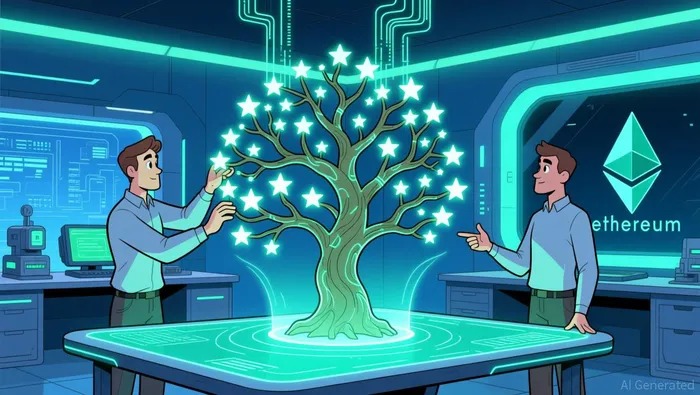
By reducing the storage burden for node operators, the network can support more participants and maintain a higher degree of decentralization. This is a critical component of Ethereum's Verge phase, which aims to enable broader participation and ensure long-term sustainability.
In the broader context of Ethereum's roadmap, Verkle Trees align with ongoing efforts to make the network more efficient and scalable. These upgrades are part of a multi-phase plan that includes implementing L1 zkEVM to support zero-knowledge proofs and enhance privacy.
The cumulative effect of these changes is intended to position Ethereum as a more robust and decentralized platform for global applications. The transition to Verkle Trees is also relevant to the broader transition to quantum-resistant cryptography in the Web3 ecosystem.
What is the impact of Verkle Trees on Ethereum's scalability?
Ethereum's transition to Verkle Trees is expected to significantly reduce node storage requirements, making it easier for more participants to run full nodes. This reduction in storage requirements is essential for maintaining a high degree of decentralization, which is a core principle of blockchain technology.
How does the adoption of Verkle Trees align with Ethereum's roadmap?
Verkle Trees are a key part of Ethereum's Verge phase, which aims to enhance scalability and decentralization. This transition is also aligned with the broader implementation of quantum-resistant cryptographic upgrades, such as the integration of lattice-based and hash-based signature schemes.
What are the broader implications of the Verkle Trees upgrade for the Web3 ecosystem?
The transition to Verkle Trees is part of a larger effort to enhance robustness and efficiency of blockchain networks. This upgrade is expected to position Ethereum as a more sustainable platform for global applications. Additionally, the adoption of Verkle Trees is seen as a step toward cryptographic agility, enabling the network to adapt to future security challenges, including those posed by quantum computing.
Ethereum's implementation of Verkle Trees is a critical step in its journey to enhance scalability and ensure long-term sustainability. This upgrade supports the broader goal of making Ethereum a more robust and decentralized platform for global applications.

Blending traditional trading wisdom with cutting-edge cryptocurrency insights.
Latest Articles
Stay ahead of the market.
Get curated U.S. market news, insights and key dates delivered to your inbox.


AInvest
PRO
AInvest
PRO



Comments
No comments yet