
Verkle Trees Power Up Ethereum's 2026 Upgrades for Scalability and Efficiency
 Aime Summary
Ethereum's 2026 roadmap includes significant technical upgrades aimed at enhancing scalability and institutional adoption. The Hegota and Glamsterdam hard forks will introduce Verkle Trees and FOCIL, which are expected to reduce node storage requirements and enforce transaction inclusion, respectively according to the roadmap. These upgrades are part of Ethereum's broader strategy to accommodate growing interest in tokenizing real-world assets and on-chain finance. Verkle Trees will allow network nodes to verify the network state more efficiently, supporting Layer 2 solutions and enabling higher throughput as technical analysis indicates.
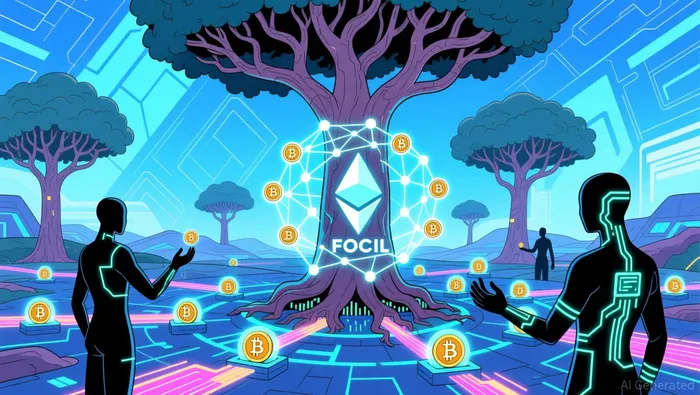
FOCIL, a key component of the Hegota upgrade, introduces a committee-based system where 16 randomly selected validators must include specific transactions in blocks. This prevents block builders from excluding valid transactions arbitrarily as reported. By embedding inclusion guarantees into consensus rules, FOCIL reinforces Ethereum's neutrality and mitigates risks of MEV (maximal extractable value) exploitation. This mechanism is a headline-level feature of the Hegota upgrade and represents a direct protocol-level response to censorship concerns.
The timing of these upgrades coincides with the full enactment of the European Union's Markets in Crypto-Assets (MiCA) regulation, which is expected to shape the integration of traditional and decentralized finance. The EthereumETH-- Community Conference (EthCC) in March 2026 will serve as a platform for these developments according to industry analysis. The regulatory clarity provided by MiCA is expected to lower entry barriers for regulated institutions, potentially funneling significant capital into the Ethereum ecosystem. However, heightened compliance demands may also pressure smaller projects, favoring more established networks like Ethereum.
What is the role of Verkle Trees in Ethereum's scalability efforts?
Verkle Trees are a critical innovation designed to improve node verification efficiency and reduce hardware requirements for node operators. By enabling stateless clients, Verkle Trees lower the barrier to running Ethereum infrastructure, which is essential for maintaining decentralization. This is particularly important as Ethereum seeks to accommodate growing institutional interest in tokenizing real-world assets. The implementation of Verkle Trees is expected to support increased transaction volume and facilitate the growth of Layer 2 solutions, contributing to Ethereum's scalability and performance.
How does FOCIL address censorship resistance and MEV risks?
FOCIL introduces a per-slot committee of 16 randomly selected validators to enforce transaction inclusion, preventing block builders from excluding valid transactions arbitrarily as detailed in analysis. This mechanism is integrated directly into Ethereum's fork-choice rule, ensuring that validators only vote for blocks that respect the committee's inclusion lists. Any block that ignores mandatory transactions risks being orphaned, making censorship economically irrational. FOCIL shifts power away from centralized builders and relays, reinforcing Ethereum's neutrality guarantees without reverting to less efficient block construction models.
What are the implications of Ethereum's 2026 upgrades for institutional adoption?
Ethereum's 2026 roadmap is centered on protocol enhancements, regulatory developments, and new financial applications as outlined in strategic analysis. The implementation of Verkle Trees and FOCIL is expected to support institutional adoption by enhancing data privacy and reducing operational barriers. Traditional financial entities require confidentiality for their transactions, and without robust privacy features, access to large-scale institutional liquidity will remain constrained. The regulatory clarity provided by MiCA and the technical advancements in Ethereum are expected to facilitate the integration of traditional and decentralized finance, presenting opportunities for Ethereum to attract institutional capital.
The coming months will be decisive in determining whether Ethereum can successfully leverage these technical and regulatory advancements to attract institutional capital on a sustainable basis. The Ethereum Community Conference in March 2026 will serve as a key event for these developments, coinciding with the full enactment of MiCA and the implementation of key hard forks. These upgrades are part of Ethereum's ongoing efforts to remain a leading platform for decentralized applications and to support the increasing demand for on-chain finance.

Mezclando la sabiduría tradicional del comercio con las perspectivas de vanguardia en el área de las criptomonedas.
Latest Articles
Stay ahead of the market.
Get curated U.S. market news, insights and key dates delivered to your inbox.


AInvest
PRO
AInvest
PRO



Comments
No comments yet